
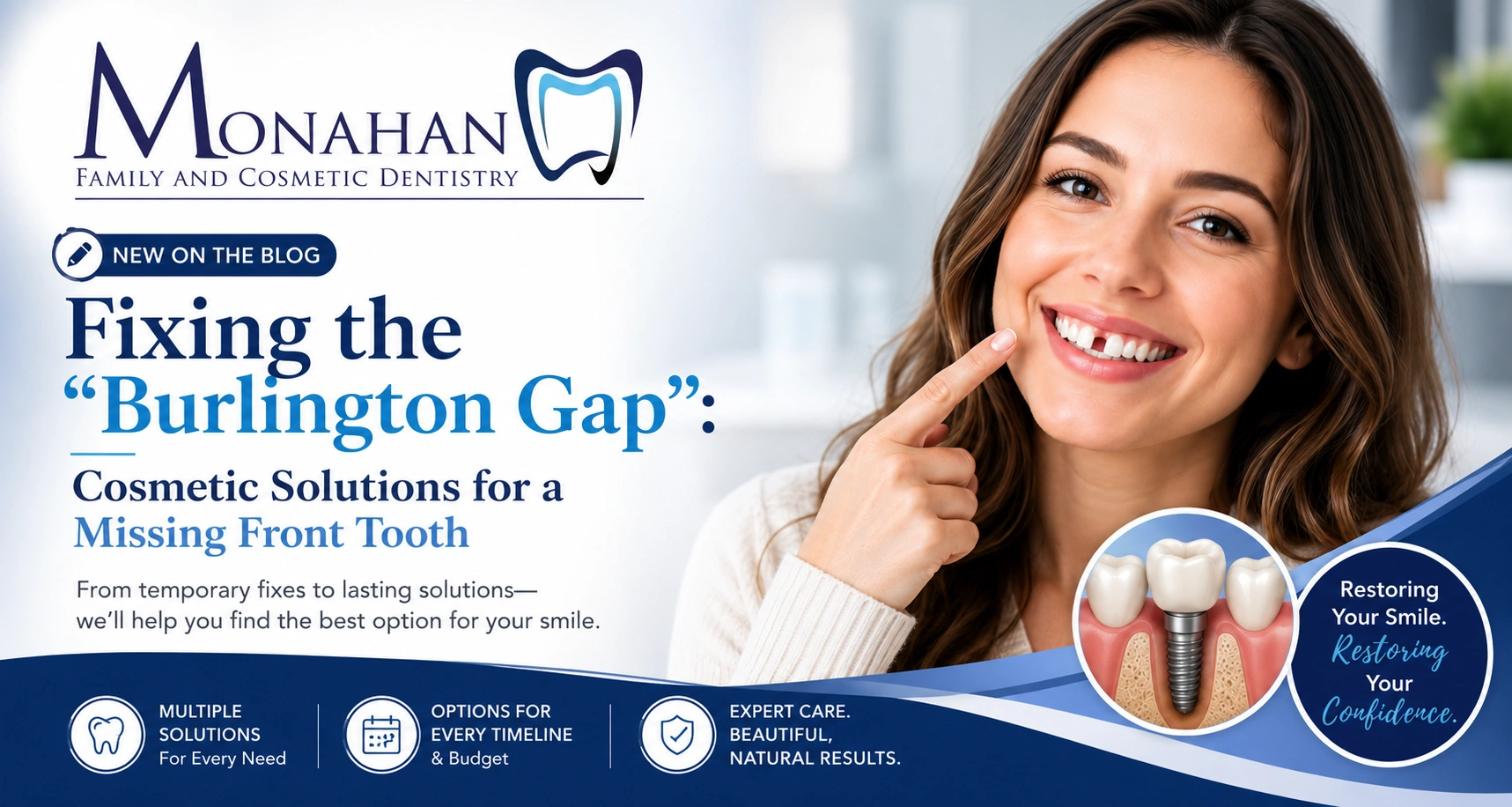
A missing front tooth is different from a missing back tooth.
A missing molar may affect chewing, but most people can hide it. A missing front tooth is right there every time you smile, talk, laugh, take a photo, walk into work, or meet someone new.
That is why patients often want the fastest fix possible.
Here’s the practical answer: the best cosmetic solution for a missing front tooth depends on whether you need a temporary fix, a long-term replacement, or both. In Burlington, NC, the main options are a temporary flipper, a Maryland bridge, a traditional dental bridge, a dental implant with crown, or in some cases a partial denture.
For most healthy adults missing one front tooth, a dental implant with a custom crown is often the strongest long-term option because it replaces the tooth root and does not require shaving down the neighboring teeth. The American Dental Association describes implants as a long-term tooth replacement option designed to blend in with other teeth.
But implants are not always the fastest, cheapest, or simplest option.
At Monahan Family and Cosmetic Dentistry in Burlington, Dr. Thomas Monahan helps patients look at the whole picture: appearance, timeline, gum shape, bone health, neighboring teeth, cost, and whether the missing tooth needs a temporary cosmetic solution while the final treatment is being planned. Monahan Family and Cosmetic Dentistry offers tooth replacement options including bridges, dentures, crowns, and dental implants for Burlington-area patients.
Don’t Let a Missing Front Tooth Hold You Back
Get a personalized cosmetic treatment plan and smile with confidence again. Schedule your appointment today.
The Front Tooth Problem: It Is Not Just “Fill the Space”
When a front tooth is missing, the cosmetic challenge is not only replacing the tooth.
A natural-looking result depends on:
- Tooth color
- Tooth shape
- Gumline position
- Bone support
- Lip movement
- Smile width
- Bite pressure
- Space between the teeth
- Condition of the neighboring teeth
- Whether the tooth was lost recently or years ago
That is why two people can both say, “I’m missing a front tooth,” but need very different plans.
One patient may be able to get a simple temporary flipper quickly.
Another may need gum shaping, bone grafting, orthodontic space correction, or an implant healing period before the final tooth is placed.
This is also why the cheapest front-tooth fix can look fake.
Front teeth are unforgiving.
Fast Answer: Front Tooth Replacement Options
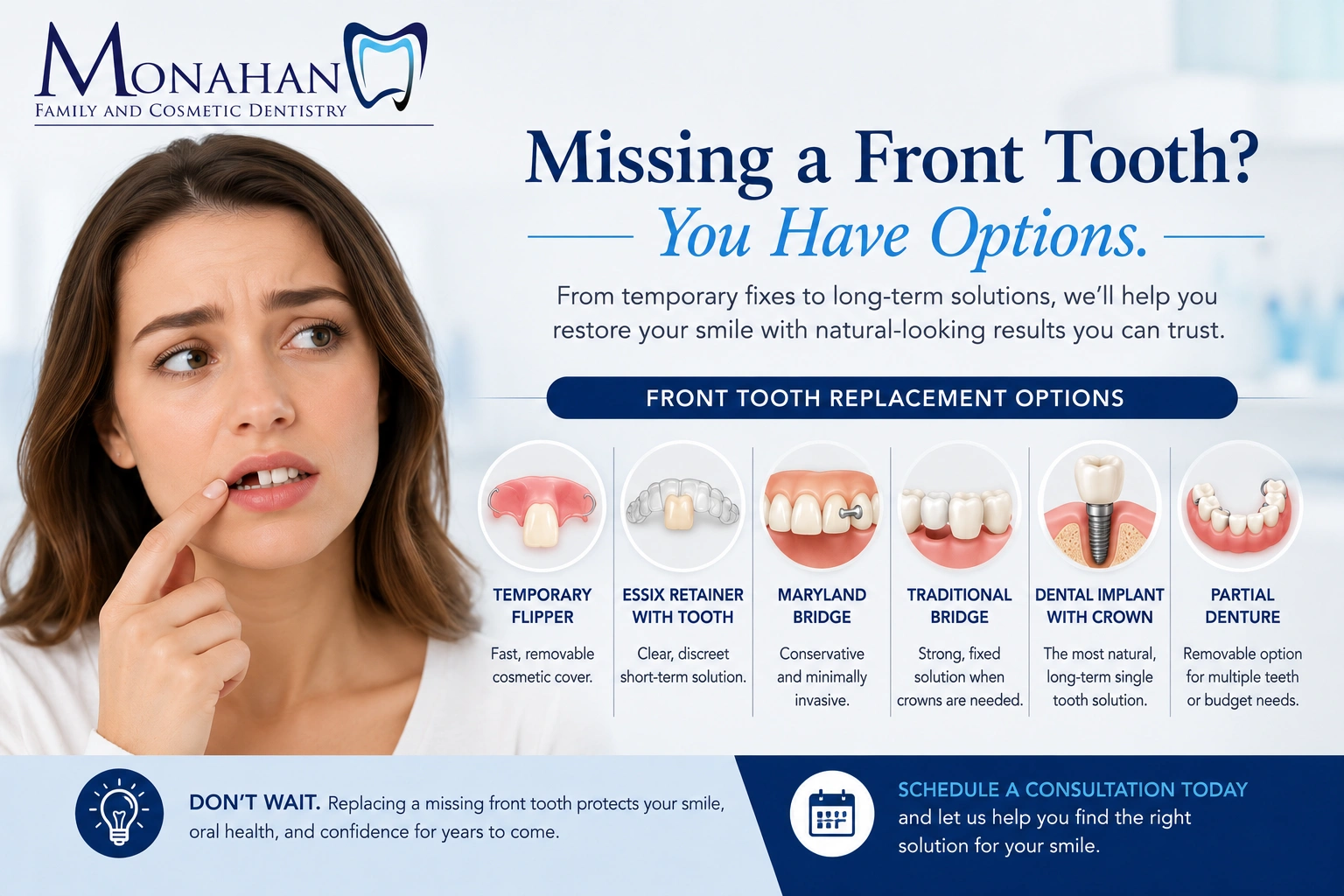
| Option | Best for | Main downside |
|---|---|---|
| Temporary flipper | Fast cosmetic cover | Removable and less stable |
| Essix retainer with tooth | Short-term cosmetic disguise | Not a true chewing tooth |
| Maryland bridge | Conservative front-tooth replacement | Can debond or fail under bite stress |
| Traditional bridge | Faster fixed option when neighboring teeth need crowns | Requires reshaping adjacent teeth |
| Dental implant and crown | Best long-term single-tooth option for many adults | Higher cost and longer timeline |
| Partial denture | Multiple missing teeth or lower budget | Removable and less natural feeling |
There is no single “best” option for everyone.
There is a best option for your mouth, your timeline, your budget, and your expectations.
Why Dental Implants in Burlington Cost More Than “Discount” Clinics in Greensboro
If you’ve seen a Greensboro implant ad promising a very [...]
Learn More
Option 1: Temporary Flipper
A flipper is a removable temporary tooth attached to an acrylic base.
It is often used when someone needs a front tooth replaced quickly for appearance while waiting on a more permanent solution.
When a Flipper Makes Sense
A flipper may be useful if:
- A front tooth was recently removed
- You are waiting for implant healing
- You need something cosmetic for work or photos
- You need a lower-cost short-term solution
- Your final treatment plan is not ready yet
What Patients Should Know
A flipper is not the same as a permanent tooth.
It can help fill the visual gap, but it may feel bulky, move slightly, affect speech at first, and usually should not be used like a strong biting tooth.
For a missing front tooth, a flipper can be a confidence-saver.
But it is usually a bridge to the final answer, not the final answer.
Option 2: Essix Retainer With a Tooth
An Essix-style retainer looks similar to a clear orthodontic retainer. A tooth-colored space can be added where the missing tooth is.
This can be a nice temporary cosmetic option because it is thin, clear, and often less bulky than a flipper.
Best Fit
An Essix retainer may work well if you need:
- A temporary front tooth during implant treatment
- A cosmetic cover for short-term use
- A removable option that is not as bulky
- A way to keep teeth from shifting while healing
Poor Fit
It is not ideal if you expect to bite into sandwiches, apples, or tougher foods with it. It is mostly cosmetic.
Think of it as a temporary smile solution, not a full-function tooth.
Option 3: Maryland Bridge
A Maryland bridge is a conservative bridge often used for missing front teeth. Instead of placing crowns on the neighboring teeth, the replacement tooth is bonded to the backs of the adjacent teeth using small wings.
Cleveland Clinic notes that Maryland bridges are typically used to replace front teeth and are not strong enough for the chewing forces of back teeth.
Why Patients Like It
A Maryland bridge can be appealing because it usually preserves more natural tooth structure than a traditional bridge.
That matters when the teeth next to the gap are healthy and have never had crowns.
The Tradeoff
Maryland bridges can come loose, especially if your bite puts too much pressure on the replacement tooth or if you grind your teeth.
They can look very good in the right case.
They can also be frustrating in the wrong case.
Best Fit
A Maryland bridge may make sense when:
- One front tooth is missing
- Neighboring teeth are healthy
- Bite forces are favorable
- The patient wants a fixed option without surgery
- The patient is not ready for an implant
- The dentist believes bonding strength will be predictable
Poor Fit
It may not be ideal if:
- You have a deep bite
- You grind or clench heavily
- The gap is too large
- Neighboring teeth are weak or heavily restored
- You want the most durable long-term option
Option 4: Traditional Dental Bridge
A traditional bridge uses crowns on the teeth next to the gap to hold a replacement tooth in the middle.
For a missing front tooth, this can look very natural when planned well.
Monahan Family and Cosmetic Dentistry’s dental bridge page explains that bridges are custom-made restorations used to fill spaces from extracted or lost teeth, and that the practice offers conventional, cantilever, Maryland, and implant-supported bridge options.
When a Traditional Bridge Makes Sense
A bridge may be a smart option if the teeth next to the missing tooth already need crowns.
For example, if both neighboring teeth have large fillings, cracks, or old crowns, using them as bridge supports may make sense.
In that case, you are not sacrificing perfectly healthy tooth structure.
The Honest Downside
A traditional bridge usually requires reshaping the adjacent teeth.
If those teeth are healthy, that is a big tradeoff.
The American Dental Association describes fixed bridges as one of the main tooth replacement options, along with implants and removable partial dentures.
The consumer version is this:
A bridge can be a very good solution.
But it makes the neighboring teeth part of the project.
That is not automatically bad. It just needs to be worth it.
Option 5: Dental Implant With Front Tooth Crown
A dental implant replaces the root of the missing tooth. After healing, a crown is attached to the implant.
This is often the most natural-feeling long-term solution for a single missing front tooth.
The American Academy of Periodontology explains that a dental implant is an artificial tooth root placed in the jaw to hold a prosthetic tooth or bridge.
Mayo Clinic describes dental implant surgery as replacing tooth roots with metal posts and replacing missing teeth with artificial teeth that look and work much like real ones.
Why Implants Are Often Preferred for a Single Front Tooth
An implant does not depend on the neighboring teeth for support.
That is a major advantage when the teeth next to the gap are healthy.
An implant can also help maintain bone in the area because it replaces the root structure. That matters in the front of the mouth, where gum shape and bone support affect how natural the final tooth looks.
The Downside
Implants take planning and time.
Monahan Family and Cosmetic Dentistry’s implant page notes that the implant process commonly takes around 4–6 months, including healing time, though some cases may allow a temporary tooth sooner.
A front tooth implant may also require:
- Extraction, if the tooth is still present
- Bone grafting
- Temporary tooth replacement
- Implant placement
- Healing time
- Custom abutment
- Final crown
- Careful shade matching
Best Fit
A front tooth implant may be the best choice when:
- You are missing one tooth
- Neighboring teeth are healthy
- You want a fixed long-term solution
- You have enough bone or can graft the area
- Gum health is stable
- You can wait for proper healing
- You want to avoid cutting down adjacent teeth
Poor Fit
An implant may not be the right first step if:
- Gum disease is active
- Bone support is poor
- You smoke heavily
- Certain medical issues affect healing
- Budget requires a temporary or phased solution
- The space is too narrow without orthodontic correction
That does not mean implants are impossible.
It means the case needs planning before anyone promises a result.
Option 6: Partial Denture
A partial denture is a removable appliance that replaces one or more missing teeth.
For a single missing front tooth, it is usually not the most elegant option, but it can be useful in certain situations.
When a Partial Denture Makes Sense
A partial may be appropriate when:
- Several teeth are missing
- Budget is the main limitation
- Surgery is not desired
- Other teeth are not strong enough for a bridge
- A temporary solution is needed
- Medical issues make implants less predictable
Monahan Family and Cosmetic Dentistry’s denture page describes partial dentures as dental prosthetics designed to replace lost teeth when some natural teeth remain.
What to Know
Partials are removable.
They may have clasps.
They may move slightly.
They can restore appearance and some function, but they usually do not feel as natural as an implant or fixed bridge.
Still, they can be a reasonable option when the goal is to restore the smile without committing to higher-cost treatment immediately.
How Much Does It Cost to Replace a Missing Front Tooth in Burlington?
The exact cost depends on the option.
A realistic 2026 planning range may look like this:
| Solution | Typical planning range |
|---|---|
| Temporary flipper | $300–$800 |
| Essix retainer with tooth | $250–$700 |
| Maryland bridge | $1,200–$2,500+ |
| Traditional bridge | $2,500–$5,000+ |
| Single dental implant, abutment, and crown | $3,500–$6,000+ |
| Partial denture | $800–$2,500+ |
These are planning ranges, not a quote from Monahan Family and Cosmetic Dentistry.
A real estimate depends on the exam, X-rays, bone level, bite, material choice, lab work, whether the tooth was recently extracted, and whether grafting or gum shaping is needed.
The front tooth area is cosmetic territory.
That means small details can change both the cost and the final result.
Why a Missing Front Tooth Should Not Be Ignored
A missing front tooth is easy to think of as a cosmetic issue.
It is cosmetic.
But it is not only cosmetic.
The ADA explains that missing teeth can make it harder to chew and speak clearly, may allow the mouth area to sag, and can let nearby teeth tilt or move out of place.
In the front of the mouth, tooth loss can also affect:
- Speech sounds
- Lip support
- Bite stability
- Gum contour
- Confidence
- Adjacent tooth position
- Bone shape where the tooth used to be
The longer the tooth is missing, the more the area can change.
That does not mean you need to panic.
It means you should get a plan.
The Biggest Cosmetic Mistake: Rushing the Final Tooth
This is the part patients need to hear.
When a front tooth is missing, everyone wants it fixed quickly. That is completely understandable.
But rushing the permanent solution can create a worse cosmetic result.
The gum tissue may need time to heal.
The bone may need grafting.
The bite may need evaluation.
The space may need correction.
The color and shape may need careful matching.
A temporary tooth can protect your confidence while the final work is being done correctly.
Do not confuse “temporary” with “bad.”
In front tooth cases, a temporary can be the thing that allows the final result to look better.
Implant vs. Bridge for a Missing Front Tooth
This is usually the biggest decision.
Choose an Implant When:
- Neighboring teeth are healthy
- You want to avoid cutting down adjacent teeth
- You want a strong long-term solution
- You have enough bone or can graft
- You are comfortable with the timeline and surgical step
Choose a Bridge When:
- Neighboring teeth already need crowns
- You want a fixed option without implant surgery
- You need a faster permanent solution
- Bone support is not ideal for an implant
- Medical factors make implant treatment less predictable
Be Cautious With Either Option When:
- Gum disease is untreated
- You grind heavily
- The bite is unstable
- The space is uneven
- You are choosing only based on the lowest price
The best front tooth replacement is not just the one that looks good on day one.
It is the one that still looks good, feels good, and functions well years later.
What if the Front Tooth Is Still There but Cannot Be Saved?
This is common.
A front tooth may need removal because of:
- Trauma
- Root fracture
- Failed root canal
- Severe decay
- Gum disease
- Resorption
- Infection
- Old crown failure
If the tooth is still present, timing matters.
Sometimes a dentist can remove the tooth and place a bone graft the same day to preserve the ridge for a future implant.
Sometimes a temporary tooth can be made before the extraction so you do not leave the office with a visible gap.
Sometimes the infection or bone loss changes the timeline.
Ask this before the tooth is removed:
“What will I wear or use cosmetically while this heals?”
That one question saves a lot of stress.
What if You Knocked Out a Front Tooth?
A knocked-out adult tooth is a dental emergency.
If the tooth is fully out, handle it by the crown, not the root. Keep it moist. Call a dentist immediately.
The fastest decisions happen in trauma cases, but the final cosmetic plan may still take time. Even if the tooth cannot be saved long term, early care can protect the socket, gum tissue, and future replacement options.
Do not wait a few days to “see how it feels.”
A missing front tooth after trauma needs prompt evaluation.
What if You Have Had the Gap for Years?
If the front tooth has been missing for a long time, treatment may still be possible.
But the plan may be more involved.
Over time, the bone where the tooth used to be can shrink. Nearby teeth may shift. The bite may change. The gum shape may flatten.
That may mean you need:
- Bone grafting
- Gum contour planning
- Orthodontic space correction
- A bridge instead of an implant
- A custom temporary
- More cosmetic planning for symmetry
This is not a reason to give up.
It is a reason not to let someone promise a “simple implant” before looking at the bone and gum position.
What Looks Most Natural?
A natural-looking front tooth replacement comes from matching several things at once:
- Color
- Translucency
- Width
- Length
- Angle
- Surface texture
- Gumline shape
- Contact points
- How the tooth emerges from the gum
A replacement tooth that is the right color but the wrong shape will look fake.
A tooth that is shaped well but has a flat gumline may look fake.
A tooth that looks good alone but does not match the neighboring teeth may stand out.
This is where cosmetic planning matters.
For a front tooth, “good enough” is not always good enough.
What Should Burlington Patients Ask Before Choosing a Solution?
Before agreeing to treatment, ask:
- Is this temporary or permanent?
- Will I ever be without a front tooth during treatment?
- Do I have enough bone for an implant?
- Are my gums healthy enough first?
- Will my neighboring teeth need to be altered?
- What will this look like in photos?
- Can I bite with it normally?
- How long should it last?
- What maintenance will it need?
- What happens if I do nothing for six months?
A good front tooth plan should answer both the cosmetic question and the health question.
When the Cheapest Option Makes Sense
Sometimes the budget option is the right option.
A flipper, Essix retainer, or partial denture may make sense if you need time to save money, heal, finish other dental work, or decide on a long-term treatment.
There is nothing wrong with using a temporary solution strategically.
The problem is when the temporary becomes permanent by accident.
If you choose a short-term fix, ask how long it is expected to last and what the next step should be.
When the Cheapest Option Is a Mistake
The cheapest option may be a poor choice if:
- It damages neighboring teeth
- It looks unnatural in the smile line
- It keeps breaking
- It delays needed infection treatment
- It allows teeth to shift
- It does not let you speak or eat comfortably
- It causes gum irritation
- It makes the final treatment harder later
Front tooth replacement is visible dentistry.
Redoing it can cost more than planning it correctly the first time.
How Dr. Monahan Can Help Fix the “Burlington Gap”
If you are missing a front tooth in Burlington, Graham, Elon, Mebane, or anywhere in Alamance County, the first step is not picking a product.
The first step is diagnosis.
Dr. Thomas Monahan can evaluate:
- Why the tooth is missing or failing
- Whether the area is healthy
- Whether bone loss has occurred
- Whether the bite is part of the problem
- Whether an implant, bridge, or temporary option makes sense
- How to protect your appearance during treatment
- What the realistic cost and timeline look like
Monahan Family and Cosmetic Dentistry offers several restorative and cosmetic options for missing teeth, including bridges, dentures, crowns, and implants.
The goal is simple: replace the missing tooth in a way that looks natural, feels stable, and does not create new problems.
FAQs About Replacing a Missing Front Tooth
What is the fastest way to replace a missing front tooth?
A temporary flipper or Essix retainer with a tooth is often the fastest cosmetic option. These do not usually function like permanent teeth, but they can hide the gap while the final plan is made.
What is the best long-term option for one missing front tooth?
For many healthy adults, a single dental implant with a custom crown is the best long-term option because it replaces the root and does not rely on neighboring teeth. It is not the right fit for every patient, especially if gum disease, bone loss, medical issues, or budget concerns are present.
Is a bridge faster than an implant?
Usually, yes. A traditional bridge can often be completed faster than an implant because implants require surgical placement and healing time. But a bridge may require reshaping the neighboring teeth.
Will I have to walk around with a missing front tooth during implant treatment?
Usually, no. Many patients can use a temporary flipper, Essix retainer, or temporary restoration while the implant site heals. Ask about the temporary plan before treatment begins.
Can a Maryland bridge replace a front tooth?
Yes, in selected cases. Maryland bridges are often used for front teeth because they are more conservative than traditional bridges. They are not ideal for every bite and may come loose if the biting forces are too heavy.
How long does a front tooth implant take?
The full process often takes several months. Monahan Family and Cosmetic Dentistry notes that dental implant treatment commonly takes about 4–6 months, including healing time, though timelines vary by patient.
What if I cannot afford an implant right now?
A temporary flipper, Essix retainer, Maryland bridge, traditional bridge, or partial denture may be considered depending on your case. The key is making sure the short-term solution does not make the long-term solution harder.
Will a replacement front tooth look natural?
It can, but front teeth require careful cosmetic planning. Shade, shape, gumline, spacing, and bite all matter. A front tooth replacement should be planned more carefully than a hidden back tooth.
Should I replace a missing front tooth even if it does not hurt?
Yes, you should at least be evaluated. A missing tooth can affect speech, chewing, tooth movement, bite stability, and appearance over time. The ADA notes that missing teeth can affect chewing, speech, facial support, and tooth position.
What is the first step?
Schedule an exam and X-rays. You need to know whether the area has enough bone, whether the gums are healthy, whether adjacent teeth are strong, and which option makes the most sense before choosing a cosmetic fix.
Missing Front Tooth? Close the Burlington Gap Today
Restore your smile with cosmetic dental solutions designed for a natural, confident look. Call now to schedule your consultation.