
A small cavity can be easy to ignore.
It may not hurt. You may still be able to chew normally. You may not even know it is there until your dentist sees it during an exam or on an X-ray.
That does not mean the cavity has stopped progressing.
Tooth decay does not repair itself once a true cavity has formed. Without treatment, the damaged area can become larger and move deeper into the tooth. What may have required a relatively simple filling can eventually require a root canal, a crown, or, in advanced cases, extraction and tooth replacement.
That difference can also become significant financially.
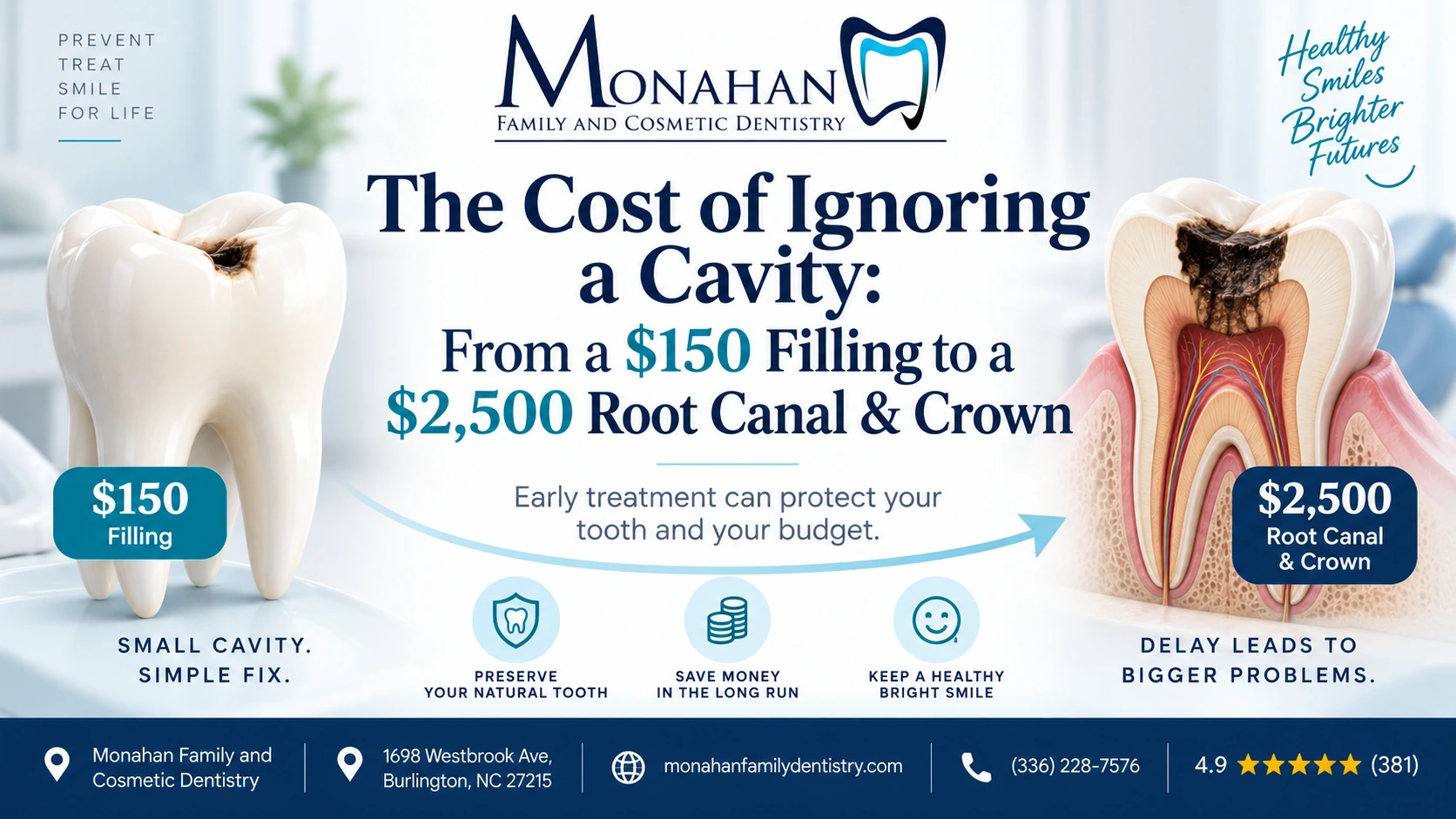
For example, a cavity that may have been treated with a filling costing around $150 could eventually turn into a case requiring a root canal and crown costing around $2,500 combined. These figures are examples only. Actual fees vary according to the tooth involved, the extent of decay, the type of restoration, insurance coverage, and other clinical factors.
The larger point is simple: treating decay earlier is usually easier, more conservative, and less expensive than waiting until the tooth becomes severely damaged.
What Actually Happens When You Ignore a Cavity?
A cavity develops when acids produced by bacteria gradually damage the hard structure of a tooth.
The process usually begins at the outer layer, called enamel. If decay continues, it can move into the dentin beneath the enamel. Eventually, bacteria may reach the pulp at the center of the tooth.
The pulp contains nerves, blood vessels, and connective tissue.
Once decay reaches this area, the problem is no longer just a small hole in the tooth. The pulp can become inflamed or infected. At that stage, a filling alone may no longer be enough.
Stage 1: Early Tooth Decay
Very early decay may begin as mineral loss in the enamel.
At this stage, there may not yet be a physical cavity. Depending on the situation, your dentist may recommend preventive measures such as improved oral hygiene, fluoride exposure, dietary changes, or closer monitoring.
This is one reason routine dental examinations matter.
Decay is often easier to manage when it is identified before significant tooth structure has been lost.
Stage 2: A Small Cavity Forms
Once decay creates an actual opening in the tooth, a dental filling is often the standard treatment.
The dentist removes the damaged portion of the tooth and restores the area with a filling material.
For many patients, this is a straightforward appointment.
There is usually more healthy tooth structure available to preserve. The treatment is less involved than procedures required for advanced decay.
Using our example, this may be the point where treatment costs approximately $150.
Again, actual fees vary. The important issue is that early treatment is generally much simpler than treating decay after it reaches the center of the tooth.
Stage 3: The Cavity Reaches the Dentin
The dentin is softer than enamel.
Once decay reaches this layer, it can progress more quickly toward the pulp.
Patients may begin noticing symptoms such as:
- Sensitivity to cold
- Sensitivity to sweets
- Discomfort while chewing
- A rough area or visible hole in the tooth
- Food repeatedly becoming trapped in one area
- Intermittent tooth discomfort
However, symptoms are not always reliable.
A tooth can have significant decay without causing severe pain.
Waiting until a cavity hurts is therefore not a safe way to determine whether treatment is necessary.
Stage 4: Decay Reaches the Tooth’s Pulp
When bacteria and decay reach the pulp, the nerve tissue inside the tooth can become severely inflamed or infected.
At this point, the treatment plan changes significantly.
A filling replaces damaged tooth structure. It does not remove infection from inside the pulp chamber and root canals.
If the tooth can still be saved, root canal treatment may be necessary.
That means the difference between treating a small cavity early and treating advanced decay later can involve an entirely different level of dental care.
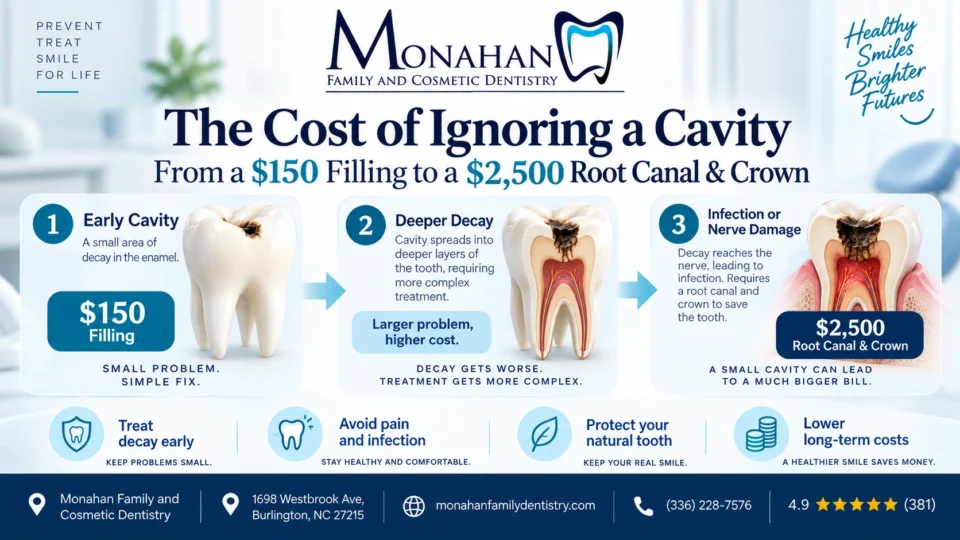
How a $150 Filling Can Turn Into a $2,500 Root Canal and Crown
The financial difference is not because the same cavity suddenly becomes more expensive.
The difference occurs because delaying treatment allows the disease process to damage more parts of the tooth.
A small cavity may require one restoration.
A deeply infected tooth may require several procedures.
The Initial Filling
When decay is limited enough, your dentist can usually remove the affected tooth structure and place a filling.
The goal is to stop the active decay and restore the shape and function of the tooth.
Treatment is relatively conservative because the pulp remains healthy.
Root Canal Treatment
If decay reaches the pulp and causes irreversible inflammation or infection, root canal treatment may become necessary.
During root canal treatment, the dentist or endodontist removes the damaged or infected tissue from inside the tooth.
The internal spaces are then cleaned, disinfected, shaped, and sealed.
The procedure is designed to preserve the natural tooth rather than remove it.
Root canal treatment is more complex than placing a standard filling because the problem now extends inside the tooth and its root system.
Why a Crown May Be Needed Afterward
A tooth that has undergone significant decay and root canal treatment has often lost a substantial amount of natural structure.
For many back teeth, a crown is commonly recommended afterward to restore strength, function, and coverage.
A crown surrounds the remaining visible portion of the tooth.
Instead of paying only for a filling, the patient may now need to account for:
- The examination
- Dental X-rays or other imaging when indicated
- Root canal treatment
- A core buildup or restorative foundation when required
- A dental crown
- Additional appointments
The combined cost can reach $2,500 or more in some situations, although it can also be lower depending on the case, insurance benefits, provider, tooth, and materials selected.
That is why delaying a cavity can become expensive.
You are no longer treating the same stage of disease.
Why Cavities Can Become Serious Before They Hurt
One of the biggest misconceptions about tooth decay is that pain always appears early.
It does not.
Enamel itself does not contain nerves. A cavity can grow through part of the enamel without causing noticeable pain.
Even when the decay enters dentin, symptoms can be mild or inconsistent.
A patient may notice sensitivity for several weeks and then feel as though the tooth has improved.
That change does not always mean the problem is gone.
In some advanced cases, nerve tissue inside the tooth can become damaged enough that symptoms change or temporarily decrease. The underlying infection may still remain.
This is why dental examinations and appropriate X-rays can be important even when your mouth feels normal.
Dentists are often able to identify decay before it produces the kind of pain that brings someone in for an emergency visit.
What Symptoms Suggest a Cavity Is Getting Worse?
Any persistent change in a tooth deserves attention.
Symptoms that may occur as decay progresses include:
- Increased sensitivity to hot or cold
- Pain when eating sweets
- Pain while biting or chewing
- A visible dark area or hole
- Food consistently becoming trapped around one tooth
- Toothache that occurs without an obvious trigger
- Lingering sensitivity after hot or cold foods
- Swelling around the tooth or gums
- A bad taste in the mouth
- Facial swelling in more serious situations
These symptoms do not automatically mean you need a root canal.
Several dental conditions can cause similar complaints.
The correct treatment depends on an examination and diagnosis.
However, persistent pain, swelling, or worsening sensitivity should not be ignored.
Is It Ever Safe to Wait on a Cavity?
That depends on what your dentist actually finds.
Very early enamel changes may sometimes be monitored or managed preventively if the tooth has not developed a true cavity.
An established cavity is different.
Once tooth structure has broken down, the damaged area generally cannot rebuild itself into a normal intact tooth. Restorative treatment is commonly needed.
The question then becomes how much tooth structure must be treated.
A smaller cavity may require a filling.
A larger cavity may require a more extensive restoration.
If decay reaches the pulp, root canal treatment may be required.
If the tooth becomes too damaged to restore predictably, extraction may become necessary.
The safest approach is not to decide based only on whether the tooth hurts.
Ask your dentist what stage the decay has reached, how quickly it should be treated, and what could happen if treatment is delayed.
Ignoring a Cavity Can Cost More Than Money
Treatment cost is important, but it is not the only concern.
As decay progresses, preserving the natural tooth becomes more difficult.
More Natural Tooth Structure May Be Lost
Dentistry generally aims to preserve healthy tooth structure whenever possible.
A small filling requires removal of less tooth structure than treatment for extensive decay.
The longer decay progresses, the more damaged tissue may need to be removed.
Treatment Becomes More Involved
A filling may often be completed in a relatively routine visit.
Root canal treatment and crown placement involve additional steps.
That can mean more appointments and a longer overall treatment process.
The Tooth Can Become Infected
When bacteria reach the pulp, infection may develop within the tooth and surrounding tissues.
Dental infections should be professionally evaluated.
If swelling, fever, difficulty swallowing, difficulty breathing, or rapidly increasing facial swelling occurs, prompt medical or dental attention is important.
The Tooth May Eventually Become Unsavable
Dentists cannot save every severely damaged tooth.
If too much structure has been destroyed, the tooth has fractured extensively, or the prognosis is otherwise poor, extraction may be recommended.
Removing the tooth may then create another decision: whether and how to replace it.
That can involve treatments such as a dental bridge, removable prosthesis, or dental implant depending on the patient’s needs.
At that point, the financial and clinical consequences can extend well beyond the original cavity.
The Real Value of Treating Cavities Early
Early cavity treatment is not simply about preventing pain.
It is about preserving options.
The earlier your dentist identifies and treats decay, the more likely the treatment can remain conservative.
That may mean:
- Preserving more natural tooth structure
- Avoiding infection of the dental pulp
- Reducing the likelihood of root canal treatment
- Avoiding emergency dental visits
- Reducing the chance of needing extraction
- Limiting the number of appointments required
- Keeping treatment costs more manageable
A small filling may seem easy to postpone when the tooth feels fine.
But the absence of pain does not guarantee that decay is stable.
Treating the problem while it is still small is usually preferable to waiting until the tooth determines the schedule for you.
Why Regular Dental Exams Can Save You From Larger Procedures
Many cavities are discovered during routine dental appointments.
Your dentist can visually examine accessible areas of the teeth and use appropriate dental X-rays when needed to look for decay that may not be visible from the surface.
This is particularly important for cavities developing between teeth.
Patients may not be able to see or feel those areas themselves.
Regular examinations also allow your dental team to compare changes over time.
Your dentist can identify areas that need preventive attention and distinguish them from cavities that require restorative treatment.
The objective is not simply to find problems.
It is to find them when the available treatment is still as conservative as reasonably possible.
What If You Already Have a Toothache?
Do not assume it is too late.
A painful tooth does not automatically need extraction. It also does not automatically require a root canal.
Different conditions can cause tooth pain, including cavities, cracked teeth, gum problems, bite-related issues, and dental infections.
A dental examination is necessary to determine the cause.
If a deep cavity has reached the pulp but the remaining tooth is restorable, root canal treatment and a crown may still allow the natural tooth to be preserved.
The key is to avoid extending the delay.
If symptoms are worsening, schedule an evaluation so you understand what is happening and what treatment options remain.
How to Reduce Your Risk of Future Cavities
No preventive routine can guarantee that a person will never develop decay.
Good daily habits can substantially reduce risk, however.
Brush Thoroughly Twice a Day
Use fluoride toothpaste and clean all accessible surfaces of your teeth.
Rushing matters.
Plaque left around the gumline, grooves of the teeth, and difficult-to-reach areas can contribute to decay.
Clean Between Your Teeth
A toothbrush cannot effectively clean every contact area between teeth.
Floss or another dentist-recommended interdental cleaner can help remove plaque and food from these spaces.
Limit Frequent Sugar Exposure
The frequency of sugar exposure matters.
Repeatedly sipping sweetened drinks or snacking on sugary foods throughout the day gives cavity-causing bacteria repeated opportunities to produce acids.
Water is generally a better choice between meals.
Keep Up With Dental Exams
A dentist may be able to identify decay long before it becomes painful.
Your recommended examination schedule should be based on your individual oral health and risk factors.
Address Dry Mouth
Saliva helps protect teeth.
Certain medications, health conditions, and other factors can reduce saliva production.
If your mouth frequently feels dry, discuss it with your dentist. They can evaluate contributing factors and recommend appropriate strategies.
Frequently Asked Questions About Cavities and Treatment Costs
Can a cavity go away without a filling?
Very early enamel demineralization may sometimes be managed before a true cavity forms. Once tooth structure has broken down and a physical cavity is present, it generally requires professional restorative treatment. Your dentist can determine which stage applies to your tooth.
How long can I wait before getting a cavity filled?
There is no universal safe waiting period. Cavities progress at different rates depending on their location, size, oral hygiene, diet, saliva, and other factors. If your dentist recommends a filling, ask how urgent the treatment is rather than waiting until pain develops.
Does a cavity always turn into a root canal if untreated?
Not immediately, but untreated decay can continue deeper into the tooth. If it reaches and irreversibly damages or infects the pulp, root canal treatment may become necessary if the tooth is to be saved.
Why does a root canal cost more than a filling?
A root canal treats disease inside the tooth’s pulp chamber and root canal system. It is a more involved procedure than removing a small area of decay and placing a filling. Many root canal-treated teeth also require a crown or other restoration afterward.
Is $2,500 the standard price for a root canal and crown?
No. The $2,500 figure is an example, not a universal fee. Costs vary according to the tooth, complexity of treatment, type of crown, provider, location, insurance coverage, and other factors. A dental office can provide a treatment estimate after evaluating the tooth.
Can regular checkups really prevent the need for a root canal?
Routine care cannot prevent every root canal. It can, however, help dentists identify decay earlier, when treatment may be more conservative. Prompt treatment of cavities can reduce the chance that decay will progress into the pulp.
Protect the Tooth While the Treatment Is Still Simple
A cavity does not become less important because it is painless.
When decay is caught early, treatment may be limited to a relatively small restoration. Once it spreads into the center of the tooth, preserving that tooth can require significantly more treatment, time, and expense.
The difference between an example $150 filling and a $2,500 root canal and crown is not simply a difference in price.
It represents a difference in how much damage the tooth has sustained.
At Monahan Family & Cosmetic Dentistry, we believe patients should understand what is happening with their teeth and why a particular treatment is recommended. If you have been told you have a cavity, have noticed new sensitivity, or are experiencing tooth pain, an examination can clarify the condition of the tooth and the appropriate next step.
Addressing decay sooner may help preserve more of your natural tooth and keep treatment simpler.