
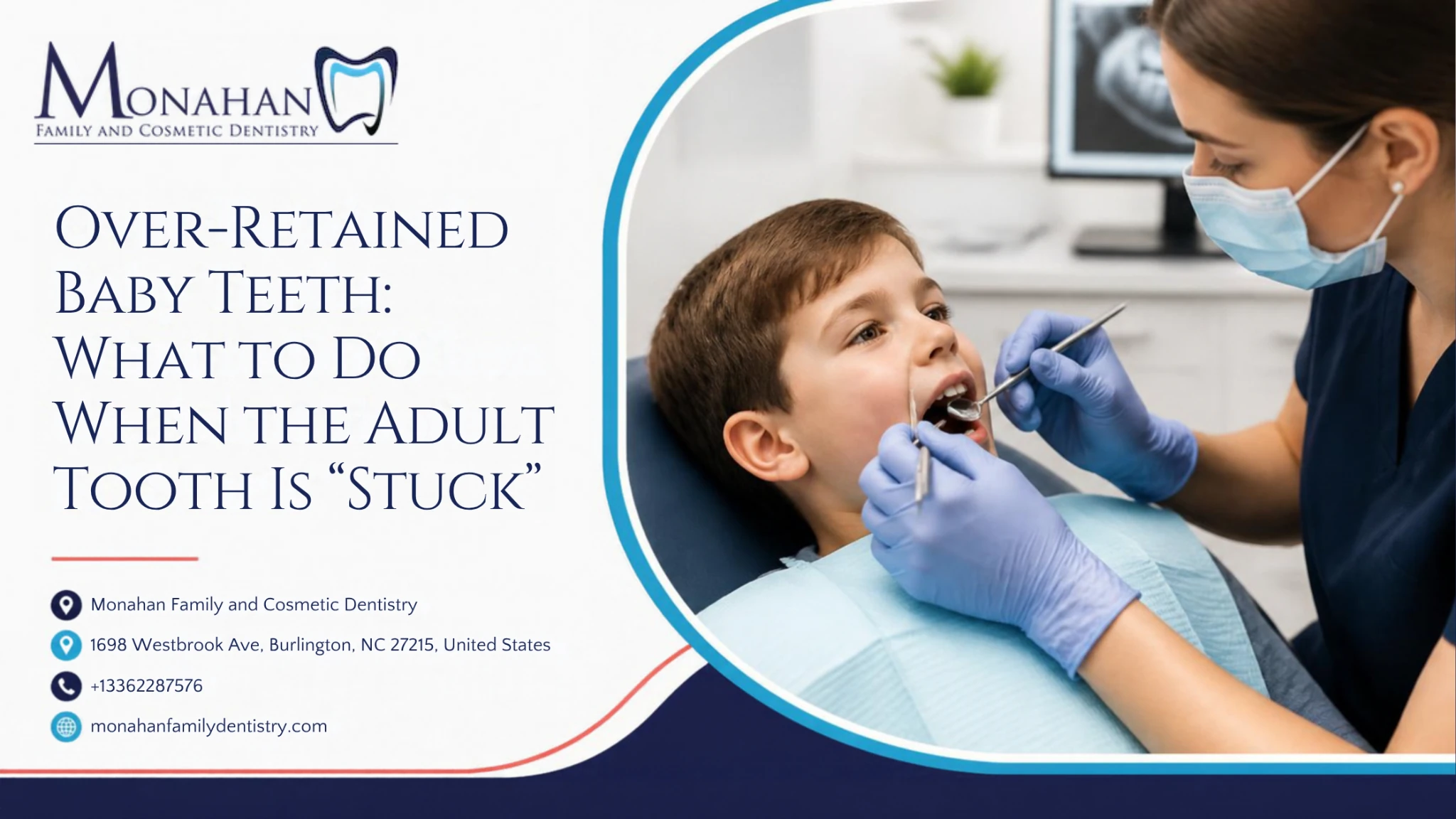
It usually starts with a parent noticing something strange.
Their child has a baby tooth that won’t come out.
But behind it or sometimes in front of it an adult tooth is already coming in.
Suddenly, it looks like there are two rows of teeth.
And the first question is almost always:
“Is this normal?”
Sometimes it is.
Sometimes it isn’t.
The good news is that an over-retained baby tooth is a common issue, and in many cases, it’s very manageable when addressed at the right time.
The Short Answer
An over-retained baby tooth is a baby tooth that remains in place longer than expected while the permanent tooth is trying to erupt.
This can happen when:
- The baby tooth root doesn’t dissolve normally
- The permanent tooth erupts in an unusual position
- There isn’t enough room in the mouth
- The adult tooth is delayed
- The adult tooth is impacted or “stuck”
Sometimes nature corrects the problem.
Sometimes the baby tooth needs to be removed to allow the permanent tooth to move into a healthier position.
The “Shark Teeth” Situation
Parents often call this “shark teeth.”
That’s when an adult tooth starts erupting behind a baby tooth, creating the appearance of two rows of teeth.
It’s especially common with lower front teeth.
And honestly, it looks alarming.
The good news?
It’s one of the most common eruption patterns we see in children.
In many cases, the permanent tooth is simply taking a slightly different path than expected.
Why Baby Teeth Usually Fall Out
Most parents assume baby teeth become loose because they wear out.
That’s not actually what happens.
As a permanent tooth develops underneath, it gradually dissolves the root of the baby tooth.
Eventually:
- The root becomes very short
- The tooth becomes loose
- The baby tooth falls out
When that process doesn’t happen normally, the baby tooth may remain in place longer than it should.
When Waiting Makes Sense
Not every over-retained baby tooth requires immediate treatment.
Sometimes we’ll recommend monitoring when:
- The permanent tooth has just started erupting
- The baby tooth is already becoming loose
- The child is within a normal eruption timeline
- There are signs the tooth will exfoliate naturally
Children’s teeth can surprise you.
Sometimes a tooth that seems “stuck” today falls out naturally a few weeks later.
When It Is Time to Intervene
A dental evaluation becomes more important when:
- The baby tooth isn’t loosening
- The adult tooth is significantly displaced
- Crowding is developing
- The eruption pattern appears abnormal
- The child is well beyond the expected age range
- There is pain, swelling, or infection
In these situations, removing the baby tooth may help create a clearer path for the permanent tooth.
The Question Parents Usually Ask
“If we remove the baby tooth, will the adult tooth move into place?”
Often, yes.
Especially in younger children.
Once the obstruction is removed, the permanent tooth frequently begins moving toward a more natural position on its own.
But not always.
That depends on:
- Age
- Available space
- Tooth position
- Jaw development
- Overall orthodontic needs
The Honest Truth About Braces
Many parents worry that a retained baby tooth automatically means braces.
That’s not necessarily true.
Some children who experience over-retained baby teeth never need orthodontic treatment.
Others already have crowding or spacing issues that make orthodontics more likely.
The retained tooth itself isn’t always the problem.
Sometimes it’s simply revealing a larger spacing issue.
What Happens If You Ignore It?
This is where timing matters.
A baby tooth that remains too long can sometimes contribute to:
- Crowding
- Misalignment
- Eruption problems
- Hygiene challenges
- Future orthodontic complications
That doesn’t mean every retained baby tooth is an emergency.
But it does mean it’s worth evaluating.
Why X-Rays Matter
Parents are often surprised by how much information we can gather from a simple dental X-ray.
An X-ray can help determine:
- Whether the permanent tooth is present
- Its position
- Its eruption path
- Whether additional teeth are involved
- Whether anything is blocking eruption
Without imaging, we’re often guessing.
With imaging, we can usually see the bigger picture.
The Bottom Line
A baby tooth that won’t come out can look dramatic, especially when the permanent tooth is already appearing nearby.
Fortunately, over-retained baby teeth are a common part of pediatric dentistry, and many cases are straightforward to manage when caught early.
At Monahan Family and Cosmetic Dentistry, Dr. Thomas Monahan helps parents throughout Burlington, Graham, Mebane, Elon, and Alamance County understand whether a retained baby tooth is something to watch, something to remove, or simply part of a normal growth process. Sometimes the best treatment is patience. Sometimes it’s intervention. The key is knowing the difference.
Frequently Asked Questions
What is an over-retained baby tooth?
It is a baby tooth that remains in place longer than expected while the permanent tooth is attempting to erupt.
Are “shark teeth” normal?
They are common, especially in the lower front teeth, but should still be evaluated to determine whether intervention is needed.
Will my child’s adult tooth move into place on its own?
Often it will, especially after the baby tooth is removed. However, every case is different.
Does a retained baby tooth mean my child needs braces?
Not necessarily. Some children do, many do not. An evaluation can help determine the likelihood.
At what point should I call a dentist?
If the adult tooth is erupting and the baby tooth shows little sign of loosening, it’s a good idea to schedule an evaluation.