
Most patients think dental insurance works like medical insurance.
It usually does not.
That is why so many people in Burlington walk into a dental office frustrated, saying things like:
- “I thought insurance covered this.”
- “Why is my maximum already gone?”
- “Why am I still paying out of pocket?”
- “What do you mean there’s a waiting period?”
- “Why does my crown only get partially covered?”
Here is the uncomfortable truth for 2026:
For many patients, dental insurance functions more like a discount coupon program than true catastrophic insurance.
That sounds blunt, but financially, it is often accurate.
Why Dental Insurance Feels So Different From Medical Insurance
Most dental plans were designed decades ago around the assumption that patients would mainly need:
- Cleanings
- Exams
- Basic fillings
- Occasional extractions
The problem is that dental costs, materials, technology, lab fees, and staffing have risen dramatically but many annual maximums barely changed.
It is still common for dental plans to cap benefits around $1,000–$2,000 annually, numbers that have remained relatively stagnant for years according to dental industry reporting.
That means one dental crown, root canal, or implant-related procedure can consume most or all of the year’s benefits quickly.
A Better Way to Think About Dental Insurance
Instead of asking:
“Will insurance pay for this?”
The smarter question is:
“How much discount does my plan provide toward this treatment?”
Because that is often what is really happening.
For example:
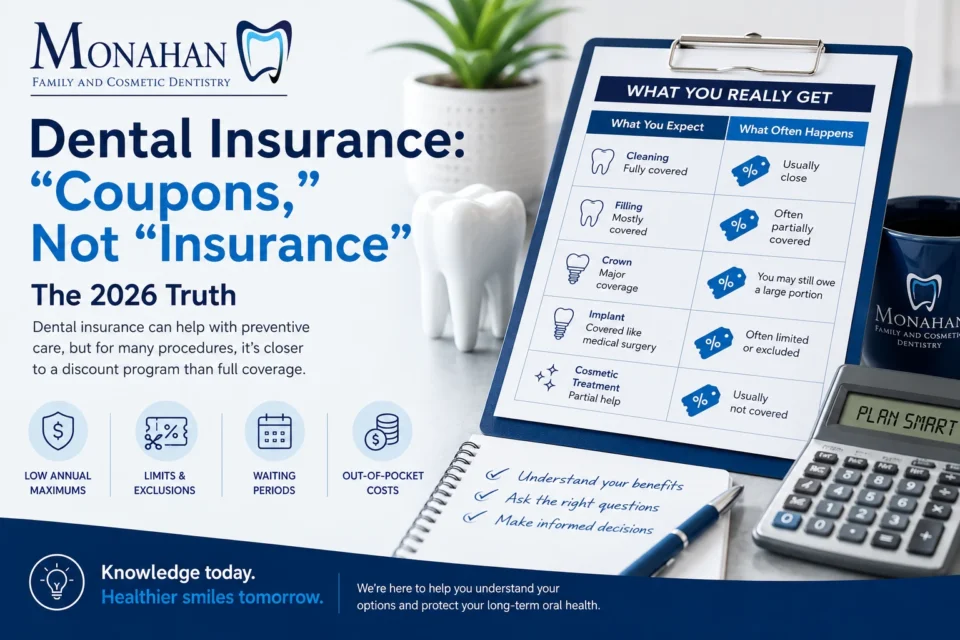
| Procedure | What Patients Expect | What Often Happens |
|---|---|---|
| Cleaning | Fully covered | Usually close |
| Filling | Mostly covered | Often partially covered |
| Crown | Major coverage | Patient may still owe a large portion |
| Implant | Covered like medical surgery | Often limited or excluded |
| Cosmetic treatment | Partial help | Usually not covered |
Why Dentists Get Blamed for Insurance Problems
This is where frustration gets misplaced.
Many patients assume the dental office decides what insurance covers.
Usually, it does not.
Insurance companies decide:
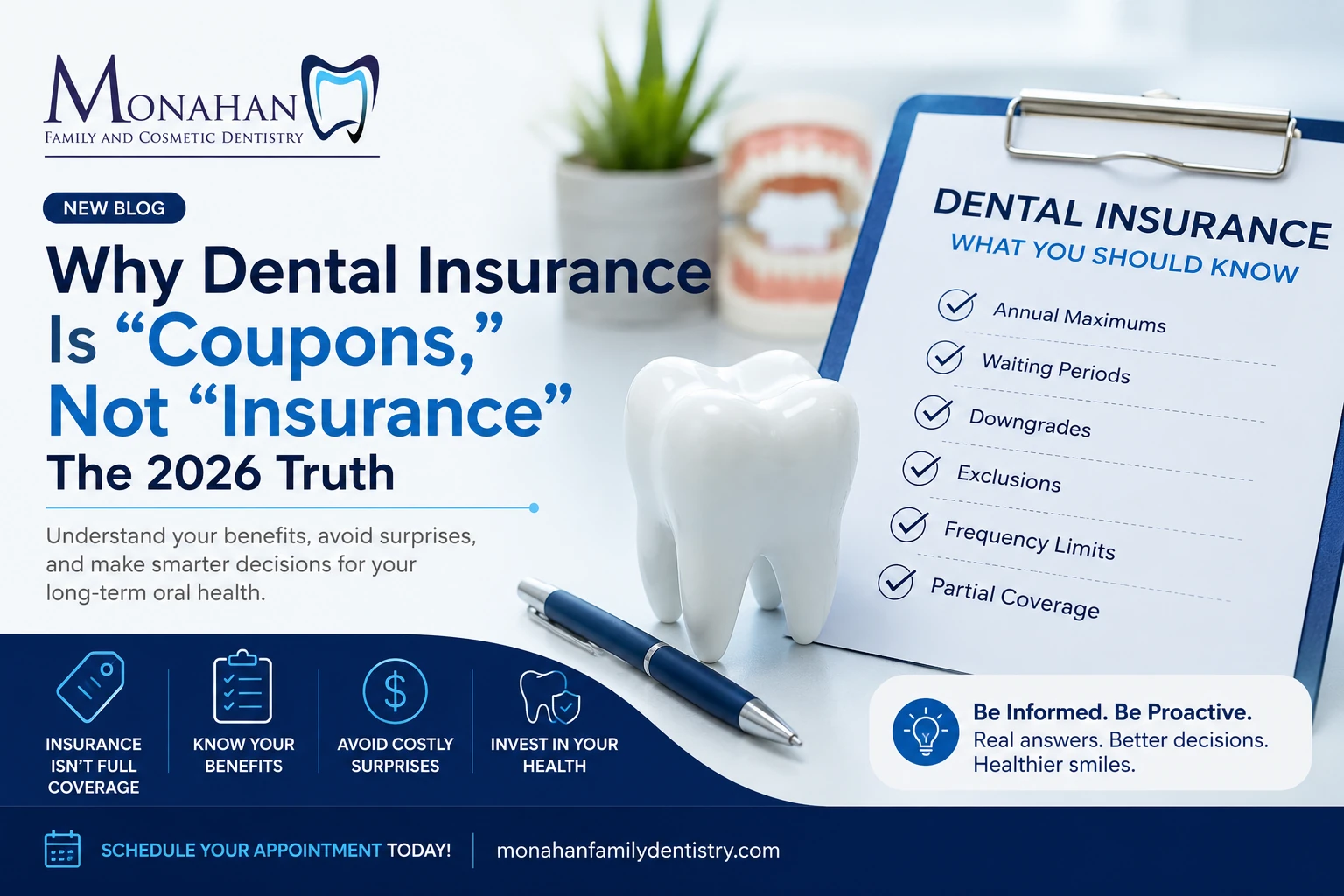
- Annual maximums
- Waiting periods
- Frequency limits
- Downgrades
- Exclusions
- “Medical necessity”
- Covered materials
- Reimbursement amounts
At Monahan Family and Cosmetic Dentistry, Dr. Thomas Monahan’s team can help patients understand benefits and estimate coverage, but they cannot force an insurance company to approve treatment.
The “Downgrade” Problem Most Patients Never Hear About
This catches people off guard constantly.
An insurance company may approve treatment but reimburse at a lower-cost material or older procedure code.
For example:
- A tooth-colored filling may be reimbursed like a silver filling
- A high-quality crown may be reimbursed at a lower fee schedule
- Implant restorations may be treated differently from bridges
So the patient hears:
“Insurance covered it.”
But the office and patient may still be left with a significant balance difference.
Why Cheap Dental Plans Can Become Expensive
Some low-premium plans look attractive until you actually need treatment.
Common limitations include:
- Waiting periods
- Low annual maximums
- Narrow provider networks
- High exclusions
- Limited major services
- No implant coverage
- Frequency restrictions on cleanings or X-rays
The ADA has repeatedly warned consumers to read plan details carefully because lower-cost plans may significantly limit access or reimbursement.
The Most Financially Dangerous Mindset
This one causes major long-term problems:
“I’ll only do what insurance covers.”
That sounds financially responsible, but it can backfire badly.
Insurance companies are not designing treatment plans around your long-term health. They are managing risk and reimbursement.
Sometimes the cheapest short-term option becomes the expensive long-term option.
A delayed crown becomes a root canal.
A postponed dental filling becomes an extraction.
A missing tooth becomes shifting, bite problems, or bone loss.
So Is Dental Insurance Worth It?
Often, yes, especially for preventive care.
Many patients still save money through:
- Dental cleanings
- Exams
- Preventive X-rays
- Some restorative coverage
- Negotiated fee reductions
But it helps to think realistically about what dental insurance actually is.
It is usually not comprehensive financial protection against major dental costs.
It is more like partial assistance.
Or, bluntly:
A coupon system with rules.
The Better Strategy for Burlington Families
The healthiest approach is usually:
- Use insurance benefits wisely
- Prioritize preventive dental care
- Avoid delaying active problems
- Understand your annual maximum early
- Ask for treatment phases when needed
- Focus on long-term value, not just immediate out-of-pocket cost
A good dental office should help you understand the financial side honestly — including what insurance is likely to pay, what it probably will not, and what treatment delays may cost later.
Because the real frustration is not usually the bill itself.
It is feeling surprised by it.