
2026 Price Guide
If your dentist told you that you need a crown, your first thought was probably not, “Great, I’ve been looking forward to this.”
It was probably closer to: How much is this going to cost me? Is insurance going to help? And do I really need the crown, or is there a cheaper fix?
Here’s the practical answer.
In Burlington, NC, a dental crown commonly costs about $1,100 to $1,700 per tooth without insurance in 2026. Some cases may be lower or higher depending on the tooth, material, lab fees, whether a buildup is needed, and whether the tooth also needs a root canal.
Statewide North Carolina estimates place dental crowns around $1,130 to $1,170 on average without insurance, though real private-practice pricing can run higher depending on the case and materials used.
With dental insurance, many patients pay somewhere around $500 to $1,000 out of pocket, but that depends heavily on your deductible, annual maximum, waiting periods, and whether the crown is considered medically necessary. Delta Dental’s own cost estimator notes that dental cost estimates are not guarantees and that patients should confirm costs with their dentist and plan.
At Monahan Family and Cosmetic Dentistry in Burlington, Dr. Thomas Monahan evaluates crowns based on what the tooth actually needs: strength, protection, function, and long-term prognosis — not just whether a crown can technically be placed. Monahan’s own dental crown page explains that crowns are used to cover, restore, and protect weakened or damaged teeth using materials such as porcelain, ceramic, or metal alloys.
Need a Dental Crown in Burlington, NC?
Find out what factors affect crown pricing and receive expert guidance tailored to your needs. Contact our office today for fast, friendly assistance.
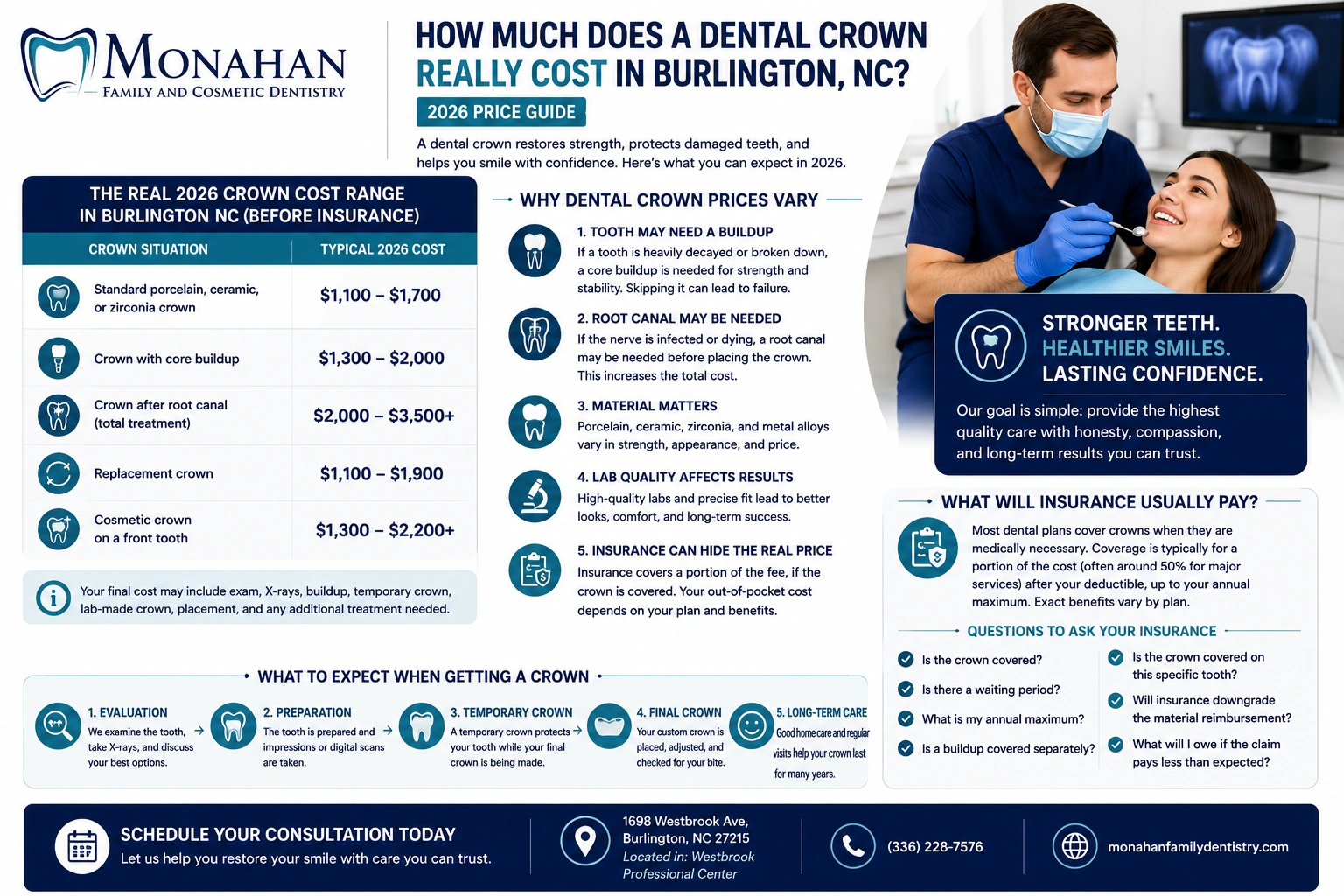
The real 2026 crown cost range in Burlington, NC
For most Burlington-area patients, a realistic crown estimate looks like this:
| Crown situation | Typical 2026 cost before insurance |
| Standard porcelain, ceramic, or zirconia crown | $1,100–$1,700 |
| Crown with core buildup | $1,300–$2,000 |
| Crown after root canal | $2,000–$3,500+ total treatment |
| Replacement crown | $1,100–$1,900 |
| Cosmetic crown on a front tooth | $1,300–$2,200+ |
The crown itself is only one part of the cost. What often surprises patients is that the final number may include other services needed to make the crown last.
That may include:
- Exam and X-rays
- Tooth buildup
- Temporary crown
- Lab-made final crown
- Crown placement
- Bite adjustment
- Root canal, if the nerve is infected or dying
That is why one person pays $1,150 and another pays $2,700 for what both people call “a crown.”
They may not be getting the same treatment.
Why dental crown prices vary so much
A crown is not just a cap that gets glued over a tooth.
A good crown has to fit your bite, seal the tooth properly, protect what remains of the natural tooth, and hold up under years of chewing. The price changes when the case gets more complicated.
1. The tooth may need a buildup first
If a tooth has a large cavity, old filling, crack, or broken corner, there may not be enough healthy structure left to hold a crown securely.
In that case, the dentist may need to rebuild the missing part of the tooth before the crown is made. This is called a core buildup.
This can add several hundred dollars.
Here’s the blunt truth: skipping the buildup to “save money” can make the crown fail faster. A crown is only as strong as the foundation underneath it.
2. A root canal may be needed
A crown protects the outside of the tooth. It does not automatically solve an infected nerve.
If the tooth has lingering pain, swelling, a deep cavity, or infection near the root, a root canal may be needed before the crown.
That changes the cost significantly.
A root canal plus crown may feel expensive, but in many cases, it is still less invasive than removing the tooth and replacing it with an implant or bridge.
3. The material matters
Common crown materials include ceramic, porcelain, zirconia, porcelain-fused-to-metal, and metal alloys.
For many back teeth, strength matters most. For front teeth, appearance and shade matching matter more. That can affect material choice and lab cost.
A cheap crown that looks wrong on a front tooth or cracks under bite pressure on a molar is not a bargain.
4. Lab quality affects the result
Not all crowns are made the same.
Better-fitting crowns usually require better impressions or scans, careful bite records, proper shade selection, and a quality dental lab. That costs more than rushing the cheapest possible crown through the cheapest possible lab.
Fit matters because tiny gaps can lead to decay under the crown.
5. Insurance can hide the real price
Insurance does not always reduce the total fee. It reduces what you personally owe, if the procedure is covered.
Most plans treat crowns as a major service. That often means partial coverage, not full coverage. Some plans also have waiting periods or annual maximums that limit how much they pay.
A plan that “covers crowns at 50%” may still leave you with a larger bill if you have already used part of your annual benefit.
What No One Tells You About the Silence After a Tooth Extraction
There’s something oddly surreal about the quiet that follows a [...]
Learn More
What will insurance usually pay for a crown?
Many dental insurance plans cover crowns when they are medically necessary — for example, when a tooth is cracked, badly decayed, heavily filled, or has had a root canal.
They may not cover a crown if it is being done only for cosmetic reasons.
A common pattern is that insurance covers part of the fee after your deductible, often up to the plan’s annual maximum. Some plans may cover around 50% of major services, but the exact amount depends on your plan language, network rules, and remaining benefits.
Here’s what patients should check before approving treatment:
- Is the crown covered under my plan?
- Is there a waiting period?
- Has my annual maximum already been used?
- Is a buildup covered separately?
- Is the crown covered on this specific tooth?
- Will insurance downgrade the material reimbursement?
- What will I owe if the claim pays less than expected?
Do not rely on the phrase “my insurance covers crowns.”
Ask for the estimated patient portion.
That number matters more.
When is a crown actually necessary?
A crown usually makes sense when the tooth is too weak for a simple filling.
That may happen when:
- A large filling takes up most of the tooth
- A tooth has cracked
- A cusp has broken off
- A root canal has weakened the tooth
- Decay has removed too much structure
- A tooth is wearing down or splitting
- A previous filling keeps breaking
A filling patches a hole.
A crown protects the whole tooth.
If too much tooth is missing, a larger filling may only delay the real problem.
When a crown may not be necessary
This is the part patients appreciate hearing.
Not every damaged tooth automatically needs a crown.
A crown may be unnecessary if:
- The cavity is small or moderate
- The tooth still has strong outer walls
- The crack is superficial
- The tooth is not under heavy biting stress
- A smaller restoration can predictably hold up
- The issue is cosmetic and bonding or whitening would be more conservative
A good dentist should be able to explain why a crown is being recommended instead of a filling, onlay, bonding, veneer, or monitoring.
If the answer is vague, ask for more detail.
Crown vs. filling: which one is cheaper long term?
A filling is cheaper upfront.
A crown is usually more expensive upfront.
But the better choice depends on how much healthy tooth is left.
If a tooth really needs a crown and you choose a large filling just to save money, several things can happen:
- The filling breaks
- The tooth cracks further
- Decay returns around the edges
- The tooth becomes painful
- A root canal becomes necessary
- The tooth becomes non-restorable
That is how the “cheaper” option becomes the more expensive option.
On the other hand, putting a crown on a tooth that could have been treated with a conservative filling is overtreatment.
The right answer depends on tooth structure, bite forces, decay depth, and crack risk.
Crown vs. implant: why saving the tooth is often cheaper
If the tooth can be predictably saved, a crown is usually less expensive than removing the tooth and replacing it.
A dental implant often involves extraction, bone grafting in some cases, implant placement, healing time, abutment, and implant crown. That can make the total cost much higher than a traditional crown.
But there is a limit.
A crown may not be worth it if:
- The tooth is cracked below the gumline
- There is not enough tooth left to support the crown
- The root is fractured
- Gum or bone support is poor
- Decay extends too far below the gumline
- The tooth has a poor long-term prognosis
This is where honest diagnosis matters.
Sometimes the most consumer-friendly answer is, “I would not spend crown money on this tooth.”
Front tooth crowns usually require more cosmetic planning
A back tooth crown mostly needs to be strong, sealed, and comfortable.
A front tooth crown has to do all of that and also look natural.
That can make front tooth crowns more technique-sensitive. Shade matching, translucency, gumline shape, and material choice matter more because the tooth shows when you smile.
If you are replacing one front crown, matching the neighboring natural tooth can be harder than crowning several teeth together.
That does not mean you need more dentistry. It means the planning needs to be more careful.
Same-day crown vs. lab-made crown
Some dental offices offer same-day crowns. Others use outside dental labs.
Neither is automatically better.
Same-day crowns can be convenient because you may avoid a temporary crown and second visit. Lab-made crowns may offer more flexibility in complex cosmetic cases or certain material choices.
What matters more than the label is:
- Is the crown appropriate for the tooth?
- Does it fit well?
- Is the bite adjusted correctly?
- Is the margin sealed?
- Is the material strong enough?
- Does it look right for that part of the mouth?
Convenience is nice.
Fit and diagnosis matter more.
Why the cheapest crown can cost more later
A low crown price is not always a red flag.
But it should make you ask questions.
A crown that is too cheap may leave out important steps, use lower-cost lab work, skip proper buildup, or fail to account for bite problems.
The hidden costs of a bad crown can include:
- Recurrent decay
- Crown replacement
- Root canal
- Gum irritation
- Bite pain
- Tooth fracture
- Tooth loss
The most expensive crown is often the one you have to redo.
How to compare crown estimates fairly
If you are comparing crown prices in Burlington, Graham, Elon, Mebane, or elsewhere in Alamance County, do not compare only the headline number.
Ask these questions:
- Does the estimate include the buildup if needed?
- What material is being used?
- Is the crown lab-made or same-day?
- Is the exam or X-ray separate?
- Is a temporary crown included?
- What happens if the tooth needs a root canal?
- What is my estimated insurance portion?
- How long should this crown reasonably last?
- What are the alternatives?
- What happens if I wait?
A trustworthy dental office should be willing to walk through those answers without making you feel rushed.
How long should a dental crown last?
Many crowns last 10 to 15 years or longer, depending on the tooth, material, bite, oral hygiene, grinding habits, and whether decay forms around the edges.
A crown can fail early if:
- You grind or clench heavily
- The bite is too high
- Decay forms under the margin
- The tooth underneath fractures
- Gum recession exposes vulnerable areas
- Home care is poor
- The original tooth was already badly compromised
A crown is strong.
It is not indestructible.
You still need to floss around it, clean the gumline, and address grinding if that is part of the problem.
Is it okay to wait on a crown?
Sometimes, yes.
Sometimes, no.
Waiting may be reasonable if the tooth is stable, symptoms are mild, and the dentist is monitoring a small crack or older filling.
Waiting is riskier if:
- The tooth hurts when biting
- A large piece has broken off
- The tooth has had a root canal
- The filling is very large
- There is visible cracking
- The tooth is sensitive to cold or sweets
- Food keeps packing into the area
- The dentist says the tooth is structurally weak
The danger with waiting is that teeth usually do not break on your schedule.
They break while eating, before a trip, over a weekend, or after the crack has spread too far.
When to call a dentist quickly
Call sooner rather than later if you have:
- Sharp pain when biting
- A broken tooth
- Swelling near the gum
- Lingering cold sensitivity
- A crown that fell off
- A cracked tooth with pain
- A bad taste or drainage
- Pain that wakes you up at night
Those signs can mean the tooth is more than “a little damaged.”
So, what should you expect to pay at Monahan Family and Cosmetic Dentistry?
The only honest answer is that your exact cost depends on the exam.
For many Burlington patients, a single dental crown will likely fall somewhere in the $1,100 to $1,700 range before insurance, with higher total treatment costs if a buildup, root canal, or more complex cosmetic work is needed.
Dr. Thomas Monahan and the team at Monahan Family and Cosmetic Dentistry can help you understand:
- Whether you truly need a crown
- Whether a filling or other option may work
- What the crown protects against
- What the risks are if you wait
- What insurance is estimated to pay
- What your out-of-pocket cost may be
The goal is not to talk every patient into a crown.
The goal is to help you make a smart decision before the tooth becomes a bigger, more expensive problem.
FAQs about dental crown costs in Burlington, NC
How much is a crown without insurance in Burlington, NC?
Most patients should expect roughly $1,100 to $1,700 per crown before insurance. More complex cases can cost more, especially if the tooth needs a buildup or root canal.
How much is a crown with insurance?
Many insured patients may pay around $500 to $1,000 out of pocket, but this varies by plan. Your deductible, annual maximum, waiting period, and coverage percentage all matter.
Why did my crown estimate include a buildup?
A buildup is needed when the tooth does not have enough healthy structure left to support the crown. It rebuilds the foundation before the crown is placed.
Is a crown cheaper than a root canal?
A crown and root canal do different jobs. A root canal treats the infected or damaged nerve inside the tooth. A crown protects the tooth structure afterward. Some teeth need both.
Can I get a filling instead of a crown?
Sometimes. If the tooth still has enough strong structure, a filling may be appropriate. If the tooth is cracked, heavily filled, or weak, a filling may not last.
Are crowns covered by dental insurance?
Often, yes, when medically necessary. Cosmetic crowns may not be covered. Coverage varies by plan.
What is the cheapest type of crown?
Metal or porcelain-fused-to-metal crowns may sometimes cost less than high-end ceramic or zirconia options, but material choice should depend on tooth location, bite, appearance needs, and longevity.
How long does it take to get a crown?
Traditional crowns usually require two visits: one to prepare the tooth and place a temporary crown, and another to place the final crown. Same-day crowns may be completed in one appointment if the office offers that option and the case is appropriate.
What happens if I do not get a crown?
If the tooth truly needs a crown, waiting can lead to a larger fracture, root canal, infection, or tooth loss. But if the tooth is stable, monitoring may be reasonable. The key is knowing which situation you are in.
Is the most expensive crown always the best?
No. The best crown is the one that fits your tooth, bite, budget, and long-term risk. A higher price does not automatically mean better care, but a suspiciously cheap crown should be carefully questioned.
Wondering What a Dental Crown Will Cost You?
Get a personalized estimate from Burlington's trusted dental professionals. Call today to discuss treatment options, insurance coverage, and affordable solutions for restoring your smile.