
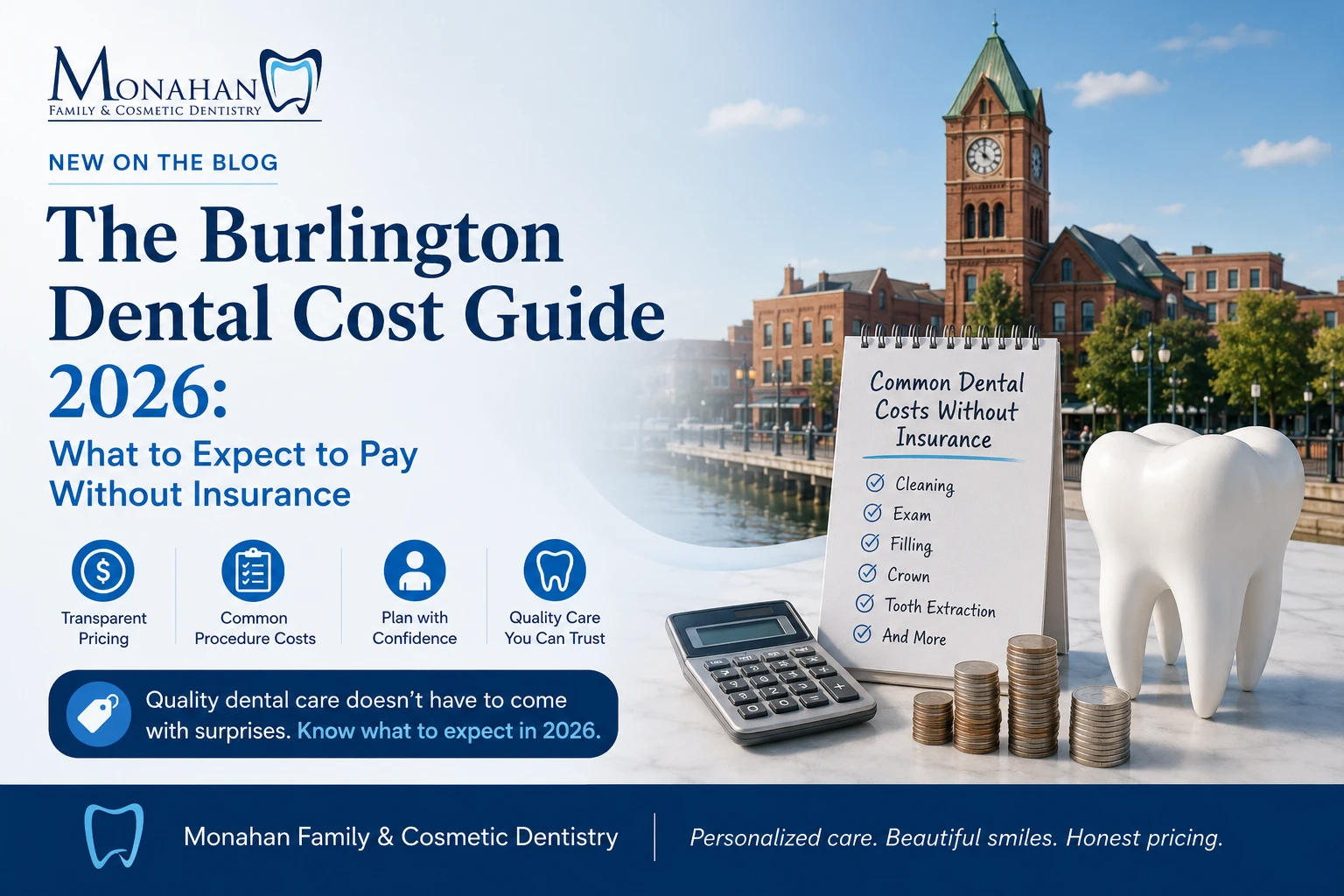
If you do not have dental insurance, dentistry can feel like a guessing game.
You may know you need a cleaning, filling, crown, extraction, or root canal — but you probably do not know what a fair price looks like in Burlington, NC. And most people do not want to call five dental offices just to ask, “How much is this going to cost me?”
Here’s the practical answer.
In Burlington, NC, most uninsured dental patients should expect basic dental care to range from $100–$400 for smaller visits and $1,000–$5,000+ for larger restorative treatment, depending on what is needed. A cleaning may cost a couple hundred dollars. A crown may cost over $1,000. A root canal plus crown may land in the several-thousand-dollar range. A dental implant can cost several thousand dollars by the time the implant, abutment, and crown are included.
Those are not scary numbers. They are planning numbers.
At Monahan Family and Cosmetic Dentistry in Burlington, Dr. Thomas Monahan sees patients from Burlington, Graham, Elon, Mebane, and across Alamance County who are trying to make smart dental decisions without being surprised by the bill. The right question is not just, “What is the cheapest option?” It is, “What do I actually need, what can safely wait, and what will cost me more if I ignore it?”
No Insurance? No Problem.
Call now to discuss dental pricing, payment options, and the care you need.
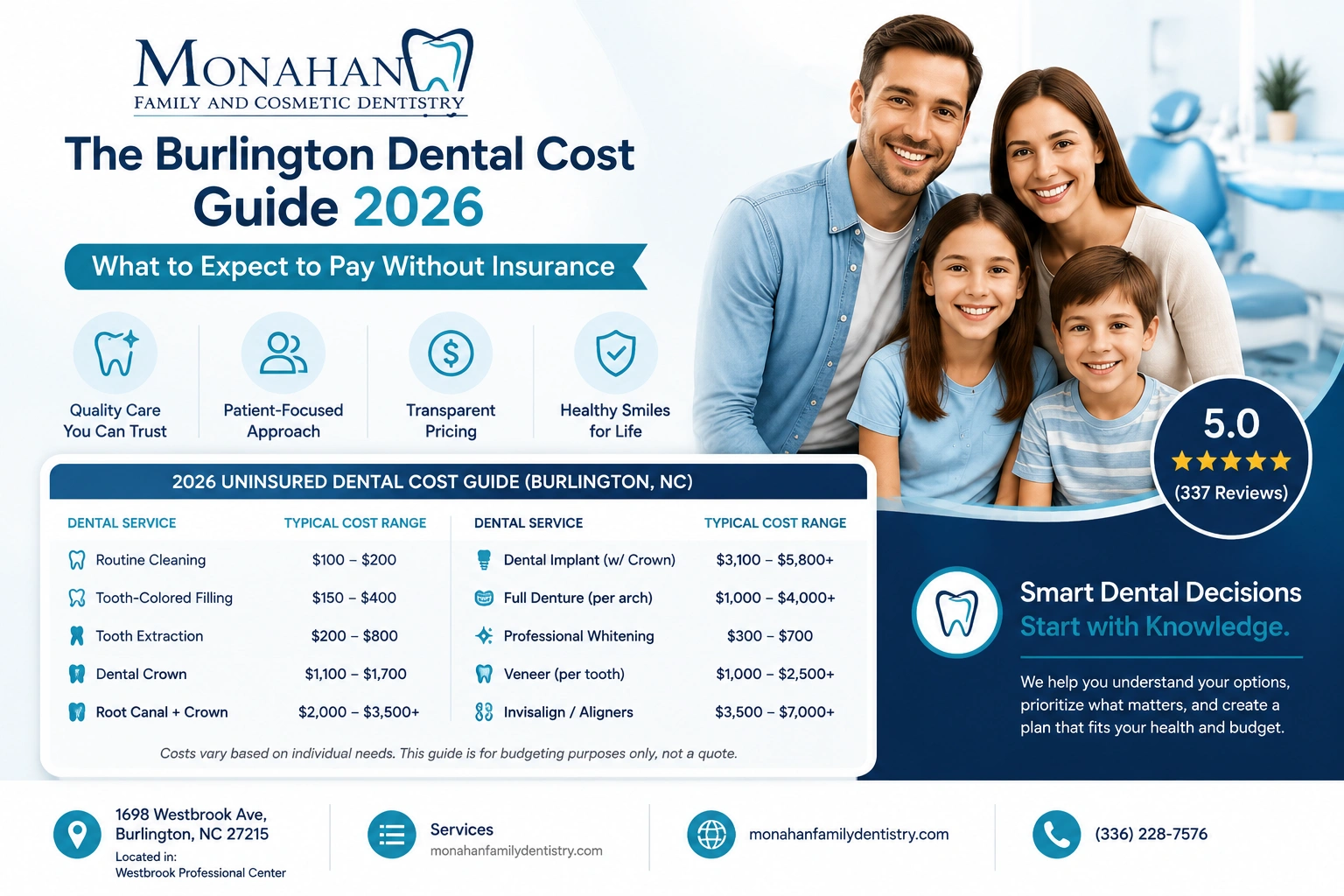
Dental costs in Burlington, NC without insurance: quick price table
These are realistic 2026 planning ranges for common dental procedures before insurance or discount adjustments.
| Dental service | Typical uninsured cost range |
| New patient exam | $100–$250 |
| Dental X-rays | $50–$250 |
| Routine cleaning | $100–$200 |
| Deep cleaning / scaling and root planing | $200–$400+ per quadrant |
| Tooth-colored filling | $150–$400 |
| Tooth extraction | $200–$800 |
| Dental crown | $1,100–$1,700 |
| Root canal | $700–$1,600+ |
| Root canal + crown | $2,000–$3,500+ |
| Full denture | $1,000–$4,000+ per arch |
| Dental implant, abutment, and crown | $3,100–$5,800+ |
| Professional teeth whitening | $300–$700 |
| Veneer | $1,000–$2,500+ per tooth |
| Invisalign / clear aligners | $3,500–$7,000+ |
National dental cost sources show similar ranges for many procedures. Humana lists basic cleanings around $75–$200, composite fillings around $90–$250 for 1–2 teeth, ceramic crowns around $800–$2,000, simple extractions around $75–$250, surgical extractions around $180–$550, and implant-related treatment commonly reaching several thousand dollars.
Delta Dental also offers a ZIP-code-based cost estimator, but it clearly warns that estimates are not guarantees and that actual costs may be higher or lower depending on the dentist, procedure, and benefits involved.
So use this guide as a serious budgeting tool — not a final treatment quote.
Why dental offices do not always give exact prices over the phone
This frustrates people, and understandably so.
But there is a real reason.
A toothache could be a small cavity, cracked tooth, gum abscess, failed crown, infected nerve, sinus-related pressure, or a tooth that cannot be saved. Those are completely different treatments with completely different costs.
A “broken tooth” could need:
- A small filling
- A large filling
- A crown
- A buildup and crown
- A root canal and crown
- An extraction
- An implant or bridge later
That is why a responsible dental office can give you a range, but not always an exact number until Dr. Monahan examines the tooth and reviews X-rays.
The exam is what keeps you from paying for the wrong thing.
The Invisible Identity Shift: How Clear Aligners are Changing More Than Smiles
You know what’s wild? Straightening your teeth without anyone even [...]
Learn More
Preventive dental care costs without insurance
Preventive care is usually the least expensive dental care you will ever buy.
Routine exam and cleaning
A routine cleaning, exam, and basic X-rays may cost roughly $150–$400 total, depending on what images are needed and whether you are a new or existing patient.
A basic cleaning alone often falls around $100–$200. Humana’s dental cost guide lists basic cleaning and polishing at $75–$200.
This is the dental visit people skip when money is tight.
That is also the visit that often catches a $200 filling before it turns into a $2,500 root canal and crown.
Dental X-rays
X-rays may cost anywhere from $50–$250, depending on whether you need bitewings, periapical images, a panoramic X-ray, or a full-mouth series.
X-rays are not just “extra pictures.” They help detect decay between teeth, bone loss, infection, impacted teeth, and problems under old dental work.
Skipping X-rays to save money can mean missing the real issue.
Filling costs without insurance
A dental filling in Burlington commonly costs around $150–$400, depending on the tooth, size of the cavity, number of tooth surfaces involved, and filling material.
Small fillings cost less.
Large fillings cost more.
Back teeth usually cost more than front teeth because they are harder to access and take more chewing force.
Humana lists composite or ionomer fillings around $90–$250 for 1–2 teeth, though real local private-practice fees can vary.
When a filling is the right call
A filling usually makes sense when:
- The cavity is small or moderate
- The tooth still has strong outer walls
- There is no deep crack
- The nerve is healthy
- The tooth does not need full coverage
When a filling is the wrong call
A filling may not be enough if:
- The tooth is cracked
- A large old filling already weakened the tooth
- A cusp has broken off
- Decay is too deep
- There is not enough tooth left to hold the filling
This is where “just patch it” can become expensive.
A large filling on a weak tooth may break, crack the tooth further, or lead to a crown or root canal later.
Dental crown costs without insurance
A dental crown in Burlington commonly costs around $1,100–$1,700 per tooth without insurance.
National ranges are broad. Humana lists metal crowns around $500–$1,500, porcelain-fused-to-metal crowns around $600–$1,800, and ceramic crowns around $800–$2,000 per tooth.
A crown may cost more if the tooth needs a core buildup, if the cosmetic demands are higher, or if additional treatment is needed first.
When a crown is worth the money
A crown may be the smarter long-term choice when:
- A tooth has a very large filling
- A tooth has cracked
- A root canal has been done
- A cusp has broken
- The tooth is structurally weak
- A filling is likely to fail
A crown is not just a cosmetic cap. It protects the tooth from splitting apart.
When a crown may not be necessary
A crown may be overkill if the cavity is small, the tooth is strong, or a more conservative filling or bonding can solve the problem.
A good dentist should be able to explain why a crown is being recommended instead of a filling.
Tooth extraction costs without insurance
At Monahan Family and Cosmetic Dentistry, the published general range for tooth extraction in Burlington is $200–$800, depending on the complexity of the procedure.
That range makes sense because extractions vary a lot.
A simple extraction of a loose or fully erupted tooth is very different from removing a broken tooth, infected tooth, impacted tooth, or tooth with curved roots.
The part patients forget: extraction is not always the final cost
Pulling a tooth may solve pain or infection.
But it leaves a space.
Replacing that missing tooth may require:
- Dental implant
- Bridge
- Partial denture
- Bone graft
- Temporary appliance
So yes, extraction is often cheaper today.
But if the tooth needs to be replaced, it may not be cheaper over the next year.
Root canal costs without insurance
A root canal commonly costs around $700–$1,600+, depending on which tooth is treated.
Front teeth are usually less expensive. Molars are more expensive because they have more canals and are harder to treat.
Humana lists root canal estimates around $500–$1,000 for an incisor and $800–$1,500 for a molar.
A 2026 North Carolina root canal cost estimate from CostWhale places most cases between $450 and $1,620.
The real cost is often root canal plus crown
Here is the part that catches patients off guard.
A back tooth that needs a root canal often also needs a crown afterward. That means the total treatment may be closer to $2,000–$3,500+, especially if a buildup is needed.
The root canal treats the infection.
The crown protects the weakened tooth.
They solve different problems.
Deep cleaning costs without insurance
A deep cleaning, also called scaling and root planing, commonly costs around $200–$400+ per quadrant.
Your mouth has four quadrants.
That means full-mouth gum disease therapy can cost significantly more than a routine cleaning.
Humana lists scaling and root planing around $169–$352 per quadrant.
Why deep cleaning costs more than a regular cleaning
A routine cleaning removes plaque and tartar above the gumline.
A deep cleaning treats bacteria and tartar below the gumline, where gum disease damages bone and tissue support around the teeth.
If you have bleeding gums, loose teeth, deep pockets, heavy tartar, or bone loss, a routine cleaning may not be enough.
This is one of the most common places patients feel confused.
They ask for “just a cleaning,” but clinically they may need gum therapy.
Dental implant costs without insurance
A dental implant replacing one tooth commonly costs around $3,100–$5,800+ when the implant, abutment, crown, and related procedures are included.
Humana cites an ADA Health Policy Institute-based range of $3,100–$5,800 for an implant, abutment, crown, and other necessary procedures.
The price can rise if you need:
- Bone grafting
- Tooth extraction
- Sinus lift
- Temporary tooth replacement
- Custom abutment
- More complex imaging
- Multiple implants
When implants make sense
Implants may be the best choice when you want a fixed replacement that does not rely on neighboring teeth.
They often make sense for patients who want strong chewing function and do not want a removable appliance.
When implants may not be the first move
An implant may not be the right immediate choice if:
- Gum disease is uncontrolled
- Bone support is poor
- Smoking risk is high
- Medical conditions affect healing
- Budget requires a phased plan
- A bridge or partial makes more sense temporarily
Good implant planning is not just about placing a screw.
It is about whether the final tooth will be stable, cleanable, and worth the investment.
Denture costs without insurance
Dentures vary widely.
A full denture may cost anywhere from $1,000–$4,000+ per arch, depending on materials, fit, appearance, extractions, relines, and whether implants are involved.
Humana lists denture ranges from $600–$1,000 for low-cost dentures, $1,000–$3,000 for mid-priced dentures, and $4,000–$8,000 for higher-quality dentures for a full set.
Cheap dentures can be expensive in a different way
A low-cost denture may be fine for some patients.
But cheaper dentures may also mean more movement, sore spots, poorer bite, weaker materials, and more frustration eating.
Dentures are not just teeth in plastic.
They are chewing tools. Fit matters.
Cosmetic dentistry costs without insurance
Cosmetic dentistry is usually not covered by insurance because it is elective.
Common uninsured ranges include:
| Cosmetic service | Typical cost range |
| Professional whitening | $300–$700 |
| Cosmetic bonding | $300–$700 per tooth |
| Veneers | $1,000–$2,500+ per tooth |
| Cosmetic crowns | $1,100–$2,200+ per tooth |
| Invisalign / clear aligners | $3,500–$7,000+ |
Cosmetic treatment costs vary because the goals vary.
Whitening is simple.
A full smile redesign is not.
The more teeth involved, the more planning matters: bite, gumline, tooth shape, shade, spacing, symmetry, and long-term maintenance.
Emergency dental visit costs without insurance
An emergency dental visit may cost around $100–$300+ for the exam and X-ray before treatment.
But the treatment itself could range from a simple filling to extraction, root canal, crown, or infection management.
The most common mistake is waiting until pain becomes severe.
Dental pain rarely gets cheaper with time.
Call quickly if you have:
- Facial swelling
- Fever
- Severe toothache
- Pain when biting
- Broken tooth
- Gum abscess
- Bad taste or drainage
- A crown or filling that fell out
- Pain that wakes you up at night
If swelling affects breathing or swallowing, that is not a normal dental appointment situation. That can be a medical emergency.
Why uninsured dental patients sometimes pay more over time
Dental insurance is not perfect.
But preventive coverage often nudges people to come in sooner.
Without insurance, many patients wait until something hurts. That is understandable, but it is also how small problems become expensive problems.
A common pattern looks like this:
- Small cavity
- Larger cavity
- Tooth sensitivity
- Broken tooth
- Root canal
- Crown
- Extraction if the tooth cannot be saved
The cheapest time to fix a tooth is usually before it hurts.
Not always. But often.
How to lower dental costs without insurance
You still have options.
Ask for a phased treatment plan
Not everything has to be done at once.
A good phased plan separates treatment into:
- Urgent problems
- Disease control
- Stabilization
- Long-term rebuilding
- Cosmetic improvements
This helps you avoid spending money on the wrong thing first.
Ask what can safely wait
Some dental problems can be monitored.
Others should not wait.
Ask directly: “What happens if I wait three months? Six months? A year?”
That question will tell you a lot.
Use HSA or FSA funds if available
If you have a Health Savings Account or Flexible Spending Account, you may be able to use pre-tax dollars for eligible dental expenses. Humana also lists HSA and FSA use as one way to reduce dental cost pressure.
Ask about payment options
Many dental offices offer financing or payment options for larger treatment.
Monahan’s own extraction cost article notes that the office accepts many insurance plans and offers interest-free payment options to make care more manageable.
Even without insurance, it is worth asking what payment options exist before delaying necessary care.
Do not choose only by price
A cheaper filling that fails, a crown that does not fit, or dentures you cannot wear are not savings.
Compare diagnosis, explanation, materials, experience, and follow-up — not just the number.
What dental work should you not delay?
You should not sit on symptoms that suggest infection, fracture, or active disease.
Do not delay care if you have:
- Swelling
- Severe pain
- A broken tooth with exposed inner structure
- A loose adult tooth
- Pus or drainage
- Pain when biting
- A cracked tooth
- Bleeding gums with bad breath and loose teeth
- A lost crown on a sensitive tooth
Waiting on these problems can turn a manageable bill into a much larger one.
What dental work can sometimes wait?
Some things may be less urgent.
That can include:
- Cosmetic whitening
- Small chips with no pain
- Minor spacing concerns
- Replacing older dental work that is still sealed
- Cosmetic veneers
- Monitoring early enamel wear
- Small cavities that are stable and being watched carefully
But “can wait” should come from an exam, not guesswork.
A tooth can look fine and still have decay between the teeth or infection at the root.
The blunt truth about “affordable dentistry”
Affordable dentistry does not always mean the lowest fee.
It means you understand what you are paying for, why it is recommended, what your alternatives are, and what happens if you delay.
A $250 filling that lasts is affordable.
A $250 filling placed on a tooth that needed a crown may not be.
A $1,400 crown on a tooth with a good long-term prognosis may be a smart investment.
A $1,400 crown on a tooth that probably cannot be saved may be wasted money.
This is why diagnosis matters more than price shopping alone.
How Monahan Family and Cosmetic Dentistry helps uninsured patients make better decisions
If you are paying without insurance, you deserve a clear explanation before treatment begins.
At Monahan Family and Cosmetic Dentistry, Dr. Thomas Monahan can help Burlington-area patients understand:
- What treatment is urgent
- What can safely wait
- What each option costs
- Whether there is a lower-cost alternative
- What happens if you delay
- Which option is likely to last longest
- Whether saving the tooth is worth the money
That does not mean every patient needs the most expensive treatment.
It means you should not have to make a dental decision in the dark.
FAQs: Burlington dental costs without insurance
How much is dental cleaning without insurance in Burlington, NC?
A routine cleaning usually costs around $100–$200, with the full visit costing more if an exam and X-rays are needed.
How much is a filling without insurance?
Most fillings cost around $150–$400, depending on the size, tooth location, and number of surfaces involved.
How much is a crown without insurance?
A dental crown commonly costs around $1,100–$1,700 in Burlington. More complex cases can cost more.
How much is a tooth extraction without insurance?
Monahan Family and Cosmetic Dentistry lists tooth extraction in Burlington at about $200–$800, depending on complexity.
How much is a root canal without insurance?
A root canal often costs around $700–$1,600+, depending on the tooth. Molars usually cost more than front teeth.
Why is my dental estimate higher than the online average?
Online averages often leave out X-rays, buildups, crowns, extractions, bone grafting, sedation, or follow-up care. They may also not reflect the complexity of your specific tooth.
Is it cheaper to pull a tooth than fix it?
Usually, yes — at first. But if you later replace the tooth with an implant, bridge, or partial denture, the total cost may be higher than saving the tooth.
Can I go to the dentist without insurance?
Yes. Many patients pay directly, use financing, use HSA/FSA funds, or phase treatment over time.
What is the cheapest way to deal with dental problems?
The cheapest safe approach is usually early diagnosis, preventive care, and treating small problems before they become emergencies.
Should I get dental insurance before having major dental work?
Maybe, but read the fine print. Many plans have waiting periods, annual maximums, exclusions, and limits on major services. Insurance may help, but it may not pay as much as people expect.
Need Dental Care Without Insurance?
Get clear Burlington dental cost guidance and call today to schedule affordable care.