
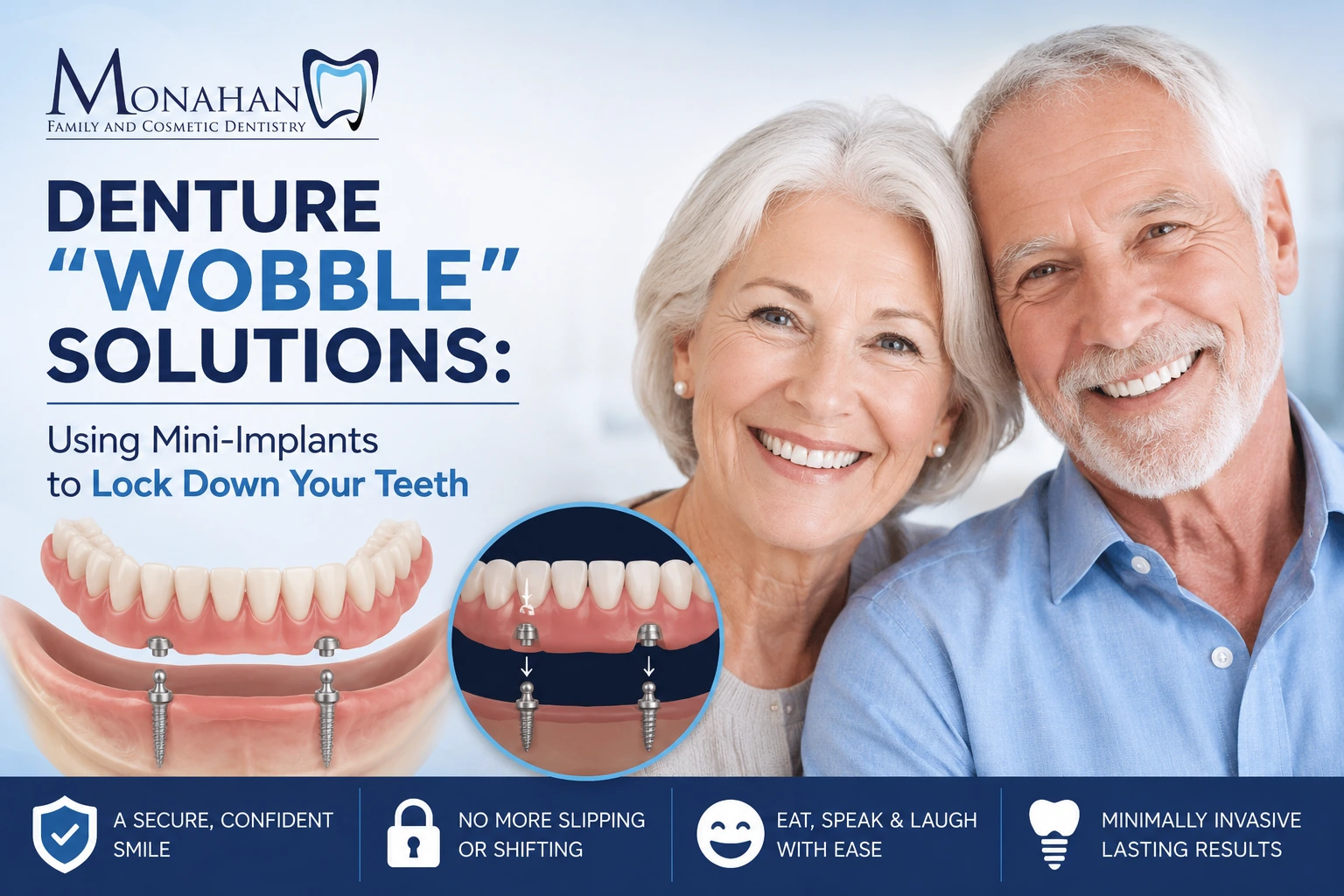
One of the biggest frustrations denture patients have is not appearance.
It is a movement.
The slipping.
The rocking.
The clicking while eating.
The fear of the denture might shift while talking or laughing.
A lot of seniors in Burlington describe the same problem:
“I can’t trust my dentures.”
That is where mini dental implants sometimes become a life-changing upgrade.
At Monahan Family and Cosmetic Dentistry, Dr. Thomas Monahan helps denture patients understand whether mini-implants can improve stability and when they may or may not be the right solution.
Lock Your Dentures in Place
Tired of slipping or shifting dentures? Ask about mini-implants for added stability. Call now.
Why Dentures Start Feeling Loose
Even good dentures can loosen over time.
The biggest reason is bone loss.
After teeth are removed, the jawbone naturally shrinks gradually because it no longer receives stimulation from tooth roots.
The National Institute of Dental and Craniofacial Research explains that bone changes after tooth loss can affect how dentures fit over time.
As the bone changes, dentures may begin to:
- Rock during chewing
- Lift while speaking
- Rub sore spots
- Need more adhesive
- Feel unstable
Many patients assume this is simply unavoidable aging.
It is common — but not always unavoidable.
What Are Mini Dental Implants?
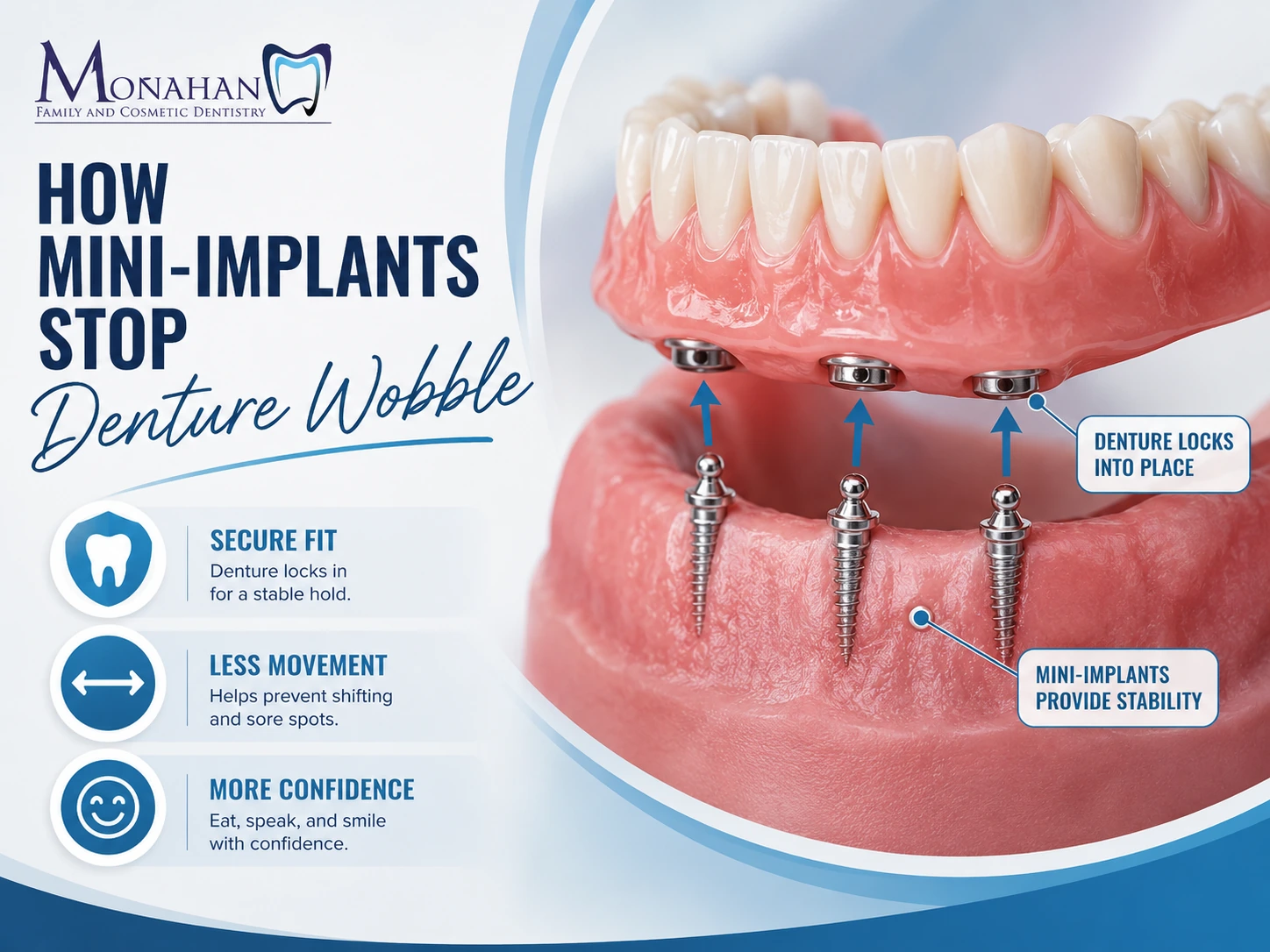
Mini-implants are smaller-diameter implants designed to help stabilize dentures.
Instead of the denture resting entirely on the gums, the denture can “snap” or anchor onto the implants for improved retention.
In simple terms:
The denture becomes more secure because it attaches mechanically instead of relying mostly on suction and adhesive.
Why Patients Like Mini-Implants
Compared with traditional full-size implants, mini-implants may sometimes involve:
- Smaller placement sites
- Less invasive procedures
- Faster healing
- Lower overall cost
- Improved denture stability
For the right patient, even a few small implants can dramatically reduce denture movement.
The Biggest Improvement Is Usually Confidence
Patients often focus on chewing first.
But emotionally, the confidence improvement is often even bigger.
Patients may feel more comfortable:
- Eating in public
- Speaking clearly
- Laughing
- Socializing
- Smiling without fear of movement
That psychological benefit matters more than many people expect.
Are Mini-Implants as Strong as Traditional Implants?
Not exactly.
Traditional implants are usually larger and may provide greater long-term support in certain situations.
Mini-implants are often best viewed as a stabilization solution not necessarily a replacement for every full traditional implant case.
That is why proper evaluation matters.
Who Is Usually a Good Candidate?
Mini-implants may work well for patients who:
- Have loose lower dentures
- Struggle with denture adhesives
- Want more stability
- Have moderate bone availability
- Prefer less invasive treatment
- Cannot tolerate major surgery well
Lower dentures tend to benefit especially because lower dentures are often much harder to keep stable than upper dentures.
Who May Not Be a Good Candidate?
Mini-implants are not ideal for every patient.
Some patients may have:
- Severe bone loss
- Uncontrolled diabetes
- Heavy smoking history
- Significant grinding habits
- Advanced medical complications
- Poor oral hygiene
- Complex bite problems
In some cases, traditional implants or alternative approaches may be better long-term solutions.
The “Cheap Denture Fix” Trap
Patients sometimes see ads promising:
“Permanent teeth in one day!”
This is where expectations need realism.
Mini-implants can improve stability significantly.
But they do not magically recreate natural teeth.
Patients still need:
- Maintenance
- Follow-up care
- Good hygiene
- Periodic denture adjustments
- Realistic chewing expectations
The “Tobacco Reset”: Professional Whitening for Former Smokers in Alamance County
One of the first things many former smokers say after [...]
Learn More
Adhesive Dependency Is Often the Breaking Point
Many denture patients become frustrated not because the dentures completely fail but because daily life revolves around adhesives.
Patients get tired of:
- Reapplying adhesive
- Food getting underneath
- Dentures shifting at restaurants
- Planning meals around denture limitations
Mini-implant stabilization may reduce some of that daily frustration.
The Goal Is Stability, Not Perfection
Most Burlington-area denture patients are not expecting 22-year-old teeth again.
They want:
- Better chewing
- Less movement
- More confidence
- Fewer sore spots
- Less adhesive dependence
- Better quality of life
For the right patient, mini-implants can provide a major functional upgrade without requiring the most aggressive or expensive full-mouth implant reconstruction.
Stop Denture Wobble
Secure your smile with mini-implant support. Call today to explore a more stable fit.