
For some people, the hardest part of going to the dentist isn’t the treatment.
It’s everything that happens before the treatment.
The bright lights.
The sounds.
The smells.
The waiting room.
The uncertainty.
For patients with autism, sensory processing differences, ADHD, anxiety disorders, PTSD, dementia, or other sensory sensitivities, a routine dental appointment can feel overwhelming long before they ever sit in the dental chair.
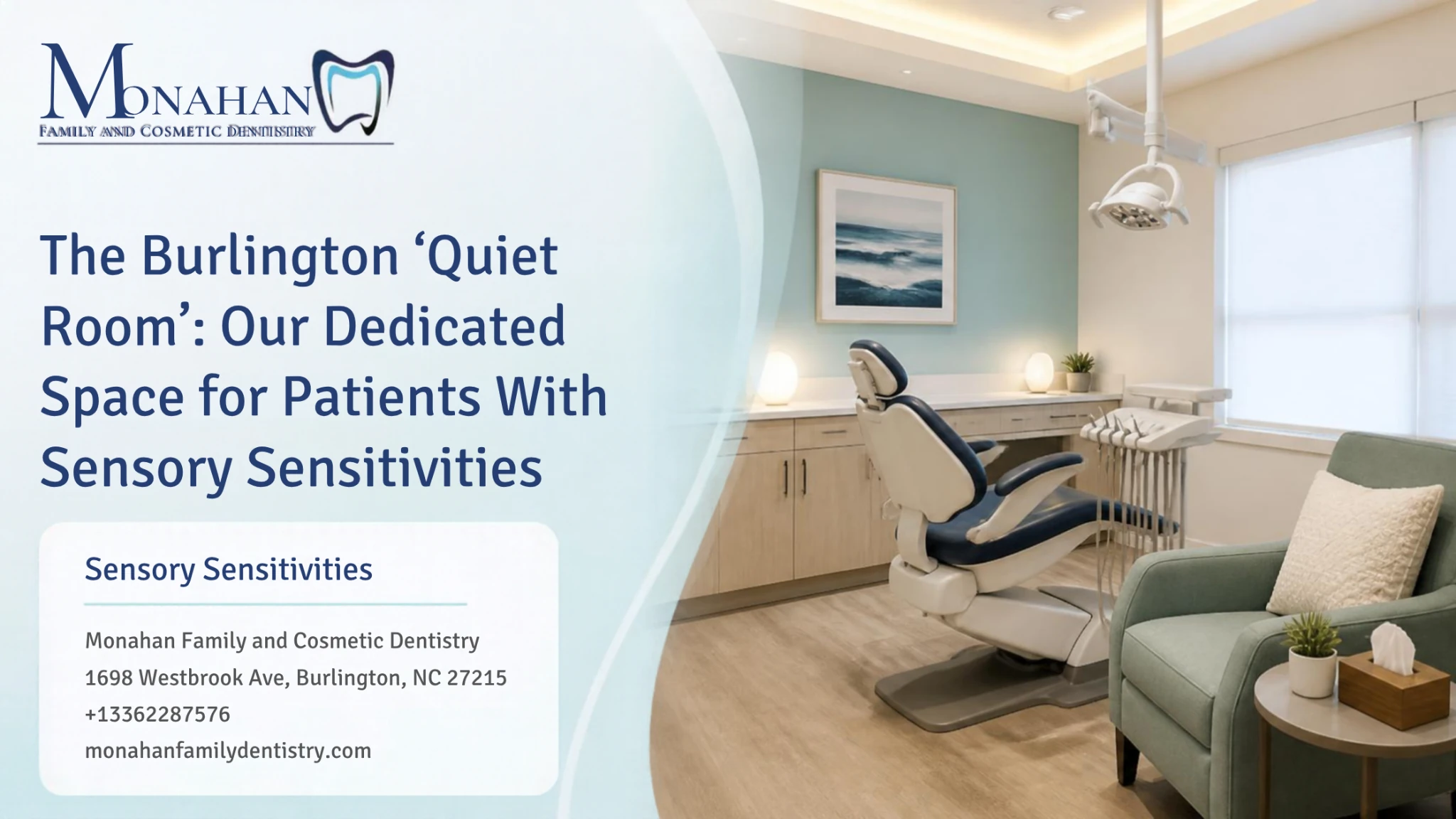
That’s why Monahan Family and Cosmetic Dentistry created a dedicated Quiet Room a calmer space designed to help patients feel more comfortable before and during their visit.
The Short Answer
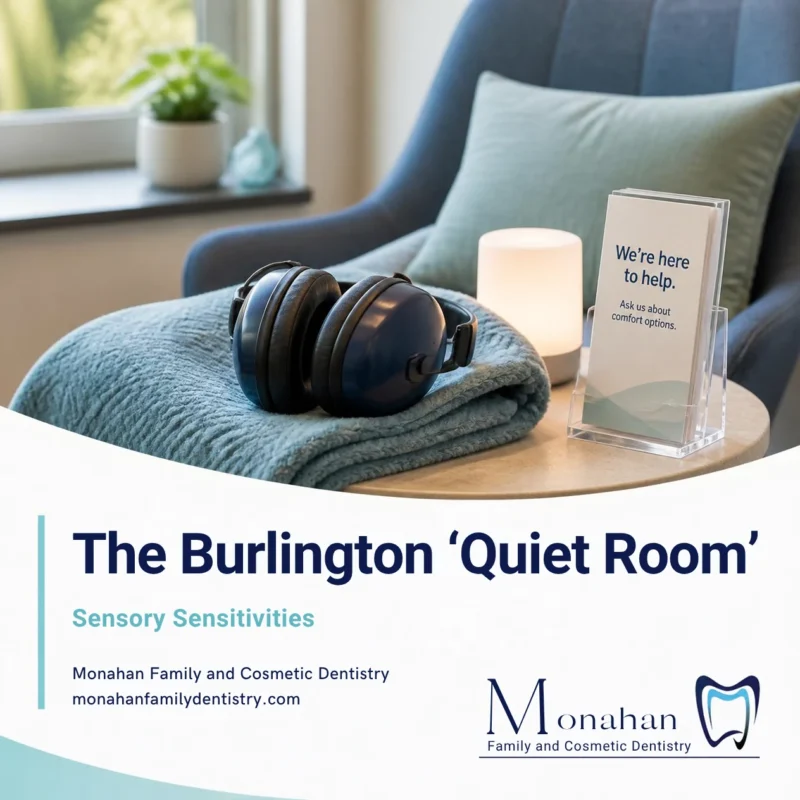
Our Quiet Room is a dedicated area within our Burlington office where patients who are sensitive to noise, stimulation, crowds, or unfamiliar environments can decompress and feel more at ease.
It’s not a treatment room.
It’s not a medical intervention.
It’s simply a quieter, lower-stimulation environment designed to help patients have a better dental experience.
For some patients, that small difference can make a very big impact.
The Problem Most People Don’t See
Many dental offices are designed for efficiency.
And that’s understandable.
But what feels normal to one patient can feel overwhelming to another.
Consider what happens during a typical dental visit:
- New surroundings
- Multiple conversations happening nearby
- Bright overhead lighting
- Dental equipment sounds
- Unfamiliar smells
- Changes in routine
- Anticipation about treatment
For patients with sensory sensitivities, those experiences can stack on top of one another quickly.
The result isn’t simply discomfort.
Sometimes it becomes a barrier to receiving dental care at all.
Who Benefits From a Quiet Room?
Many different patients find value in having access to a lower-stimulation environment.
Patients on the Autism Spectrum
Predictability and reduced sensory input can help create a more comfortable experience.
Patients With Sensory Processing Differences
Some individuals are particularly sensitive to sound, light, touch, or environmental changes.
Patients With Dental Anxiety
Not all anxiety is sensory-related, but a quieter environment can help reduce stress before treatment begins.
Children Who Become Overstimulated
Dental appointments involve a lot of new experiences. Some children simply do better when they have a calm space available.
Adults With PTSD or Trauma Histories
For some patients, reducing environmental stressors can make appointments feel more manageable.
Patients With Dementia or Cognitive Changes
A calmer environment may help reduce confusion and anxiety during visits.
What Actually Matters
When people hear about accommodations like a Quiet Room, they sometimes assume it’s about making patients comfortable.
Comfort is part of it.
But the bigger goal is access.
If sensory challenges prevent someone from getting routine dental care, small accommodations can make the difference between receiving treatment and avoiding the dentist altogether.
That’s what actually matters.
The Honest Truth About Sensory-Friendly Dentistry
A Quiet Room doesn’t solve every challenge.
There are still dental instruments.
There are still lights.
There are still parts of treatment that may feel unfamiliar.
What it can do is help reduce some of the environmental stress before those moments occur.
Sometimes patients need additional accommodations.
Sometimes they don’t.
Every person is different.
Why We Believe This Matters
Good dentistry isn’t just about treating teeth.
It’s about helping people receive care in a way that respects their individual needs.
For some patients, that means explaining treatment thoroughly.
For others, it means scheduling additional time.
And for some, it means providing a quieter place to begin the appointment.
The goal isn’t to treat every patient the same.
The goal is to help every patient receive the care they need.
What Parents Often Tell Us
Parents of children with sensory sensitivities frequently share a similar concern:
“We’re worried about how they’ll handle the appointment.”
That’s a reasonable concern.
Many parents have experienced medical or dental visits that became stressful because the environment itself felt overwhelming.
A quieter space can help ease some of that uncertainty.
The Bottom Line
If you or a family member has sensory sensitivities, dental anxiety, autism, ADHD, PTSD, or simply feels overwhelmed in traditional healthcare environments, you’re not alone.
Many patients need a different approach to feel comfortable receiving care.
At Monahan Family and Cosmetic Dentistry, Dr. Thomas Monahan and our team believe that dental care should be accessible to everyone including patients who benefit from a quieter, lower-stimulation environment. Our dedicated Quiet Room is one way we’re working to make that possible for families throughout Burlington, Graham, Mebane, Elon, and the surrounding Alamance County communities.
Frequently Asked Questions
What is a sensory-friendly dental environment?
A sensory-friendly dental environment seeks to reduce unnecessary stimulation such as noise, bright lighting, and environmental stressors that may overwhelm some patients.
Is the Quiet Room only for children?
No. Patients of all ages may benefit from a quieter environment.
Can I request the Quiet Room before my appointment?
Yes. If sensory accommodations would help you or your family member, let our team know when scheduling.
Does using the Quiet Room change my treatment?
No. It simply provides a more comfortable environment before or during portions of your visit.
Is this only for patients with autism?
Not at all. Patients with anxiety, PTSD, ADHD, sensory processing differences, dementia, and many other conditions may benefit from a lower-stimulation space.