
Most people worry about getting their teeth straight.
Very few people worry about keeping them straight.
Until the braces come off.
Or the Invisalign trays are finished.
And suddenly there’s a small wire glued behind their front teeth.
That’s when many patients discover something nobody really talked about during treatment:
Permanent retainers can be harder to clean.
Not impossible.
Not a bad idea.
Just different.
And if you don’t understand how to care for them, plaque and tartar can start building up in places that never used to be a problem.
The Short Answer
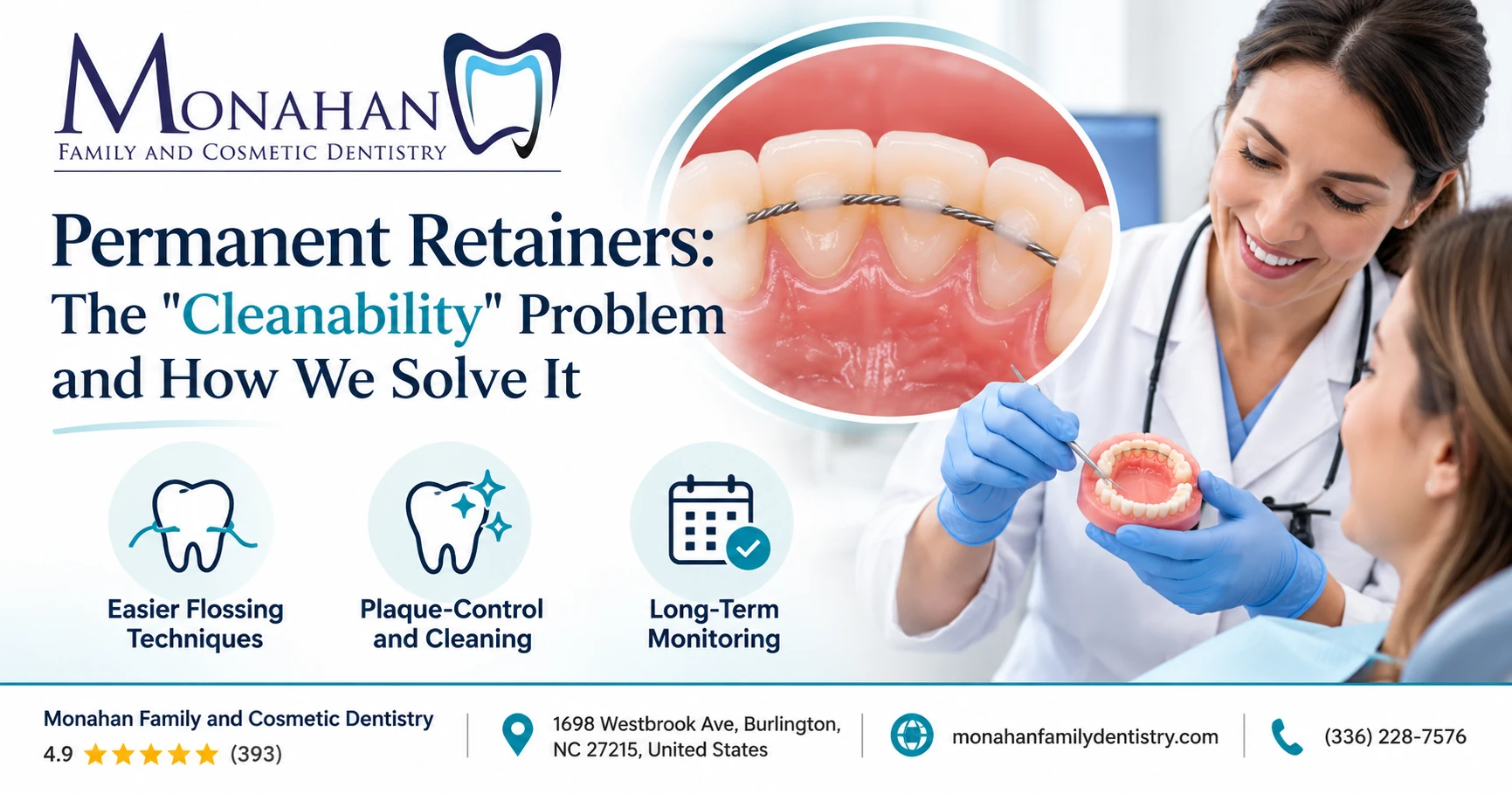
Permanent retainers are thin wires bonded to the back of certain teeth, usually the lower front teeth to help prevent them from shifting after orthodontic treatment.
They’re effective.
But they also create new challenges when it comes to:
- Flossing
- Plaque removal
- Tartar buildup
- Gum health
- Long-term maintenance
The good news?
With the right tools and a few adjustments, most patients do very well.
Why Teeth Move After Braces
This surprises people.
Teeth have a memory.
Even after orthodontic treatment is completed, teeth naturally want to drift back toward their previous positions.
That’s why retention matters.
A beautifully straight smile can begin changing surprisingly quickly if retention is ignored.
Permanent retainers help reduce that risk.
The Problem Nobody Talks About
The issue isn’t the wire itself.
It’s what the wire blocks.
Before the retainer, floss moved freely between teeth.
After the retainer, there’s now a small wire connecting them.
That means traditional flossing becomes more complicated.
Not impossible.
Just less convenient.
And whenever something becomes less convenient, people tend to do it less often.
That’s where trouble starts.
What Happens When Cleaning Gets Neglected
The most common issues we see are:
- Plaque accumulation
- Tartar buildup
- Gum inflammation
- Bleeding during flossing
- Staining around the bonded areas
Notice what’s missing from that list?
The retainer itself usually isn’t the problem.
The cleaning habits around the retainer are.
The Lower Front Teeth Are Already High-Risk
This is what makes permanent retainers particularly important to monitor.
The lower front teeth naturally collect more tartar than many other areas of the mouth.
Why?
Because they’re located near major salivary glands.
That means mineralized plaque can develop more quickly there.
Add a retainer wire to the equation and cleaning becomes even more important.
The Three Tools That Make the Biggest Difference
Most patients don’t need a complicated routine.
They usually need better tools.
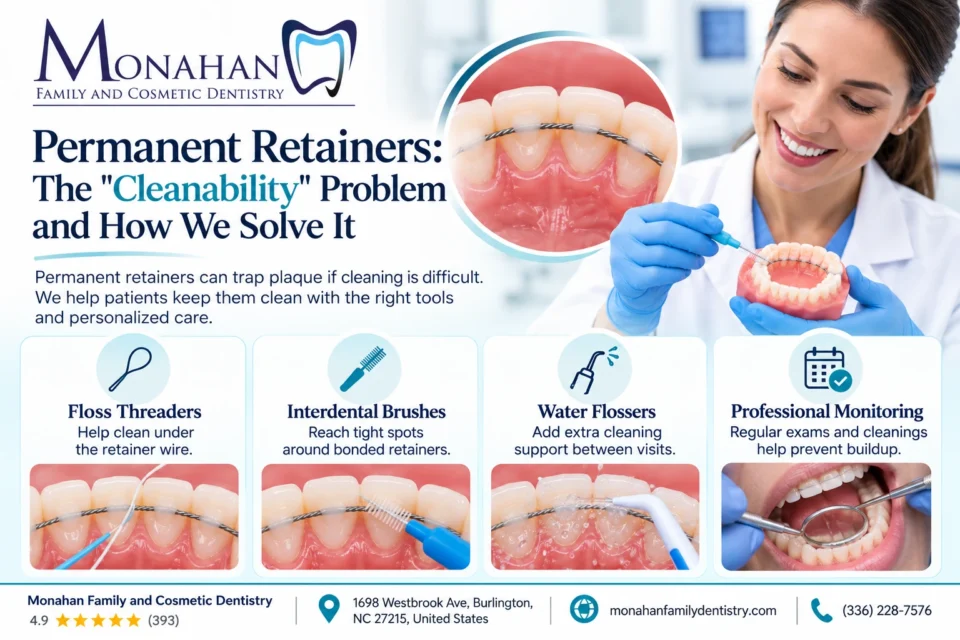
Floss Threaders
These help guide floss underneath the retainer wire.
Think of them as a needle for your floss.
Super Floss
Many patients find specialized orthodontic floss easier to use than standard floss.
Water Flossers
Water flossers can be extremely helpful around permanent retainers.
They’re not necessarily a replacement for traditional flossing, but they can make plaque control significantly easier.
For some patients, this is the game changer.
The Question Patients Ask After Five Years
Usually it sounds like this:
“Do I still need this thing?”
Maybe.
Maybe not.
Every patient is different.
Some retainers remain stable and beneficial for many years.
Others may eventually need repair, replacement, or reevaluation.
The answer depends on:
- Tooth stability
- Orthodontic history
- Gum health
- Retainer condition
- Patient preference
That’s a conversation worth having during routine exams.
The Honest Truth About Permanent Retainers
They’re not truly permanent.
This is one of the biggest misconceptions.
Retainers can:
- Break
- Debond
- Bend
- Wear down
- Require replacement
Many patients assume that if the wire is still attached, everything is fine.
Not always.
A damaged retainer can sometimes allow teeth to move without the patient realizing it.
The Hidden Cost of Ignoring a Broken Retainer
This is where things become expensive.
A small break that goes unnoticed can allow teeth to shift.
Then the patient may need:
- Orthodontic retreatment
- New aligners
- Additional retention appliances
The repair itself is often far easier than correcting tooth movement later.
What We Mean by “Solving the Cleanability Problem”
We don’t eliminate the challenge.
We help patients manage it.
That means:
- Monitoring gum health
- Checking retainer integrity
- Teaching cleaning techniques
- Recommending appropriate tools
- Removing tartar buildup during professional cleanings
The goal is preserving both the retainer and the health of the surrounding teeth.
The Bottom Line
Permanent retainers are one of the most effective tools we have for protecting orthodontic results.
But they come with a tradeoff.
They’re excellent at preventing tooth movement.
They’re not always excellent for easy cleaning.
At Monahan Family and Cosmetic Dentistry, Dr. Thomas Monahan helps patients throughout Burlington, Graham, Mebane, Elon, and Alamance County protect their orthodontic investment while keeping their gums and teeth healthy for the long term. Straight teeth are important. Keeping them clean is just as important.
Frequently Asked Questions
Are permanent retainers difficult to clean?
They can be more challenging than teeth without a retainer, but most patients adapt quickly with the right techniques and tools.
Can I floss with a permanent retainer?
Yes. Specialized floss threaders and orthodontic floss products can help you clean underneath the wire.
Do permanent retainers cause gum disease?
Not directly. However, plaque accumulation around the retainer can increase the risk of gum problems if cleaning is neglected.
How long do permanent retainers last?
Some last for many years, but they can break, loosen, or require maintenance over time.
Is a water flosser worth it?
For many patients with permanent retainers, a water flosser can make daily cleaning significantly easier.