
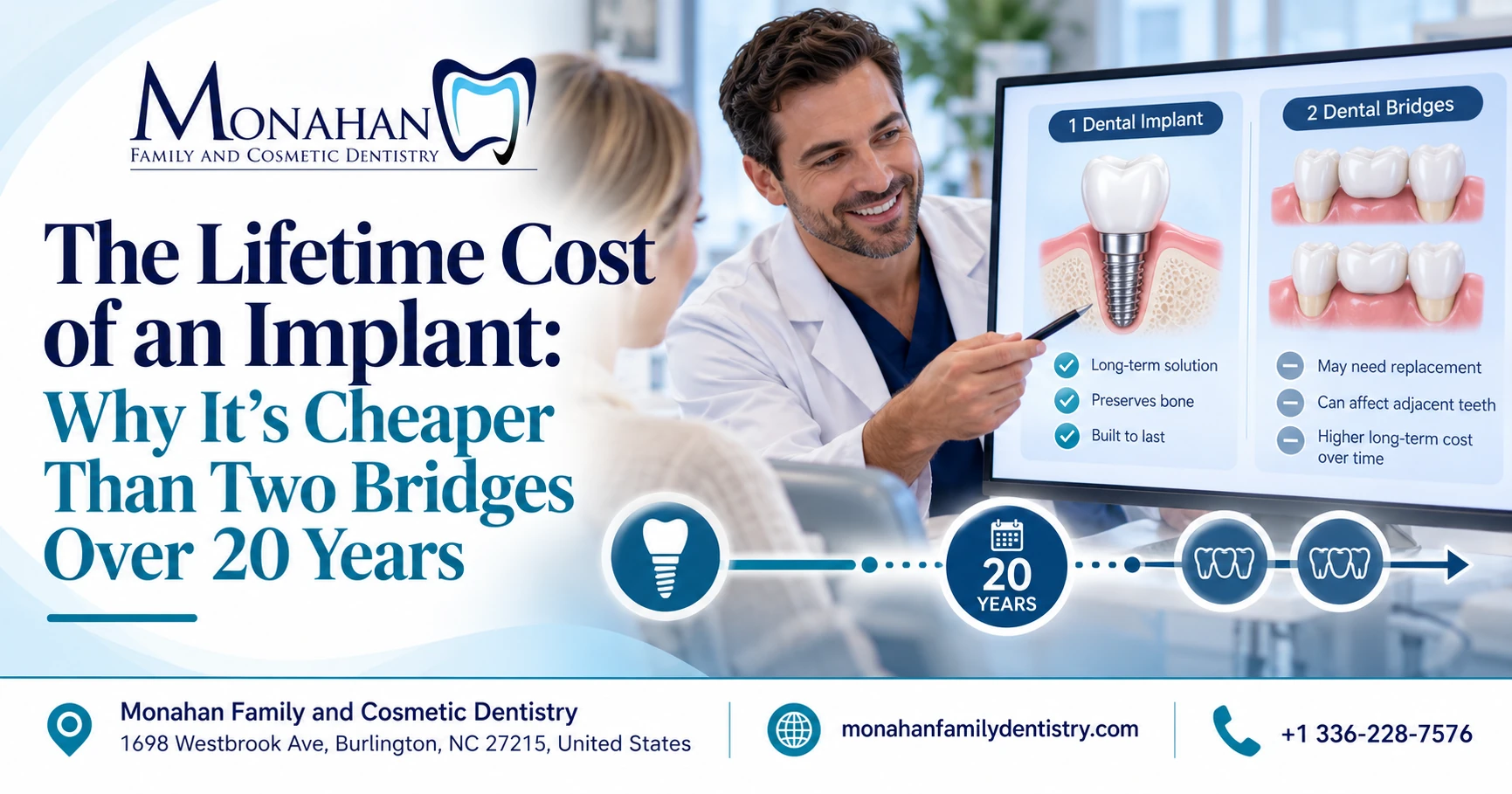
When one tooth is missing, patients usually hear two fixed replacement options:
A dental implant.
Or a dental bridge.
The bridge often looks attractive because treatment is faster and the initial cost may be lower.
But the first bill is not always the best way to compare these treatments.
If you are 45, 50, or 60 years old, the more useful question is:
What is this tooth replacement likely to cost me over the next 20 years?
That changes the conversation.
At Monahan Family & Cosmetic Dentistry, our current Burlington cost guide places a complete single-tooth implant implant, abutment, crown, and related procedures at roughly $3,100 to $5,800+ before insurance, depending on the case.
For comparison, Delta Dental currently reports an average out-of-network cost of about $3,600 for a conventional three-unit dental bridge. CareCredit’s national study places the average traditional bridge higher, at approximately $5,197.
So yes, a bridge can cost less initially.
But suppose that bridge has to be replaced once during a 20-year period.
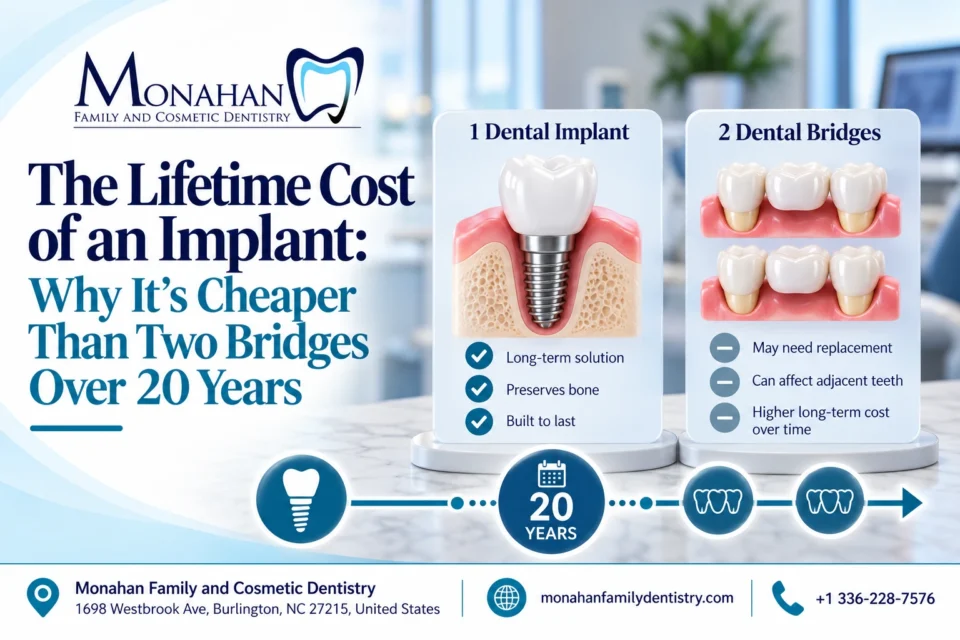
Using today’s $3,600 planning figure, two bridges would total about $7,200 before considering inflation, repairs, root canals, decay, or treatment to the supporting teeth.
At the higher $5,197 national estimate, two bridges would exceed $10,000.
That is where the lifetime economics of an implant become easier to understand.
The implant costs more today in some cases.
But you may be buying a restoration that does not depend on two neighboring teeth and whose implant fixture itself can remain functional for decades.
That can change the long-term math substantially.
Dental Implant vs. Bridge: What Are You Actually Comparing?
A dental implant in Burlington, NC and a traditional bridge both replace a missing tooth.
They do it very differently.
A conventional bridge typically uses the natural tooth on each side of the gap for support.
Those teeth are prepared for crowns.
The two crowns are connected to an artificial tooth in the middle. The three connected units fill the space.
Monahan Family & Cosmetic Dentistry describes a traditional bridge as an artificial tooth supported between crowns placed on the adjacent natural teeth.
An implant does not rely on those neighboring teeth.
Instead, a dental implant is placed in the jawbone to replace the missing tooth root. An abutment and crown are then attached to restore the visible portion of the tooth.
That structural difference is central to the 20-year cost discussion.
With a bridge, you are treating three tooth positions to replace one tooth.
With a single implant, you are primarily treating the missing-tooth site.
How Much Does a Single Dental Implant Cost in Burlington, NC?
Our current 2026 Burlington cost guide gives patients a realistic planning range of approximately $3,100 to $5,800+ for a complete single dental implant when the implant, abutment, crown, and related procedures are included.
That is not a guaranteed quote.
Some patients need relatively straightforward treatment.
Others may need:
- Tooth extraction
- Bone grafting
- Additional imaging
- A custom abutment
- Temporary tooth replacement
- More complex surgery
- Additional healing procedures
Those services can change the final cost.
This is also why very low implant advertisements deserve a closer look.
A low advertised price may refer only to the implant post rather than the entire tooth replacement.
Our Burlington implant-cost guide specifically advises patients to ask whether the quoted amount includes the exam, imaging, implant, abutment, crown, grafting when needed, and follow-up care.
Always compare complete treatment to complete treatment.
A $1,500 “implant” and a $4,500 complete implant restoration may not be remotely comparable quotes.
How Much Does a Traditional Dental Bridge Cost?
Bridge pricing also varies.
Delta Dental’s 2026 cost guide reports an average out-of-network price of approximately $3,600 for a three-unit dental bridge.
CareCredit reports a national average around $5,197, with its study showing a broad range of approximately $4,100 to $9,650 depending on the situation.
Why does replacing one tooth involve three units?
Because a conventional bridge generally includes:
- A crown on the tooth in front of the gap.
- An artificial replacement tooth in the gap.
- A crown on the tooth behind the gap.
That is why a bridge should not be compared with the price of one crown.
It is a multi-unit restoration.
What Happens to the Math Over 20 Years?
This is where patients should stop thinking only about today’s payment.
Consider a simplified example using current planning numbers.
| Treatment scenario | Initial treatment | One replacement | Approximate 20-year treatment total |
| Implant at $4,500 | $4,500 | None assumed in example | $4,500 |
| Bridge at $3,600 | $3,600 | $3,600 | $7,200 |
| Bridge at $5,197 | $5,197 | $5,197 | $10,394 |
This is not a promise that your implant will never require maintenance.
It is also not a prediction that every bridge will fail after 10 years.
It is simply the financial scenario described in the title:
What happens if you buy two bridges over a 20-year period instead of one implant-based tooth replacement?
Under that scenario, the implant can be substantially less expensive over time.
And the bridge totals above do not include inflation.
They also do not include treatment that may become necessary on either supporting tooth.
Do Bridges Really Need to Be Replaced Every 10 Years?
No.
This is important.
You will sometimes hear statements such as, “Bridges last 10 years.”
That is too simplistic.
Some bridges fail earlier.
Some function for much longer than 10 years.
Research has shown good long-term performance for conventional tooth-supported bridges. One systematic review estimated approximately 89.2% survival after 10 years for conventional fixed dental prostheses.
A long-term study following short-span fixed bridges reported an estimated survival of about 70.8% at 20 years.
Another study following bridges for 7 to 19 years estimated survival at approximately 90.4% after 10 years and 80.5% after 15 years. However, the probability of remaining completely free of complications declined substantially over time.
So a bridge should not be treated as a disposable 10-year product.
But neither should patients assume the first bridge will unquestionably last the rest of their lives.
That uncertainty belongs in the financial decision.
Do Dental Implants Really Last 20 Years?
Many can.
But there are two different pieces that patients often lump together as “the implant.”
There is the implant fixture in the bone.
Then there is the crown attached to it.
Those parts do not necessarily have identical lifespans.
A systematic review of single implants with at least 10 years of follow-up reported implant survival around 95% at the implant level. The survival rate of the original implant crowns was lower, around 89.5%, meaning some crowns had been replaced even though the underlying implants remained functional.
This distinction matters enormously.
An implant crown can chip, wear, loosen, or eventually require replacement.
That does not necessarily mean you are starting the entire implant process again.
In many cases, the implant fixture may remain integrated while the restoration above it is repaired or replaced.
So an honest 20-year implant calculation should allow for maintenance.
“Implants last forever” is not responsible advice.
Why Can a Bridge Become More Expensive Over Time?
Replacement of the bridge itself is only part of the issue.
A traditional bridge depends on the teeth supporting it.
Dentists call these abutment teeth.
If one of those teeth develops a serious problem, the entire bridge can be affected.
Decay can develop around supporting teeth
Bridge-supporting teeth remain natural teeth.
They can still develop decay.
Research examining long-term tooth-supported fixed prostheses has identified caries as an important biological complication and cause of failure.
If decay develops beneath one bridge retainer, treatment can become more complicated than replacing a small filling.
A supporting tooth may need a root canal
A bridge requires the supporting teeth to carry additional restorative work.
Long-term studies of bridges report endodontic complications among the potential reasons additional treatment becomes necessary.
That does not mean bridges cause every future root canal.
It means the health of the supporting teeth becomes part of the bridge’s long-term prognosis.
A supporting tooth can fracture
Natural teeth can crack.
Roots can fracture.
If a critical abutment tooth can no longer support the bridge, the restorative plan may need to change completely.
That is where a seemingly inexpensive replacement can become a much larger dental project.
The Hidden Cost of Cutting Down Two Healthy Teeth
This is one of the biggest differences between an implant and a traditional bridge.
A conventional bridge generally requires preparation of the teeth beside the missing space.
That involves removing tooth structure so crowns can fit over them.
If those teeth already need crowns because they contain large fillings, fractures, or other damage, this may not be much of a disadvantage.
In fact, a bridge can be an excellent option.
But imagine both neighboring teeth are completely healthy and unrestored.
You are now preparing two healthy teeth to replace the one that is missing.
That does not automatically make the bridge wrong.
It does change the long-term equation.
An implant can replace the missing tooth without depending on adjacent natural teeth for support. Monahan’s implant guidance highlights this independence from neighboring teeth as one of the major differences between implant and bridge treatment.
That is a value that does not show up on the first estimate.
What About Bone Loss After Losing a Tooth?
Natural tooth roots transfer forces into the jawbone.
When a tooth disappears, that stimulation changes and the bone in the area can gradually resorb.
Dental implants differ from tooth-supported bridges because the implant fixture sits within the jawbone and functions as a replacement root structure.
Monahan’s current implant information identifies maintenance of jawbone support as one of the benefits of implant-based tooth replacement.
A conventional bridge fills the visible gap.
It does not place a replacement root into the missing-tooth site.
This is another reason dentists sometimes recommend implants even when the initial fee is higher.
The treatment objectives are not completely identical.
When Is a Bridge Actually the Better Financial Choice?
Implants are not always the winner.
A bridge can make excellent financial and clinical sense.
A bridge may be the better choice when the neighboring teeth already need crowns
Suppose the tooth on each side of the gap already has a large failing filling and needs a crown.
Preparing those teeth for a bridge is very different from cutting down two untouched healthy teeth.
You may already need to pay for crowns on those teeth.
A bridge can solve several problems at once.
A bridge may make sense when implant surgery is not advisable
Implant placement requires adequate healing and appropriate bone and gum conditions.
Our current implant guidance notes that uncontrolled gum disease, inadequate bone, smoking risk, certain medical considerations, or the need to phase treatment financially can affect whether implant therapy makes sense immediately.
A bridge may be faster
Implants require a biological healing process.
A conventional bridge can often be completed more quickly because there is no need to wait for an implant to integrate with bone.
For a patient who needs a fixed replacement quickly, that can matter.
Insurance may change the decision
Dental benefit plans do not all cover implants and bridges in the same way.
One treatment can have a higher sticker price but a lower out-of-pocket cost because of your particular benefits.
Always compare your actual estimated responsibility, not just the office fee.
When Does the Implant Usually Have the Stronger Long-Term Case?
A single-tooth dental implant deserves serious consideration when:
- The teeth beside the gap are healthy.
- There is adequate bone or grafting is predictable.
- Gum health is controlled.
- The patient can heal appropriately.
- Long-term fixed tooth replacement is the priority.
- Avoiding preparation of neighboring teeth matters.
- The patient is willing to accept the higher initial investment and longer treatment timeline.
The financial advantage becomes especially relevant for younger and middle-aged adults.
If someone expects to use the restoration for another 20, 30, or 40 years, replacement cycles matter more than they do for a very short planning horizon.
The 20-Year Comparison Should Include Repairs, Not Just Replacement
A realistic lifetime-cost discussion needs another layer.
Neither treatment is maintenance-free.
An implant may eventually require:
- Replacement of the implant crown
- Tightening or replacement of a component
- Treatment for inflammation around the implant
- Bite adjustments
- Repair of chipped restorative material
A bridge may eventually require:
- Recementation
- Repair
- Root canal treatment on an abutment
- Treatment of decay
- Replacement of the entire bridge
- Treatment or extraction of a failed supporting tooth
Research on both implants and tooth-supported bridges shows that survival is not the same thing as being completely complication-free.
A restoration can technically still be “surviving” while requiring additional treatment along the way.
That is why lifetime-cost estimates should be viewed as planning models rather than guarantees.
Is the Cheapest Option Today Actually the Cheapest Option?
Sometimes.
But not always.
Suppose your choices are:
Option A: $3,600 bridge today.
Option B: $4,500 implant today.
If both treatments perform perfectly for 20 years, the bridge wins financially.
You spent $900 less.
Now change one assumption.
Suppose the bridge requires replacement once.
You have now spent roughly $7,200 at today’s pricing.
The implant that originally looked $900 more expensive is now $2,700 cheaper in this simplified example.
That is the lesson.
Long-term dentistry is highly sensitive to how many times you have to pay for treatment.
A cheaper treatment performed twice can cost much more than a more expensive treatment performed once.
Don’t Forget Inflation
The simple examples above intentionally use today’s dollars.
Real life is less friendly.
If a $3,600 bridge needs replacement 12 or 15 years from now, there is no reason to assume the replacement will still cost $3,600.
Dental laboratory costs change.
Materials change.
Staff costs change.
Insurance benefits change.
Inflation changes prices.
Nobody can responsibly predict the exact Burlington price of a bridge in 2041 or 2046.
But assuming that future treatment will cost exactly what it costs today probably understates the financial risk of replacement.
The Best Treatment Is Not Decided by a Spreadsheet
This may sound strange in an article about lifetime cost.
But it matters.
You should not choose an implant solely because a 20-year spreadsheet says it might save money.
And you should not choose a bridge solely because it costs less next month.
The dentist needs to evaluate:
- The health of neighboring teeth
- Bone volume
- Gum health
- Bite forces
- Location of the missing tooth
- Medical history
- Smoking or nicotine use
- Esthetic requirements
- Timing
- Financial constraints
- Your willingness to undergo surgery
- Your long-term priorities
The cheapest appropriate treatment and the cheapest treatment are not always the same thing.
How to Compare Your Implant and Bridge Quotes Correctly
Before making the decision, ask for complete estimates.
For the implant, determine whether the quote includes the implant placement, abutment, final crown, imaging, grafting if needed, extraction if required, temporary replacement, and follow-up care.
For the bridge, determine whether the number represents the complete three-unit bridge, temporary bridge, laboratory work, preparation, and final placement.
Then ask one question that rarely appears on a treatment estimate:
“What happens financially if this treatment has to be replaced in 10 or 15 years?”
Your dentist cannot predict the future.
But that question forces the discussion beyond today’s deductible.
A Missing Tooth Is a 20-Year Decision, Not a One-Day Purchase
At Monahan Family & Cosmetic Dentistry, we believe patients considering dental implants in Burlington, NC deserve to understand both the upfront fee and the long-term tradeoffs.
Dr. Thomas Monahan and our Burlington team provide implant and bridge options for patients from Burlington, Graham, Elon, Mebane, and throughout Alamance County. Our practice currently offers single implants, traditional dental bridges, and implant-supported options.
If the teeth beside your missing tooth are healthy, an implant may offer an important long-term advantage because those teeth do not have to become supports for the replacement.
If the neighboring teeth already need crowns, a conventional bridge may make considerably more sense.
And if finances, bone health, medical considerations, or timing make an implant inappropriate today, that should be discussed openly.
Our goal is not to tell every patient that an implant is automatically better.
It is to answer the question that matters:
Which option gives you the best combination of health, function, predictability, and total cost over the years you expect to use it?
If you are comparing an implant with a bridge, contact Monahan Family & Cosmetic Dentistry for an evaluation and a clear treatment estimate.
Bring your insurance information.
Ask about the complete cost.
Then make the decision using more than the first number on the page.
Frequently Asked Questions About Dental Implant vs. Bridge Costs
Is a dental implant cheaper than a bridge?
Not necessarily at the beginning.
Our Burlington cost guide places a complete single implant at roughly $3,100 to $5,800+, while Delta Dental reports about $3,600 as the average out-of-network price for a three-unit conventional bridge.
The implant can become less expensive over a longer period if the bridge has to be replaced.
How much would two dental bridges cost over 20 years?
Using Delta Dental’s current $3,600 average, purchasing two bridges would total approximately $7,200 in today’s dollars.
Using CareCredit’s $5,197 national average would put two bridges at approximately $10,394.
Actual future fees will differ.
Does every dental bridge need replacement after 10 years?
No.
Research shows many bridges continue functioning beyond 10 years. Studies have reported survival around 89% to 90% at 10 years, with some bridges functioning for 15 to 20 years or longer.
Ten years should be viewed as a planning horizon, not an expiration date.
Can a dental implant last 20 years?
Yes, many implants can function for decades.
Ten-year research on single implants has shown implant-level survival around 95%. However, the crown attached to the implant may eventually need repair or replacement even when the implant fixture remains healthy.
Does an implant damage neighboring teeth?
A single implant generally does not require neighboring teeth to be prepared as supports.
That is one of its main differences from a conventional bridge.
Is a bridge bad for healthy teeth?
Not necessarily.
Traditional bridges are established and effective treatments.
The tradeoff is that the neighboring teeth normally must be prepared for crowns. If those teeth already need crowns, that may be a very reasonable treatment plan.
Which is better if the teeth beside the gap are already crowned?
A bridge may become much more attractive in that situation.
The advantage of avoiding preparation of untouched neighboring teeth is reduced if those teeth already require substantial restorative treatment.
Your dentist needs to assess their prognosis first.
Does insurance usually cover implants or bridges?
Many plans provide benefits for tooth replacement, but coverage varies significantly.
Deductibles, annual maximums, waiting periods, replacement clauses, missing-tooth provisions, and network agreements can all affect what you actually pay.
Ask for a benefits estimate for both options.
What is the biggest financial mistake when replacing a missing tooth?
Comparing only the initial payment.
Instead, compare the expected cost of the treatment, maintenance, possible replacement, and treatment to neighboring teeth over the period you expect to use the restoration.
For a 20-year decision, today’s lowest price is only the beginning of the calculation.