
It usually does not happen during anything dramatic.
You are not chewing ice.
You did not get hit in the face.
You did not bite into a bone.
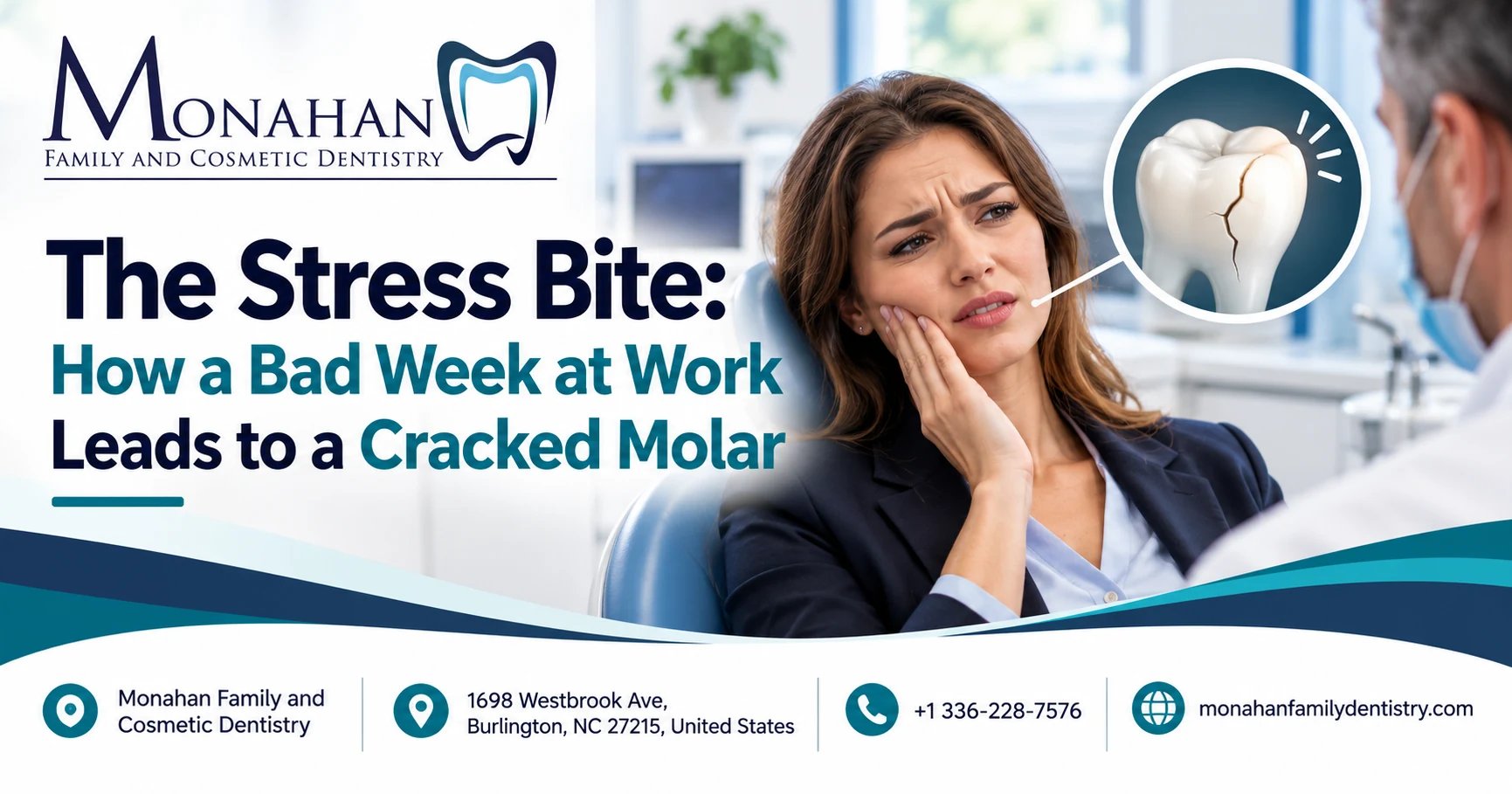
You are eating lunch after a miserable week at work, bite down on something ordinary, and suddenly feel a sharp pain in your back tooth.
Then the pain disappears.
You try again.
There it is.
That pattern often makes people ask:
“How did I crack a tooth eating something soft?”
The answer may have started days or years before that bite.
Stress can increase clenching and grinding. Dentists call that bruxism. Mayo Clinic notes that awake bruxism can be associated with stress, anxiety, anger, frustration, tension, and even intense concentration. More severe bruxism can contribute to flattened, chipped, fractured, or damaged teeth.
But there is an important distinction.
A bad week at work usually does not take a perfectly healthy molar and suddenly split it in half.
More often, repeated biting pressure is acting on a tooth that already has a weak point.
Maybe there is a large filling.
Maybe the tooth has been worn down for years.
Maybe a cusp already contains a microscopic crack.
Maybe you have been clenching every night without knowing it.
Then stress adds more force.
Eventually, an ordinary bite becomes the final event.
At Monahan Family & Cosmetic Dentistry, that is why we care about both sides of the problem:
Why did the tooth crack?
And:
Can we prevent the next one from doing the same thing?
Can Stress Really Crack a Tooth?
Indirectly, yes.
Stress itself does not physically fracture enamel.
The behavior associated with stress can.
When some people become tense, they press their teeth together.
Others grind.
Some clench while sleeping.
Others do it while reading email, driving, preparing a presentation, or sitting through an uncomfortable meeting.
Mayo Clinic identifies extra stress and anxiety as factors that can increase teeth grinding and clenching.
The American Dental Association also saw this pattern on a large scale during the pandemic. In a 2021 Health Policy Institute survey, more than 70% of responding dentists reported seeing an increase in grinding and clenching, while more than 60% reported increases in chipped and cracked teeth.
That survey does not prove stress caused every fracture.
It does show that dentists were seeing more of these problems during a period of unusually high stress.
The relationship makes clinical sense.
More clenching means more repeated force on teeth.
And weak teeth do not always announce themselves before they fail.
Why Does a Molar Crack Instead of a Front Tooth?
Molars handle heavy chewing loads.
Every time you bite, the back teeth absorb significant force.
That normally is not a problem.
Teeth are built for chewing.
The problem begins when the tooth is already structurally compromised.
Large fillings can weaken the remaining tooth
Imagine a molar with a large filling occupying much of the center.
The filling may be stable.
But the natural tooth walls around it are thinner than they once were.
Those remaining cusps flex under pressure.
Over years of chewing and clenching, one can eventually fracture.
Monahan’s current Burlington cost guide specifically notes that a large old filling can leave a tooth structurally weak enough that a filling may no longer be the right repair.
Previous dental work changes how force moves through the tooth
A root-canal-treated tooth may need additional protection because the tooth has often lost significant structure from decay, previous fillings, and treatment.
An old crown can also experience years of heavy loading.
Dental work is designed to restore function.
It does not make a tooth indestructible.
Existing cracks can grow
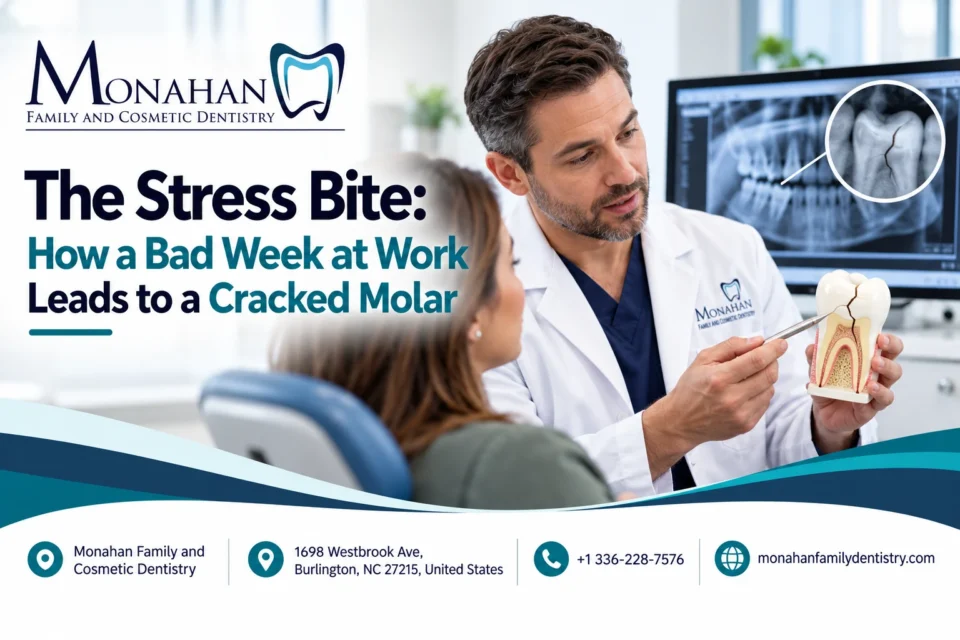
The American Association of Endodontists explains that cracked teeth can develop from wear and tear and that cracks may progressively extend deeper into the tooth. Unlike a broken bone, a tooth crack does not heal itself.
That means a tooth may tolerate years of force before symptoms begin.
A stressful week may simply be when the crack finally starts moving enough to hurt.
What Does Stress Clenching Actually Do to Your Teeth?
Clenching is different from ordinary chewing.
When you eat food, the teeth contact, separate, and move through a normal chewing cycle.
With clenching, the teeth may remain pressed together for extended periods.
There is no food cushioning the force.
Your jaw muscles are simply loading one tooth against another.
The force can concentrate on one vulnerable cusp
If one molar has a large filling or unusual bite contact, it may receive more stress than surrounding teeth.
That does not guarantee it will crack.
But repeated loading can become part of the problem.
Restorations can break too
Grinding does not only affect natural enamel.
Mayo Clinic notes that severe bruxism can damage fillings, crowns, and other dental restorations.
Patients sometimes say:
“My crown broke, so the crown must have been bad.”
Sometimes a restoration does fail because of a material or fit problem.
But sometimes the restoration has been taking unusually heavy force every night.
That difference matters when deciding how to prevent another failure.
How Do You Know Whether You Are Clenching?
Many patients genuinely do not know.
Sleep grinding happens while you are unconscious.
Awake clenching can become such an automatic habit that you stop noticing it.
Morning jaw soreness
If you wake with tired or tight jaw muscles, that can be a clue.
Temple headaches
Mayo Clinic lists dull headaches beginning near the temples among symptoms associated with bruxism.
Flattened or shortened teeth
Years of grinding can gradually wear the biting surfaces down.
The change may happen so slowly that you never notice until a dentist compares the teeth over time.
Chipped edges
Repeated forces can contribute to small chips or fractures.
Monahan’s chipped-tooth guidance specifically lists grinding and clenching among potential causes of tooth damage.
Your teeth are touching while you work
Check right now.
Are your teeth firmly together?
If you are not eating or swallowing, they generally do not need to remain tightly clenched.
People often discover their daytime habit only after becoming intentional about checking it.
What Does a Cracked Molar Feel Like?
This is where cracked teeth become frustrating.
They do not always hurt continuously.
The American Association of Endodontists describes one of the classic symptoms as erratic pain while chewing, sometimes especially when releasing biting pressure. Temperature sensitivity can also occur.
That creates a common pattern.
You bite a sandwich.
Sharp pain.
You stop.
The pain disappears.
You eat dinner on the other side.
No problem.
The next morning the tooth feels normal.
So you decide to wait.
Then three days later you bite a nut and the pain returns.
Sharp pain when biting deserves attention
AAE guidance identifies sharp biting pain as something that may result from a cracked tooth, decay, a loose filling, or damage to the pulp inside the tooth.
In other words, the symptom does not tell us exactly what is wrong.
It tells us the tooth should be examined.
Can a Cracked Molar Still Be Saved?
Often, yes.
The outcome depends primarily on how far the crack extends.
Fractured cusp
Sometimes a cusp breaks away around a filling.
The AAE notes that fractured cusps often do not damage the pulp and may be restored with a new filling or crown.
This can be one of the more favorable outcomes.
Crack extending into the tooth
If the crack extends from the chewing surface toward the root but has not divided the tooth, early treatment may help preserve it.
A crown is often used to hold and protect the remaining tooth structure.
Crack reaches the pulp
If the pulp becomes irreversibly damaged, root canal treatment may be required before the crown.
The root canal treats the damaged or infected pulp.
The crown protects the weakened tooth.
Those procedures solve different problems.
Crack extends too far below the gumline
This is the outcome we are trying to avoid.
The AAE explains that a crack extending below the gumline may make the tooth non-restorable, meaning extraction may be necessary.
This is why waiting on biting pain is not always harmless.
The tooth crack will not knit itself back together.
How Much Does a Stress-Damaged Molar Cost to Fix in Burlington?
The cost depends on where the problem is caught.
Monahan’s current 2026 Burlington cost guide gives useful uninsured planning ranges.
Smaller filling: approximately $150–$400
If the tooth has a limited defect and remains structurally strong, a filling may sometimes be appropriate.
But placing another large filling into an already weakened tooth simply because it is cheaper can become expensive later.
Crown: approximately $1,100–$1,700
A crown may make sense when a tooth has cracked, a cusp has broken, or a large filling has left too little strong tooth structure.
Monahan currently places many Burlington crowns in the $1,100–$1,700 planning range before insurance.
Root canal plus crown: approximately $2,000–$3,500+
If the crack damages the pulp, treatment can become substantially more expensive.
Monahan’s current guide places root canal therapy around $700–$1,600+, with root canal plus crown treatment commonly reaching $2,000–$3,500+.
Extraction: approximately $200–$800 before replacement
If the tooth cannot be saved, extraction may cost roughly $200–$800, depending on complexity.
But pulling the tooth may only be the first bill.
Implant replacement: approximately $3,100–$5,800+
If you choose to replace a lost molar with an implant, Monahan’s current guide gives a planning range around $3,100–$5,800+ for an implant, abutment, crown, and related procedures.
That progression explains the financial importance of early diagnosis.
A tooth that can still be protected by a crown is a very different problem from one that has split beyond repair.
Should You Put a Crown on Every Tooth With a Crack?
No.
“Cracked” is not one diagnosis.
Some enamel craze lines are superficial and need no restorative treatment.
A tiny chip may need smoothing or bonding.
A fractured cusp may need a filling or crown.
A deeper structural crack may need full coverage.
Monahan’s current crown guidance makes the same point: a crown can be worthwhile when a tooth is structurally weak, cracked, heavily filled, or has lost a cusp, but it can be excessive when the tooth remains strong enough for a more conservative restoration.
You should be able to ask:
“Why does this tooth need a crown instead of a filling?”
And receive a clear answer.
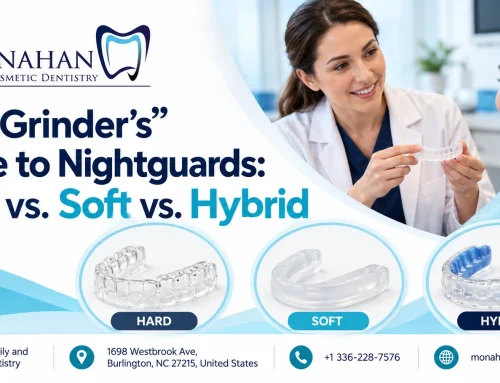
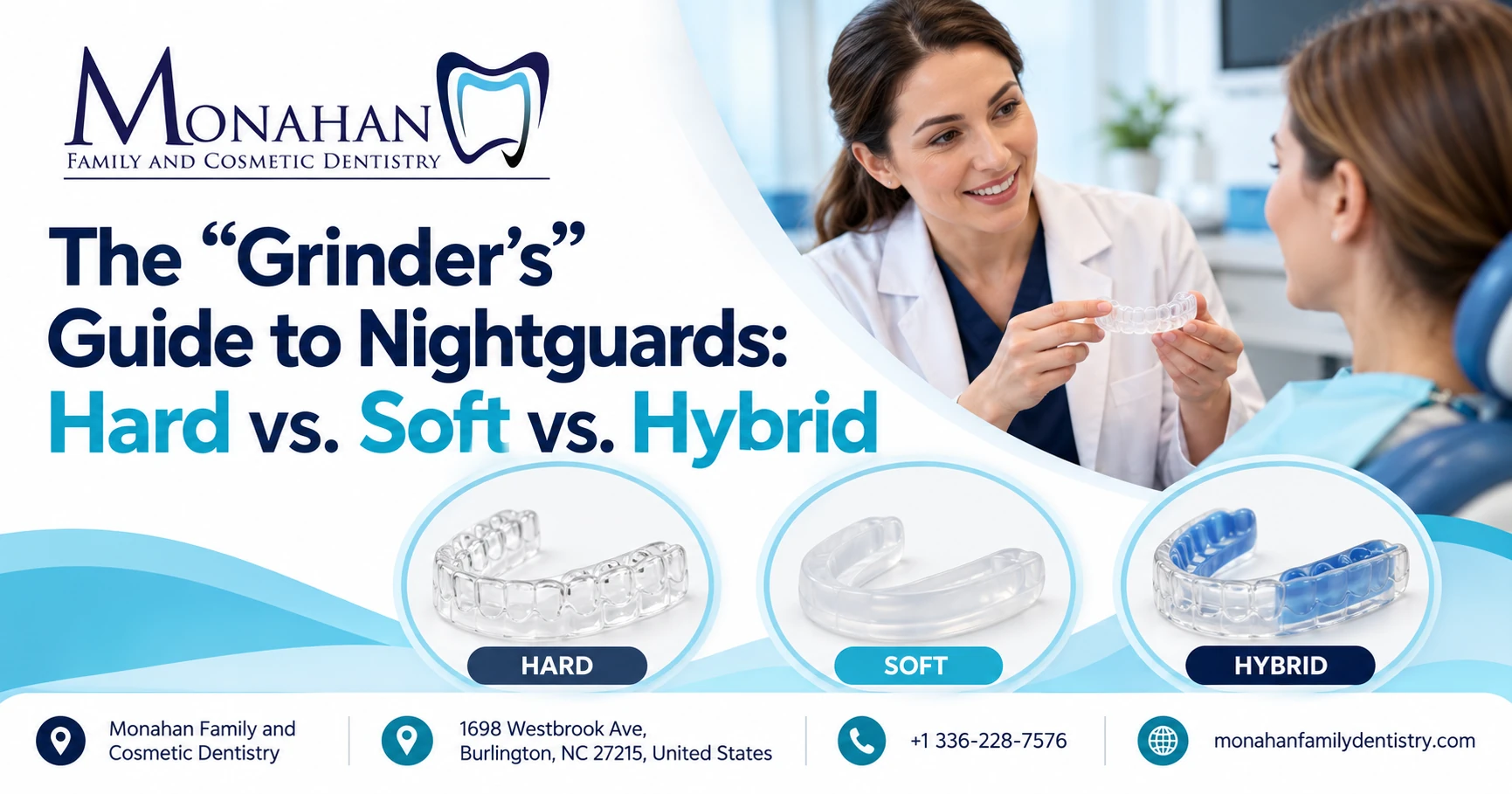
Does a Night Guard Prevent Cracked Teeth?
It can help protect teeth when bruxism is part of the problem.
But we need to use careful language.
A night guard does not guarantee that you will stop grinding.
Mayo Clinic explains that splints and mouth guards keep the upper and lower teeth separated and can reduce dental damage from clenching and grinding, even though they may not eliminate bruxism itself.
Monahan Family & Cosmetic Dentistry currently provides custom dental night guards for patients managing grinding and related problems.
Who has a stronger reason to consider one?
A guard may be more worth discussing if you have:
- Visible tooth wear
- Previous cracked teeth
- Repeatedly broken fillings or crowns
- Morning jaw soreness
- Known nighttime grinding
- A spouse who hears you grinding
- Multiple teeth showing signs of heavy load
That is different from giving every stressed Burlington employee a night guard.
The appliance should solve a documented problem.
Can You Fix Daytime Clenching Without a Night Guard?
Sometimes behavior awareness can help significantly.
Mayo Clinic recommends behavior change as one management strategy for awake bruxism. Once someone recognizes the habit, reminders can help reinforce a more relaxed jaw position.
Try something simple.
Put a note beside your monitor:
Lips together. Teeth apart. Jaws relaxed.
Check whenever you:
- Open your email
- Start a meeting
- Hit “send”
- Notice shoulder tension
- Get stuck on a difficult problem
- Finish a phone call
You are not trying to hold your jaw in an unnatural position.
You are trying to catch unnecessary clenching before it becomes hours of repeated loading.
What About Stress Management?
Dental care cannot remove your work deadline.
But if stress is driving awake clenching, addressing the stress response may be part of protecting your teeth.
Mayo Clinic includes relaxation strategies, behavior modification, exercise, meditation, and appropriate mental-health support among potential approaches when stress or anxiety contributes to bruxism.
That does not mean:
“Your cracked tooth is psychological.”
The crack is physical.
But the force contributing to it can have behavioral triggers.
Treating only the tooth while ignoring the repeated clenching may leave the next molar exposed to the same problem.
Can Caffeine Make Grinding Worse?
For some people, possibly.
Mayo Clinic lists caffeinated beverages, tobacco, alcohol, certain medications, and other substances among factors associated with increased bruxism risk.
That does not mean one cup of Burlington coffee is destroying your teeth.
Look at the full pattern.
If you are under heavy stress, drinking caffeine late into the day, sleeping poorly, waking with jaw soreness, and clenching during work, it is reasonable to evaluate several of those behaviors.
You do not need to blame one thing.
Bruxism often has multiple contributing factors.
What If You Grind Mostly at Night?
Daytime stress may not be the whole story.
Sleep bruxism is considered a sleep-related movement disorder.
Mayo Clinic notes that people with sleep bruxism are also more likely to have certain other sleep problems, including snoring and obstructive sleep apnea.
Grinding does not prove that you have sleep apnea.
But if you also have loud snoring, witnessed breathing pauses, gasping during sleep, or significant daytime sleepiness, tell your healthcare provider.
A night guard should not become a substitute for evaluating a possible sleep disorder.
When Should You Stop Blaming Stress and Call the Dentist?
Stress may explain why you clench.
It does not diagnose the tooth.
Contact a dentist promptly if you develop:
- Sharp pain when biting
- Pain when releasing your bite
- A visibly cracked tooth
- A broken cusp
- New temperature sensitivity
- A loose filling or crown
- Swelling
- A bad taste or drainage
- Pain that wakes you at night
Monahan’s current Burlington cost guide specifically advises patients not to delay evaluation of a cracked tooth, pain when biting, broken teeth, swelling, or other signs of active disease.
Monahan also provides emergency dental evaluation for cracked and chipped teeth and works to see urgent patients as quickly as possible.
What Should You Do Until the Appointment?
Do not keep testing the tooth.
Patients do this constantly.
They bite down repeatedly to see whether it still hurts.
If you think a molar is cracked, repeatedly loading it is not useful.
Chew on the other side.
Avoid ice, hard nuts, popcorn kernels, and other hard foods.
Do not use the tooth to tear packaging or bite objects.
The AAE specifically recommends avoiding hard objects and addressing grinding habits as ways to reduce crack risk.
If swelling or severe pain develops, call sooner.
The Expensive Part Is Often Waiting for the Next Bad Bite
A cracked tooth is frustrating because the final bite may look completely innocent.
A sandwich.
A piece of chicken.
A soft granola bar.
Patients understandably blame the food.
But the tooth may have been accumulating structural stress for years.
The large filling mattered.
The worn enamel mattered.
The clenching mattered.
The final bite was simply when the problem became obvious.
At Monahan Family & Cosmetic Dentistry, that is why Dr. Thomas Monahan looks beyond the immediate fracture.
We need to determine:
Can this tooth be saved?
How should it be restored?
Is the rest of your mouth showing signs of the same force?
If you repair one cracked molar but leave severe grinding unaddressed, you may have solved only half the problem.
Don’t Let Friday’s Deadline Become Monday’s Crown Emergency
A difficult week at work should end when the workweek ends.
The pressure should not continue through your molars.
If you live or work in Burlington, Elon, Graham, Mebane, or elsewhere in Alamance County and you have developed biting pain, a broken filling, jaw soreness, or signs that you are grinding your teeth, contact Monahan Family & Cosmetic Dentistry.
We can examine the tooth, evaluate your existing fillings and crowns, look for signs of excessive wear, and explain whether a night guard for teeth grinding in Burlington, NC is actually appropriate.
If the molar only needs conservative treatment, you should know that.
If it needs a crown, we should be able to explain why.
If the crack has reached the nerve, we can discuss what saving the tooth would involve.
And if the tooth cannot predictably be saved, you deserve to hear that before spending money on treatment that is unlikely to last.
The goal is not to blame your job for every tooth problem.
It is to recognize when a stressful habit is putting extra force on teeth that are already vulnerable.
Sometimes the warning is jaw soreness.
Sometimes it is worn enamel.
And sometimes it is one very sharp bite at lunch.
Do not wait for the crack to decide the treatment for you.
Frequently Asked Questions About Stress, Grinding, and Cracked Molars
Can stress actually cause a cracked molar?
Stress can increase clenching and grinding in some people. Severe bruxism can damage teeth and restorations.
However, a cracked molar often has additional risk factors such as a large filling, previous dental work, existing wear, or an earlier microscopic crack.
Why did my tooth crack while eating something soft?
The food may only have been the final load placed on an already weakened tooth.
A crack can develop gradually from wear, previous damage, large fillings, and repeated biting forces.
What does a cracked molar feel like?
Common symptoms include inconsistent sharp pain when chewing, pain when releasing biting pressure, and hot or cold sensitivity. Symptoms may come and go.
Is pain when biting always a cracked tooth?
No.
AAE guidance notes that sharp biting pain can also result from decay, a loose filling, or pulp damage.
The tooth needs an examination to determine the cause.
Can a cracked molar heal itself?
No.
A tooth crack does not heal like a broken bone. Treatment can stabilize some cracks, but untreated cracks may continue to progress.
Does every cracked molar require a crown?
No.
Treatment depends on the location and extent of the fracture and how much healthy tooth remains.
Some small defects may be restored conservatively. Structurally weakened or deeply cracked teeth are more likely to need crowns.
How much does a crown cost in Burlington?
Monahan’s current 2026 Burlington guide places many crowns at approximately $1,100–$1,700 before insurance.
Your actual fee depends on the tooth and any additional treatment required.
What if the crack reaches the nerve?
Root canal therapy may be necessary if the pulp is irreversibly damaged.
Monahan’s current planning range for root canal plus crown treatment is approximately $2,000–$3,500+.
Will a night guard stop me from grinding?
Not necessarily.
A guard can protect teeth by separating them and reducing damaging contact, but it may not eliminate the underlying bruxism behavior.
How do I know if I need a night guard?
Evidence of tooth wear, previous fractures, repeated restoration failures, morning jaw soreness, or known sleep grinding can make a guard worth discussing.
The decision should follow a dental evaluation rather than simply assuming every stressed person needs one.
What is the biggest mistake with a possible cracked molar?
Waiting because the pain comes and goes.
Intermittent biting pain is typical of some cracked teeth, and deeper cracks can become harder or impossible to restore.
Early evaluation gives you more options.