
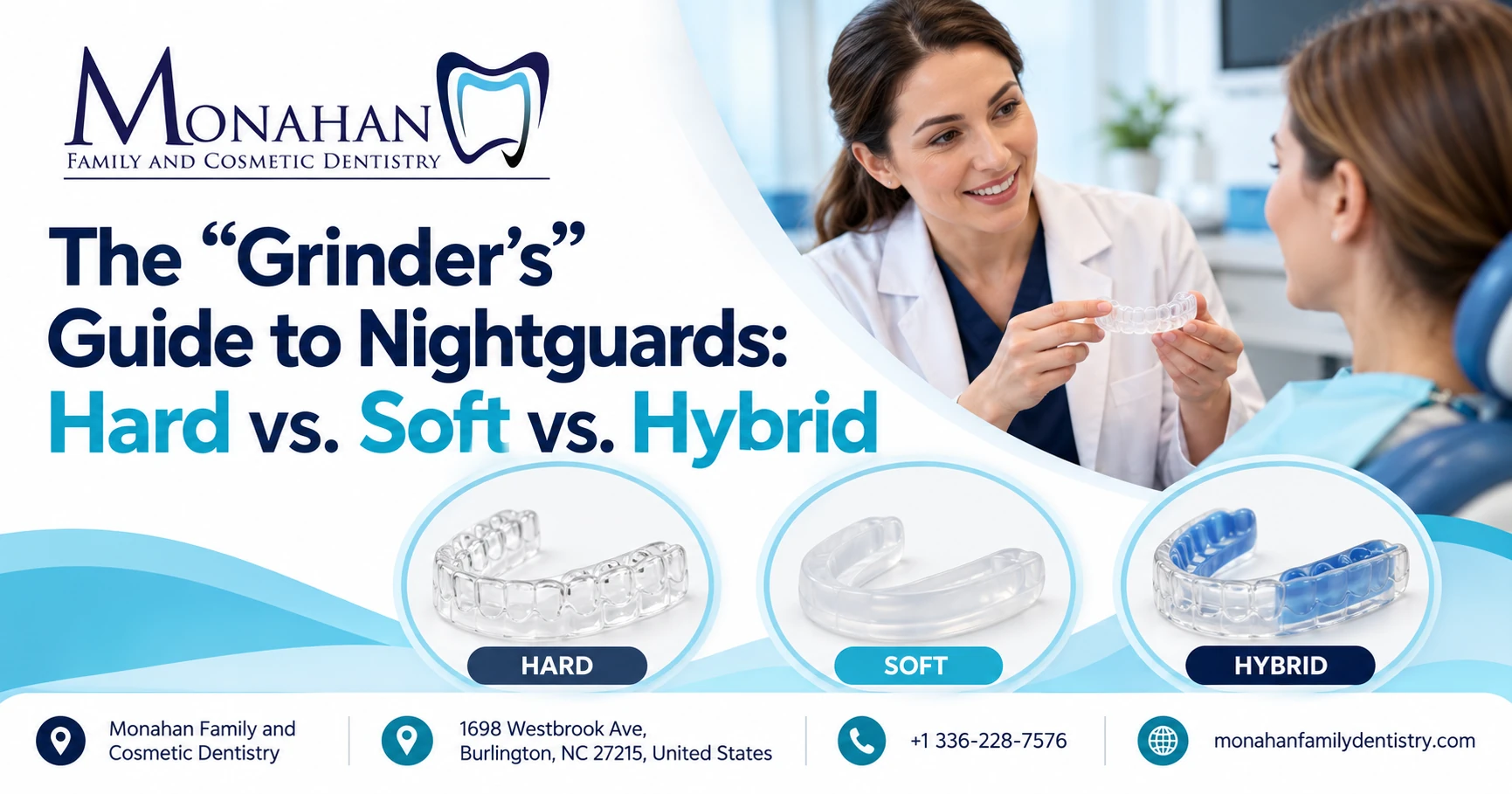
If you grind your teeth, buying a nightguard sounds simple.
Then you start looking.
Hard acrylic.
Soft rubbery material.
Dual-layer.
Hybrid.
Boil-and-bite.
Upper arch.
Lower arch.
Full coverage.
Now a $20 drugstore purchase has turned into a dental-materials research project.
Here is the useful answer.
There is no single best nightguard for every grinder.
For many adults with significant bruxism, a properly fitted hard full-coverage guard is a strong option because the dentist can control and adjust how the opposing teeth contact the appliance.
A soft guard may feel easier to tolerate and can work for selected patients, particularly when comfort is a major issue.
A hybrid or dual-material guard attempts to combine a softer tooth-facing layer with a harder biting surface.
But none of those descriptions tells us whether the appliance is right for your mouth.
At Monahan Family & Cosmetic Dentistry in Burlington, the decision should be based on what your teeth are actually doing.
Are you lightly clenching?
Are you destroying fillings?
Have you already cracked a molar?
Do you have crowns or implants?
Is jaw pain the main complaint?
Are you grinding during sleep, clenching during the workday, or both?
Those questions matter more than whether an online advertisement describes a guard as “professional strength.”
What Does a Nightguard Actually Do?
A nightguard is an oral appliance worn over the teeth, generally during sleep.
Its primary dental job is protection.
Mayo Clinic explains that splints and mouth guards separate the upper and lower teeth and can help prevent damage caused by grinding and clenching. The appliances may be made from hard or soft materials.
That wording is important.
A guard can protect the teeth.
It does not necessarily switch bruxism off.
A nightguard is not a cure for grinding
Sleep bruxism involves jaw-muscle activity during sleep.
The reasons people grind can involve several factors, including sleep physiology, stress, medications, health conditions, and sleep disorders.
Putting acrylic over your teeth does not necessarily remove those triggers.
Research on occlusal splints has repeatedly shown that their effect on actual bruxism activity varies among patients and appliance designs. A systematic review comparing different splints concluded that occlusal appliances remain useful in bruxism management, but their effects on muscle activity and symptoms are variable.
So when a dentist says:
“This can protect your teeth.”
That is reasonable.
When someone says:
“This device will permanently stop you from grinding.”
That deserves more skepticism.
What Is a Hard Nightguard?
A hard nightguard is made with a rigid material rather than a flexible rubber-like one.
Many stabilization splints use hard acrylic or another rigid dental material.
The surface can be shaped and adjusted so the opposing teeth contact it in a controlled way.
That adjustability is one of its biggest clinical advantages.
The ADA even distinguishes hard and soft occlusal guards in its dental coding system. A full-arch hard appliance is reported differently from a full-arch soft appliance.
Why dentists often use hard guards for heavy grinders
A rigid appliance can provide a stable biting surface.
The dentist can check where your teeth contact the guard and make adjustments.
Hard materials also tend to resist chewing and grinding wear better than softer materials.
A 2024 randomized clinical trial comparing a rigid splint with a mixed-material splint found that both groups experienced improvements in pain-related outcomes, but the mixed splint showed more appliance wear at six months.
That durability matters when someone is capable of grinding through dental materials.
Who may be a good candidate for a hard guard?
A hard guard may deserve serious consideration when you have substantial tooth wear, repeatedly break restorations, have cracked teeth, or generate significant grinding forces.
It may also be useful when the dentist wants a highly adjustable and stable occlusal surface.
But “harder” does not automatically mean “better.”
What Are the Downsides of a Hard Nightguard?
The most common objection is comfort.
Hard appliances can initially feel bulky or unforgiving.
Some patients need several nights to adapt.
Research comparing different splints has found that soft appliances can score better on short-term comfort measures. In one study, participants reported more discomfort with a hard splint than with a soft one.
That creates a practical problem.
The technically perfect guard sitting in your bathroom drawer protects nothing.
Fit matters more than toughness
A hard guard should not rock, fall out, painfully squeeze the teeth, or create a new bite problem.
At Monahan, custom dental nightguards are designed for the individual patient, and the practice notes that a short adjustment period is normal.
If a guard remains painful or suddenly makes your bite feel different after removal, call the dentist rather than forcing yourself to keep wearing it.
What Is a Soft Nightguard?
A soft nightguard uses a resilient, flexible material.
When patients first handle one, it often feels more appealing.
It bends.
It feels cushioned.
It may seem less intimidating than rigid acrylic.
That comfort is a legitimate advantage.
But comfort is not the entire engineering problem.
Soft guards can work for selected patients
Mayo Clinic recognizes both soft and hard materials as possible options for bruxism appliances.
Research has also produced some positive findings for soft splints.
A randomized trial involving 115 patients with sleep bruxism found that short-term use of 2-mm and 3-mm soft splints reduced maximum bite force and was associated with improved sleep-quality scores over two months.
Other studies have shown improvement in muscle or TMD symptoms with soft appliances.
So it would be wrong to say:
“Soft guards never work.”
They can.
The question is for whom.
What Is the Concern With Soft Nightguards?
One concern is durability.
A person who grinds aggressively may chew grooves into a softer appliance more quickly.
Another concern is that some patients may actually clench or chew against the resilient material.
The research is mixed, but that possibility has been documented for decades.
A classic study comparing hard and soft splints found that the hard appliance reduced nighttime muscle activity in 8 of 10 participants. The soft appliance reduced it in only one participant and actually increased activity in five. That was a very small study, so it should not be treated as the final answer, but it illustrates why soft does not automatically mean less grinding.
A more recent review likewise concluded that soft splints have produced variable outcomes and should be selected according to the individual patient rather than assumed to be universally appropriate.
The “chew toy” problem
Some heavy grinders describe finding themselves chewing against a soft guard.
That does not happen to everyone.
But if you notice yourself repeatedly biting into the appliance, the dentist should know.
The guard may still protect enamel from direct tooth-to-tooth contact, but the material may not be the best long-term choice for your particular pattern.
What Is a Hybrid Nightguard?
A hybrid guard tries to combine two material properties.
Typically, there is a softer or more flexible portion for comfort around the teeth and a harder portion where the opposing teeth bite.
You may also hear terms such as:
dual-laminate, dual-layer, mixed-material, or hard-soft guard.
Those names are not always used identically by every laboratory or manufacturer.
That is why asking what the actual biting surface is made from can be more informative than the product name.
How does the ADA classify a hard-soft appliance?
The ADA offers a useful technical distinction.
When an occlusal guard contains both hard and soft components, the classification depends on the material at the occlusal, or biting, surface.
If that working surface is hard, the ADA says the appliance is documented as a hard occlusal guard even when a softer component is also present for comfort.
That tells us what the hybrid concept is trying to accomplish:
soft where comfort helps, hard where the bite needs control.
Are Hybrid Guards Better Than Hard Guards?
Not automatically.
A 2024 randomized clinical trial followed adults with possible sleep bruxism using either a rigid splint or a mixed-material appliance.
Both groups experienced decreasing jaw and TMJ pain over time and improved quality-of-life measures.
The mixed appliance produced broadly similar clinical results but showed a higher rate of wear at the six-month evaluation.
That is a useful tradeoff.
Hybrid construction may offer comfort or manufacturing advantages.
Rigid construction may tolerate wear better.
One trial does not establish a universal winner.
Hard vs. Soft vs. Hybrid: Which One Is Best?
Here is the practical comparison.
Hard nightguard
Potential strengths: durability, stability, adjustability, controlled biting surface, and suitability for significant grinding or heavily restored teeth.
Potential weaknesses: may feel less comfortable initially, requires careful fit and adjustment, and can be more difficult for some patients to tolerate.
Soft nightguard
Potential strengths: flexibility, easier initial adaptation, cushioning, and comfort for certain patients.
Potential weaknesses: may wear faster, can be harder to adjust precisely, and may encourage additional clenching in some patients.
Hybrid nightguard
Potential strengths: attempts to combine internal comfort with a firmer functional surface.
Potential weaknesses: more complex construction, not automatically more durable than a fully rigid guard, and clinical evidence does not show that hybrid appliances are universally superior.
The correct question is not:
“Which material has the best reviews?”
It is:
“Which design best protects my teeth given my bite and grinding pattern?”
What If You Have Crowns, Veneers, Bridges, or Implants?
This is where a custom appliance becomes more important.
Grinding forces do not disappear because a tooth has been restored.
They transfer into the restoration.
Monahan specifically advises patients with dental implants who grind their teeth to discuss a custom nightguard to help protect those restorations.
The same broader logic applies to expensive restorative work.
If you have invested in several crowns or veneers, protecting them may be financially worthwhile when bruxism is clearly present.
A guard itself can wear.
That may be preferable to repeatedly fracturing ceramics or natural tooth structure.
Can a Nightguard Prevent a Cracked Molar?
It can reduce one important source of repetitive tooth-to-tooth loading.
That does not make fractures impossible.
Cracked molars can involve multiple factors:
large fillings,
weakened cusps,
previous root canal treatment,
existing microscopic cracks,
hard foods,
and heavy bite forces.
Bruxism can add to that load.
Monahan currently lists grinding and clenching among possible causes of chipped and damaged teeth.
A guard cannot repair a tooth that is already cracked.
If biting hurts, diagnose the tooth first.
Do not simply cover the problem with an appliance.
Should You Buy a Drugstore Nightguard First?
For some people, an inexpensive over-the-counter appliance may seem like a reasonable experiment.
But understand what it can and cannot tell you.
A boil-and-bite appliance is not automatically the equivalent of a professionally designed occlusal splint.
Athletic mouthguards are different again.
The ADA evaluates certain over-the-counter mouth-formed sports mouthguards for protection against athletic impact, but that does not mean every athletic guard is designed for chronic nighttime bruxism.
If you have already broken teeth or restorations, the least expensive piece of plastic may not be the most useful place to start.
The bigger need is finding out what is being damaged.
How Do You Know If Your Nightguard Fits Correctly?
A properly fitted appliance should feel secure.
It should not require you to clench simply to keep it in place.
It should not produce sharp pressure against one tooth.
And it should not repeatedly fall out while you sleep.
With a hard appliance, the dentist may also evaluate the contacts across the biting surface and adjust them.
That is one major reason professional follow-up matters.
What if your bite feels strange in the morning?
A very temporary awareness of your bite after removing an appliance can occur.
A persistent or progressive bite change deserves attention.
Splint design, fit, wear schedule, and tooth coverage can all matter.
Do not simply keep wearing an appliance for months when your bite feels increasingly wrong.
Call the office and have it checked.
Does a Nightguard Help TMJ Pain?
Sometimes.
But bruxism and TMD are not the same diagnosis.
Mayo Clinic notes that both soft and firm oral splints may help some people with jaw pain, although exactly why they help is not fully understood. Conservative measures such as reducing clenching, improving resting jaw posture, and physical therapy may also play a role.
Monahan currently evaluates and treats TMJ/TMD concerns in Burlington and includes mouthguards or splints among the conservative options that may be used when clenching or grinding contributes to symptoms.
The mistake is assuming:
Jaw pain = bruxism = buy a nightguard.
Jaw pain has several possible causes.
Diagnosis comes first.
Can a Guard Make TMJ Symptoms Worse?
A poorly fitting or inappropriate appliance can create problems.
That is one reason people with significant jaw pain should be cautious about self-prescribing long-term appliances.
If a guard increases pain, causes locking, significantly changes your bite, or makes symptoms steadily worse, stop treating that as a normal adjustment period.
Call the dentist.
The answer may be a simple adjustment.
Or the initial diagnosis may need another look.
How Long Should a Nightguard Last?
There is no universal number.
A light clencher may use an appliance for years.
A severe grinder may visibly wear one much faster.
The 2024 trial comparing mixed and rigid splints is useful here because the mixed appliance already showed greater wear at six months.
Your own appliance tells a story.
Deep grooves.
Cracks.
Thinning.
Rough areas.
Loss of fit.
Those changes are evidence that force is being applied.
Bring the guard to dental visits so it can be inspected.
How Should You Clean a Custom Nightguard?
Monahan recommends rinsing the appliance with cool or lukewarm water after use and maintaining good oral hygiene.
Avoid very hot water unless your dentist specifically tells you the material can tolerate it.
Heat can distort some dental appliances.
Clean the guard according to the instructions given for its material.
Then allow it to dry appropriately and store it safely.
And keep it away from dogs.
Dental offices replace a surprising number of appliances that became expensive chew toys.
Does Dental Insurance Pay for Nightguards?
Sometimes.
Not always.
Dental plans may provide benefits for occlusal guards, but coverage can depend on the reason for the appliance, frequency limits, network status, and the specific plan.
The ADA currently uses distinct procedure codes for full-arch hard and soft occlusal guards, including D9944 for a hard full-arch appliance and D9945 for a soft full-arch appliance.
A code does not guarantee payment.
Before treatment, ask the office for an estimate of:
the practice fee,
the estimated insurance benefit,
and your estimated portion.
Monahan’s public website currently confirms that custom nightguards are provided, but it does not publish a definitive current nightguard fee.
That means we should not invent a Burlington price simply to make the article look more complete.
Who Probably Does Not Need a Nightguard?
Not everyone who occasionally clenches needs an appliance.
Mayo Clinic notes that many adults do not grind or clench severely enough to require treatment.
A nightguard may offer little value when there is no meaningful evidence of:
tooth wear,
fractures,
restoration damage,
muscle symptoms,
or clinically significant bruxism.
Likewise, someone who mainly notices daytime clenching may benefit significantly from behavioral awareness rather than assuming a nighttime appliance solves the daytime habit.
The guard should have a job.
If nobody can explain what it is protecting, ask why you need it.
When Should You Get Evaluated Instead of Ordering a Guard Online?
Schedule a dental evaluation when you notice:
- A tooth hurts when biting
- A molar has cracked
- Fillings or crowns repeatedly break
- Teeth are becoming visibly flatter
- You wake with jaw soreness
- Your partner hears grinding at night
- You have persistent headaches around the temples
- You have implants or extensive restorative work and grind heavily
- An existing guard no longer fits
- A nightguard seems to be making your jaw symptoms worse
Those are situations where material selection should come after diagnosis.
The Best Nightguard Is the One With a Specific Job
At Monahan Family & Cosmetic Dentistry, we do not believe “custom nightguard” should automatically mean one material for every patient.
A heavy grinder with multiple crowns presents a different problem from someone with mild jaw-muscle soreness.
A patient who chews through soft appliances presents a different problem from someone who cannot tolerate rigid material.
And someone with significant TMJ symptoms may need a broader evaluation rather than simply thicker plastic.
Our Burlington practice currently provides custom nightguards for bruxism and evaluates TMJ/TMD concerns.
The useful conversation is:
What are we trying to protect?
How much grinding damage do you already have?
What material makes sense for those forces?
Can the appliance be adjusted properly?
Will you actually wear it?
Those questions lead to a better decision than choosing “hard” or “soft” from an online menu.
Protect the Dentistry You Already Paid For
Grinding becomes expensive when the nightguard conversation starts after the damage.
After the cracked molar.
After the broken crown.
After the veneer chips.
After the implant restoration begins taking excessive force.
If you live in Burlington, Elon, Graham, Mebane, or elsewhere in Alamance County and suspect you are grinding your teeth, Monahan Family & Cosmetic Dentistry can examine your wear pattern, existing dental work, bite, and jaw symptoms before recommending an appliance.
Dr. Thomas Monahan can explain whether a hard, soft, hybrid, or another design is appropriate or whether you need a guard at all.
That last possibility matters.
The goal is not to sell every grinder a piece of plastic.
It is to protect vulnerable teeth with the right appliance when there is a legitimate reason to do so.
Frequently Asked Questions About Hard, Soft, and Hybrid Nightguards
Which nightguard is best for severe teeth grinding?
A rigid, professionally adjusted appliance is often worth considering for substantial grinding because of its durability and controllable biting surface.
However, the best design depends on the patient’s bite, restorations, symptoms, and ability to tolerate the appliance.
Is a hard nightguard better than a soft nightguard?
Not universally.
Research comparing the two has produced mixed results. Hard appliances offer stability and adjustability, while soft appliances can provide greater comfort. Some studies have also found increased muscle activity with soft splints in certain patients.
What is a hybrid nightguard?
It is an appliance combining different material properties, commonly a softer tooth-facing area with a harder functional biting surface.
The ADA classifies an appliance with a hard occlusal surface as a hard guard even when it also contains a soft component.
Are hybrid guards more comfortable?
They are designed partly to combine comfort with a firmer biting surface, but individual tolerance varies.
Comfort should not be judged by material alone.
Fit matters.
Are soft nightguards bad for grinders?
No.
Soft splints can help selected patients and have produced positive outcomes in clinical trials. But they may wear faster and can produce different muscle responses among patients.
Which nightguard lasts the longest?
Rigid appliances generally have an advantage when durability under heavy wear is the priority.
In a 2024 randomized trial, the mixed-material splint showed significantly more wear at six months than the rigid appliance.
Actual lifespan still depends heavily on grinding intensity and appliance design.
Will a nightguard stop me from grinding?
Not necessarily.
Nightguards are primarily used to protect the teeth and separate opposing surfaces. They may influence symptoms or muscle activity, but they do not reliably eliminate the underlying bruxism behavior.
Is a sports mouthguard the same as a nightguard?
No.
Sports mouthguards are designed primarily to protect against impact.
Occlusal nightguards are designed around grinding, clenching, tooth wear, and the patient’s bite.
Can I wear a nightguard if I have crowns or implants?
Often, yes.
In fact, significant bruxism can be a reason to consider protecting extensive restorative work. Monahan specifically recommends discussing custom nightguards when grinding may threaten dental implants.
Does Monahan Family & Cosmetic Dentistry make custom nightguards?
Yes.
Monahan currently provides custom dental nightguards for patients with bruxism and related concerns.
How much does a custom nightguard cost in Burlington?
Monahan’s public website does not currently publish a definitive nightguard price.
The appropriate approach is to request a current fee and insurance estimate rather than relying on an online national average.
What is the biggest mistake when choosing a nightguard?
Choosing the material before diagnosing the problem.
If you already have biting pain, a cracked tooth, failing restorations, or persistent jaw symptoms, those problems should be evaluated before you simply cover the teeth with an appliance.