
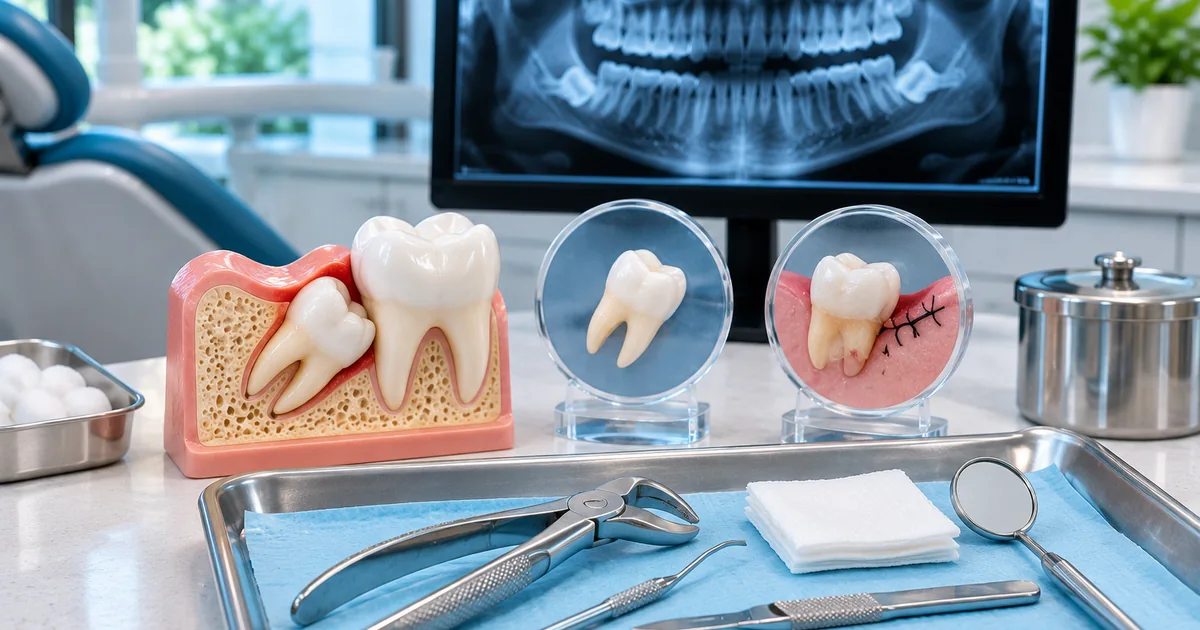
If you call a dental office and ask, “How much does it cost to remove a wisdom tooth?” you may not get one simple number.
There is a good reason.
A wisdom tooth that has fully erupted through the gum can sometimes be removed much like another tooth.
A wisdom tooth buried under gum or bone is a different procedure.
That difference can change the price substantially.
For Burlington patients, Monahan Family & Cosmetic Dentistry currently publishes a general tooth-extraction planning range of approximately $200 to $800, depending on complexity. But wisdom teeth can fall outside a simple one-price comparison, particularly when several teeth are impacted or sedation is needed.
National data shows the same pattern.
CareCredit currently lists an average simple extraction at about $177 per tooth, compared with approximately $363 for a surgical extraction, $423 for a soft-tissue impaction, $532 for a full bony impaction, and $835 for a complicated impaction. Actual ranges are much wider.
Delta Dental gives another useful comparison. Its current estimate for removing four fully erupted wisdom teeth is about $720 out of network, while surgical removal of all four impacted wisdom teeth with up to an hour of general anesthesia averages about $3,120 out of network.
That is why two Burlington patients can both say they are “getting their wisdom teeth out” and receive very different estimates.
The price depends on what actually has to be done.
How Much Does Wisdom Teeth Removal Cost in Burlington, NC?
There is no responsible single price without examining the teeth and reviewing X-rays.
For general planning, the numbers look roughly like this:
| Type of extraction | Current national average | Published national range |
| Simple extraction | About $177 | $137–$335 |
| Surgical extraction | About $363 | $281–$702 |
| Soft-tissue impaction | About $423 | $325–$829 |
| Full bony impaction | About $532 | $413–$1,041 |
| Complicated impaction | About $835 | $639–$1,620 |
These figures are per tooth and generally reflect local anesthesia rather than every possible sedation or anesthesia charge.
There is also useful North Carolina-specific data. CareCredit currently reports an average of roughly $331 for an impacted wisdom-tooth extraction in North Carolina, although the actual fee can be higher or lower depending on the type of impaction, provider, location, and anesthesia used.
At Monahan, our published general extraction range is $200–$800.
That is a planning number.
It is not a promise that every impacted wisdom tooth can be surgically removed for $800 or less.
If you need several surgical extractions, an oral-surgery referral, deeper sedation, or additional imaging, your total treatment cost can be considerably higher.
What Is a Simple Wisdom Tooth Extraction?
A simple extraction generally means the tooth is visible above the gumline and accessible without surgical exposure.
The dentist numbs the area.
The tooth is loosened from the surrounding tissues and removed from its socket.
There is usually no need to cut through significant gum tissue, remove bone, or section the tooth into several pieces.
Delta Dental describes simple extractions similarly: they can be completed without incisions in the gum and without specialized surgical techniques.
Why simple extractions usually cost less
A simpler procedure generally requires less treatment time and fewer surgical steps.
That usually means:
- Less extensive access
- Little or no bone removal
- No surgical sectioning in many cases
- Simpler instrumentation
- Less procedure time
The important word is usually.
A wisdom tooth can look erupted but still have unusual roots or other factors that make removal more complicated.
X-rays help the dentist see what cannot be determined by looking at the crown of the tooth alone.
What Is a Surgical Wisdom Tooth Extraction?
A surgical extraction is needed when the dentist or oral surgeon cannot simply access and remove the tooth normally.
The tooth may have partially erupted.
It may be trapped below the gum.
It may be partly or completely surrounded by bone.
It may be positioned at an angle.
CareCredit describes surgical extraction as removal that may require an incision in the gum, removal of surrounding bone, or dividing the tooth into pieces so it can be removed safely.
Those extra steps are why surgical wisdom-tooth removal costs more.
What does “impacted” actually mean?
An impacted wisdom tooth has not erupted normally into a usable position.
The tooth may be:
- Covered mainly by gum tissue
- Partially covered by bone
- Completely encased in bone
- Angled toward another tooth
- Positioned horizontally
- Angled toward the back of the jaw
CareCredit identifies several common impaction patterns, including mesial, vertical, horizontal, and distal positions.
The word “impacted” alone still does not tell you the price.
A shallow soft-tissue impaction is not the same operation as a deeply buried full-bony impaction.
Why Can Surgical Wisdom Teeth Cost Two or Three Times More?
Because the procedure itself is different.
The dentist may need to create access through the gum.
Bone may need to be removed.
The tooth may need to be divided.
The roots may be difficult to reach.
The procedure may take longer.
Sedation or anesthesia may also be added.
This is why asking only for the dentist’s “extraction fee” can be misleading.
A useful estimate should tell you which kind of extraction is being planned.
Does the Position of the Wisdom Tooth Affect the Cost?
Yes.
Position is one of the biggest cost factors.
Fully erupted wisdom tooth
This is generally the least complicated scenario.
If the tooth is accessible and the roots are favorable, removal may qualify as a simple extraction.
Soft-tissue impaction
The tooth has not fully erupted and is still partly covered by gum tissue.
CareCredit currently reports an average around $423 per tooth, with a national range of roughly $325–$829.
Full bony impaction
The tooth is completely surrounded by the jawbone.
Removal generally requires more surgical access.
The current national average is approximately $532 per tooth, with a reported range around $413–$1,041.
Complicated impaction
Some teeth are deeply positioned or otherwise difficult to remove.
CareCredit places complicated impactions at an average of about $835, with a national range reaching approximately $1,620 per tooth.
That is a very different procedure from a $177 simple extraction.
How Much Does It Cost to Remove All Four Wisdom Teeth?
Again, it depends on whether those teeth are simple or surgical.
Delta Dental currently gives one of the clearest examples.
For four fully erupted wisdom teeth removed non-surgically, its average out-of-network estimate is approximately:
$720 total
For four surgically removed wisdom teeth below the gumline plus up to an hour of general anesthesia, the average is approximately:
$3,120 total
CareCredit’s national averages are somewhat higher.
It reports approximately $2,685 for four wisdom teeth and about $3,340 for four impacted wisdom teeth.
Those differences are exactly why internet prices should be used for planning, not treated as quotes.
Different sources use different datasets.
Different practices include different services.
Different patients need different procedures.
Is Removing Four Teeth at Once Cheaper Than Removing Them Separately?
It can be.
Certain costs can overlap when several wisdom teeth are removed during one appointment.
For example, the patient may need one examination, one surgical setup, and one period of sedation rather than repeating those parts across several appointments.
You also go through recovery once instead of several times.
But cost should not be the reason to remove a wisdom tooth that does not need removal.
The clinical question comes first.
Ask:
Which wisdom teeth actually need treatment?
Then ask:
If several need treatment, does removing them together make clinical and financial sense?
That is a better decision process than assuming all four automatically have to come out.
Does Sedation Increase the Price?
Yes, potentially.
Local anesthesia and sedation are not the same thing.
Local anesthesia numbs the treatment area.
Sedation can help reduce awareness and anxiety.
General anesthesia involves a deeper level of anesthesia and additional monitoring.
CareCredit currently reports approximate national averages of:
- Sedation: $349
- General anesthesia: $639
Its published ranges extend from approximately $273–$675 for sedation and $494–$1,253 for general anesthesia.
Delta Dental notes that local anesthesia is generally included in the extraction cost, while sedation or general anesthesia can create an additional charge.
Does everyone need sedation?
No.
Some simple wisdom teeth can be removed comfortably with local anesthesia.
More involved surgical cases may justify additional sedation.
Patient anxiety can also affect the discussion.
The correct anesthesia plan should be based on the procedure and patient not on automatically adding the most expensive option.
What Other Costs Should You Ask About?
The tooth-extraction fee may not be the complete treatment cost.
Ask specifically about the following.
Examination
The dentist needs to determine whether the tooth should actually be removed.
Do not skip the diagnostic step simply to save the examination fee.
X-rays
Wisdom teeth require imaging because the dentist needs to understand the root shape, eruption pattern, surrounding bone, and relationship to nearby structures.
A panoramic X-ray is commonly useful for evaluating all four wisdom teeth.
CareCredit currently lists a national average of about $200 for a panoramic X-ray.
Additional imaging
Certain cases may benefit from three-dimensional cone-beam CT imaging.
That is not automatically required for everyone.
CareCredit currently lists a national average around $466 for cone-beam CT, though local fees and clinical need vary.
Sedation or anesthesia
Ask whether the estimate includes it.
Never assume.
Follow-up care
Ask what routine postoperative follow-up is included and what happens if you develop a problem.
Does Dental Insurance Cover Wisdom Teeth Removal?
Often, but the percentage depends on the individual plan.
Delta Dental states that its plans commonly cover roughly 50% to 80% of wisdom-teeth removal costs, depending on the policy and circumstances.
That does not mean your plan automatically pays 80%.
Your benefits may be affected by:
- Deductible
- Annual maximum
- Network status
- Surgical benefits
- Anesthesia limitations
- Age restrictions
- Frequency rules
- Coordination with medical insurance in unusual circumstances
If the expected treatment is expensive, ask whether a pre-treatment estimate can be submitted to your insurer.
“Covered” does not mean “free”
Suppose a surgical procedure costs $2,000.
Even if insurance recognizes the treatment, you may still owe a significant portion.
The word “covered” simply means some benefit may apply according to your contract.
Always ask:
What is my estimated out-of-pocket cost?
That is the number that matters.
When Might You Be Referred to an Oral Surgeon?
Not every wisdom tooth should necessarily be removed in a general dental office.
Some cases are more complex.
Delta Dental notes that the dentist may recommend an oral surgeon depending on wisdom-tooth position and complexity.
A referral may be appropriate when the teeth are deeply impacted, unusually positioned, close to important anatomical structures, or otherwise require surgical care beyond what is appropriate for the individual case.
A referral is not a failure.
It is good judgment.
At Monahan Family & Cosmetic Dentistry, wisdom-tooth removal is among the extraction services we provide, but the right treatment setting still depends on the patient and the complexity of the case.
Does Every Wisdom Tooth Need to Come Out?
No.
This matters because the cheapest extraction is the one you do not actually need.
Some wisdom teeth erupt into healthy, functional positions.
Others remain stable and can be monitored.
Removal becomes more relevant when wisdom teeth contribute to problems such as:
- Pain
- Recurrent inflammation
- Infection
- Decay
- Damage to a neighboring tooth
- Cyst formation
- Problematic impaction
- Difficulty keeping the area clean
Monahan’s current wisdom-tooth information identifies impaction, infection, crowding, and cyst formation among the common reasons removal may be considered.
Age alone should not be the entire diagnosis.
Ask your dentist to show you the X-ray and explain why removal is being recommended.
Is It Cheaper to Wait Until the Wisdom Tooth Hurts?
Not necessarily.
Waiting can sometimes make a simple financial decision more complicated.
A wisdom tooth that is merely being monitored today may never cause a major problem.
So preventive extraction is not automatically necessary.
But a tooth that already shows disease is different.
If infection, decay, or damage progresses, you may end up dealing with:
- Emergency examination
- Medication
- More difficult surgery
- Missed work or school
- Damage to a neighboring tooth
- Additional restorative treatment
That can quickly erase whatever money was saved by postponing necessary treatment.
The useful question is not:
“Can I wait?”
Ask:
“What is likely to happen if I wait?”
Your dentist should be able to explain the risk rather than simply pressure you to schedule.
How Do Simple and Surgical Extractions Differ in Recovery?
A simple extraction often causes less surgical trauma.
That can mean a more straightforward recovery.
Surgical removal of deeply impacted teeth can produce more swelling, soreness, and postoperative limitations.
Monahan notes that recovery varies according to extraction complexity and individual health, although many patients resume regular activities within a few days.
The exact recovery period cannot be guaranteed.
A patient having one fully erupted wisdom tooth removed may feel very different from someone having four full-bony impactions surgically removed.
Plan based on your procedure, not someone else’s TikTok video or a friend’s experience.
What Questions Should You Ask Before Comparing Wisdom-Tooth Quotes?
If you are comparing costs between Burlington dental offices or an oral surgeon, make sure you are comparing the same treatment.
Ask:
- How many wisdom teeth need removal?
- Is each tooth simple, surgical, soft-tissue impacted, or bony impacted?
- What is the fee for each tooth?
- Is local anesthesia included?
- Is sedation being recommended?
- What does sedation cost?
- Are the exam and X-rays separate?
- Is additional imaging needed?
- Are follow-up visits included?
- Is the provider in network with my dental plan?
- What is my estimated insurance benefit?
- What is my estimated total out-of-pocket cost?
A $300 quote for a simple extraction should never be compared directly with a $900 quote for a complicated bony impaction.
They are not the same procedure.
The Cheapest Wisdom-Tooth Quote Is Not Always the Lowest Total Cost
Cost matters.
Patients should ask about it.
But a bargain price without context is not useful.
A low advertised figure may apply only to:
- One fully erupted tooth
- Local anesthesia only
- Extraction itself
- No imaging
- No sedation
- No surgical impaction
Then the patient’s actual case turns out to involve four impacted teeth.
The advertised price was not technically false.
It was simply irrelevant.
That is why we encourage patients to ask for a treatment-specific estimate after appropriate imaging.
You want the complete number for your case, not the lowest number on a website.
Get the X-Ray Before You Guess the Price
At Monahan Family & Cosmetic Dentistry, we would rather tell a Burlington patient why the price differs than pretend wisdom-tooth removal has one simple fee.
Our published tooth extraction cost in Burlington, NC currently ranges around $200 to $800 for general extractions, depending on complexity.
Wisdom teeth need more specific evaluation.
Dr. Thomas Monahan and our team can examine the area, review appropriate X-rays, determine whether removal is necessary, and explain whether the tooth appears straightforward or surgically complex.
If the case belongs with an oral surgeon, that should be explained too.
For patients from Burlington, Elon, Graham, Mebane, and elsewhere in Alamance County, the goal is straightforward:
Know what kind of extraction you actually need before you try to compare prices.
If you are experiencing wisdom-tooth pain or have been told your wisdom teeth should come out, contact Monahan Family & Cosmetic Dentistry for an evaluation.
Bring your dental insurance information.
Ask us to show you what we see.
Then ask for the expected cost.
A useful dental estimate starts with the diagnosis.
Frequently Asked Questions About Wisdom Teeth Costs in Burlington
How much is a simple wisdom-tooth extraction?
CareCredit currently reports a national average around $177 per simple extraction, with a broad range of approximately $137 to $335 per tooth.
Actual Burlington fees depend on the provider and case.
How much is a surgical wisdom-tooth extraction?
The current national average for a surgical extraction is approximately $363 per tooth, with a reported range around $281 to $702.
More complicated impactions can cost considerably more.
How much does an impacted wisdom tooth cost in North Carolina?
CareCredit currently reports an average around $331 for impacted wisdom-tooth removal in North Carolina.
That is an average, not a quote. Different types of impaction can produce very different fees.
How much does it cost to remove all four wisdom teeth?
Delta Dental reports approximately $720 out of network for four non-surgical, fully erupted wisdom teeth and approximately $3,120 for four surgical removals with up to an hour of general anesthesia.
CareCredit reports national averages around $2,685 for four wisdom teeth and $3,340 for four impacted wisdom teeth.
Why are impacted wisdom teeth more expensive?
They require more surgical work.
The dentist or surgeon may need to open gum tissue, remove bone, divide the tooth, or work around more difficult anatomy.
More complicated treatment generally requires more time and resources.
Is sedation included in wisdom-tooth removal?
Do not assume it is.
Delta Dental notes that local anesthesia is generally included in the removal cost, while sedation or general anesthesia can create additional costs.
Does insurance cover surgical wisdom-tooth removal?
Many dental plans provide benefits for medically appropriate extractions, but coverage varies.
Delta Dental says its plans often cover approximately 50% to 80%, depending on the specific plan and circumstances.
Check your actual benefits before treatment.
Do I need an X-ray before getting a price?
For a useful surgical estimate, usually yes.
The dentist needs to understand root development and tooth position before accurately judging complexity. Delta Dental specifically notes that examination and X-rays are used to evaluate these factors.
Does Monahan Family & Cosmetic Dentistry remove wisdom teeth?
Yes. Monahan lists wisdom-teeth removal among its extraction services in Burlington.
The appropriate treatment setting still depends on the complexity of your individual case.
What is the most important thing to ask when comparing prices?
Ask:
“Is this quote for a simple extraction or the actual type of surgical extraction shown on my X-ray?”
That one question can prevent a very misleading price comparison.