

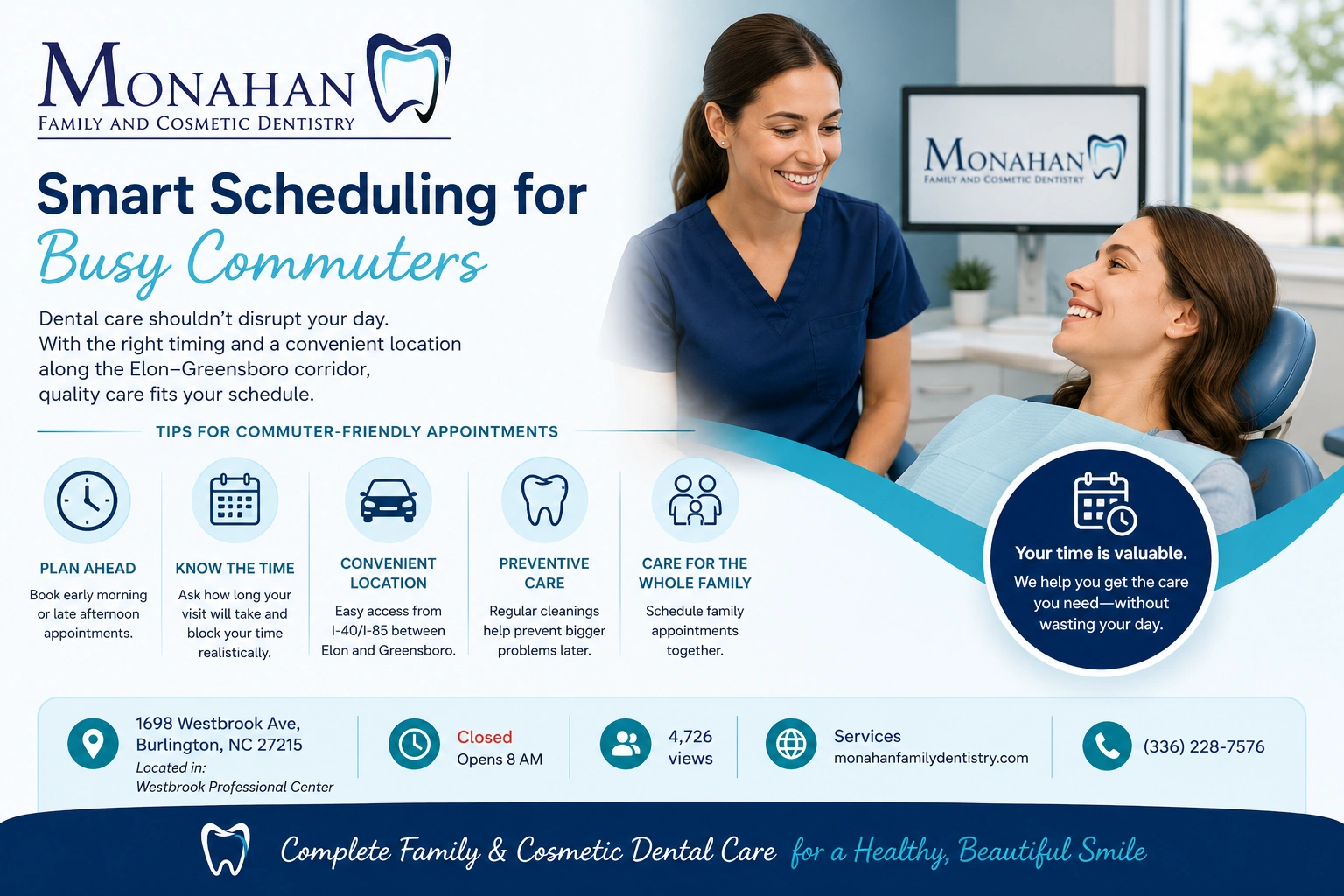
If you commute between Elon and Greensboro, dental appointments can feel like one more thing fighting for space on your calendar.
The drive is not huge Elon to Greensboro is roughly 19–20 miles, usually around 26–27 minutes without major traffic—but that is just the drive. Add parking, check-in, treatment time, getting numb, waiting for a crown scan, or getting back to work, and a “quick appointment” can eat half your day if it is scheduled poorly.
That is why commuters need a different strategy for dental care.
The goal is simple: get the care you need without wasting PTO, missing meetings, or delaying treatment until a small problem becomes an expensive one.
Busy Schedule? We Make Dental Visits Easier
Get convenient dental care along the Elon to Greensboro corridor. Schedule today.
Why Dental Visits Are Hard for Elon–Greensboro Commuters
People who live, work, study, or commute between Elon, Burlington, Gibsonville, Whitsett, and Greensboro often have a predictable problem: they are close to dental care, but not always close at the right time.
You may be:
- Leaving Elon early for work in Greensboro
- Driving from Greensboro back toward Alamance County after 5 p.m.
- Working near I-40/I-85 but living farther east or west
- A parent trying to schedule around school pickup
- A professional who cannot easily leave in the middle of the day
- A student, faculty member, or staff member working around campus schedules
A dental office located along the commuter corridor can be convenient, but only if appointments are planned around how people actually move through the day.
The Best Dental Appointment Times for Commuters
The “best” appointment time depends on the type of visit.
For cleanings and exams
Early morning or late afternoon appointments usually work best. These visits are predictable, do not require numbing, and rarely affect your ability to return to work.
A commuter-friendly cleaning slot might be:
- Before work
- During a long lunch break
- After school drop-off
- Late afternoon on the way home
For many people, this is the easiest dental visit to fit into a normal day.
For fillings
Fillings can be done during the workday, but you need to think about numbness. If the filling is on the lower jaw, your lip and tongue may stay numb for a while. That can make meetings, phone calls, eating lunch, or presentations awkward.
If you have a client-facing job, a filling may be better:
- Late morning if you can work quietly afterward
- Late afternoon if you can go home after
- On a day without major meetings
Do not schedule a filling 45 minutes before a sales presentation unless you are comfortable talking with a numb lip.
What to Consider Before Choosing Dental Implants
Dental implants can provide a stable, long-term option for replacing [...]
Learn More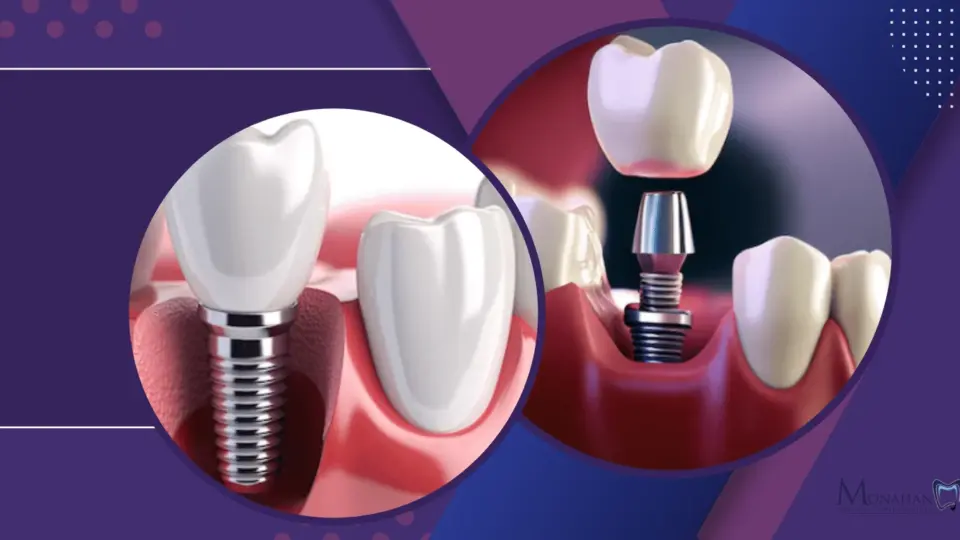
For crowns, veneers, or longer restorative visits
These should be scheduled more carefully. Longer appointments can run 90 minutes or more depending on the procedure, technology used, and complexity.
A crown, veneer, implant restoration, or multiple fillings may be better scheduled:
- First thing in the morning
- On a lighter workday
- Before a remote-work afternoon
- On a day when you do not need to rush back into meetings
Trying to squeeze a major appointment into a tiny gap usually creates stress for everyone.
For emergency dental visits
Do not over-optimize the schedule if you have swelling, severe pain, trauma, or a broken tooth with sharp edges.
Emergency dental problems rarely improve because your calendar is busy. If you have facial swelling, fever, uncontrolled bleeding, or trouble swallowing or breathing, that is urgent and should not wait.
How to Use the Elon Greensboro Corridor to Your Advantage
The Elon-to-Greensboro route commonly uses the I-40/I-85 corridor, and route tools place the drive around 19–20 miles depending on the source and exact starting point.
That creates a useful scheduling advantage: you may not need to choose between a dentist near home and a dentist near work. A corridor-based appointment can work if it sits naturally between the two.
Think of dental care as part of your route, not a separate errand.
A good commuter appointment is usually one that lets you:
- Avoid doubling back
- Park easily
- Arrive without rushing
- Return to work or home without crossing town again
- Handle follow-up visits without rearranging your entire week
This matters most for treatments that require multiple visits, such as crowns, Invisalign check-ins, implant restorations, periodontal therapy, or cosmetic dentistry.
What to Ask Before Scheduling
Before booking, ask the dental office a few practical questions.
How long should I realistically block off?
Do not ask only how long the procedure takes. Ask how long you should plan to be away from work or home.
Will I be numb afterward?
This matters if you talk for a living, teach, present, see clients, or lead meetings.
Can I drive myself?
Most routine dental visits allow you to drive yourself. Sedation dentistry is different. If sedation is involved, you may need someone to drive you.
Will I be able to eat afterward?
After some visits, you may need to avoid chewing until numbness wears off. After others, you may need to avoid sticky or hard foods.
Can treatment be phased?
If you need multiple fillings, crowns, or cosmetic work, you may not have to do everything in one visit.
What happens if traffic makes me late?
This is especially important for commuters. A good office should have a clear late-arrival policy.
The Smartest Way to Schedule Preventive Care
Preventive dental care is easiest when it is boring and predictable.
For commuters, the best strategy is to schedule your next cleaning before you leave the current one. Do not wait until six months later when your calendar is already full.
A practical approach:
- Book early morning if you want to go straight to work after
- Book late afternoon if you want to head home afterward
- Book the same weekday every six months if your schedule is stable
- Pair family cleanings together if it reduces separate trips
- Avoid scheduling during known peak work seasons
Skipping cleanings to “save time” often backfires. The small cavity you do not feel today may become the crown, root canal, or emergency visit that actually ruins your schedule later.
When It Is Worth Taking Time Off Work
Some dental visits are worth protecting with real calendar space.
Take more time than you think you need for:
- Root canals
- Tooth extractions
- Implant surgery
- Multiple fillings
- Crown appointments
- Veneer preparation visits
- Deep cleanings
- Sedation appointments
- Emergency visits for severe pain or swelling
This does not mean you need a full day off for every dental procedure. But it does mean you should not treat every appointment like a 30-minute errand.
The more complex the treatment, the more breathing room you should give yourself.
When a Quick Visit Is Usually Enough
Some visits are easier to fit into a commuter schedule.
These often include:
- Routine exams
- Regular cleanings
- Invisalign or clear aligner check-ins
- Simple X-rays
- Whitening consultations
- Cosmetic consultations
- Nightguard scans
- Retainer checks
- Small bonding evaluations
These are good candidates for before-work, lunch-hour, or after-work scheduling.
Dental Care for Elon Students, Faculty, and Staff
The Elon–Greensboro corridor is not only for traditional commuters. Students, faculty, and university staff also need appointment timing that does not disrupt classes, clinical schedules, exams, or campus responsibilities.
For students, the best dental visits are usually:
- Before the semester gets intense
- Before study-heavy exam periods
- Before travel breaks
- Early in the day if transportation is limited
- Planned before dental pain becomes urgent
Dental pain during finals, interviews, athletics, or travel is miserable. If a tooth is already sensitive, cracked, or hurting, do not wait until the most inconvenient week of the semester.
Dental Care for Greensboro Professionals Living Near Elon
If you work in Greensboro but live near Elon, Burlington, or Gibsonville, the ideal dental appointment often depends on whether you are headed east or west.
A morning appointment may work best if the office is near your route into Greensboro.
An afternoon appointment may work best if you can stop on the way home.
A midday appointment may only make sense if the office is very close to work or you have a flexible schedule.
The mistake is choosing a dental office based only on distance from your house. For commuters, convenience is about route timing, not just mileage.
How to Avoid Losing a Whole Day to Dentistry
Here is the commuter-friendly way to plan:
- Ask how long the full visit will take, not just the procedure.
- Add drive time both ways.
- Add a buffer for traffic, check-in, and checkout.
- Avoid scheduling important calls right after numbing.
- Schedule bigger procedures on lighter workdays.
- Book follow-ups before leaving the office.
- Handle small problems early so they do not become emergencies.
The goal is not to rush dentistry. The goal is to schedule it intelligently.
Do Not Let Convenience Override Quality
A convenient dental office is helpful. But convenience should not be the only reason you choose a dentist.
Before committing to treatment, especially bigger treatment, make sure the office explains:
- What is wrong
- What happens if you wait
- What your options are
- What each option costs
- How many visits are needed
- What insurance may cover
- What risks or limitations exist
- Whether treatment can be phased
A rushed, unclear treatment plan is not a good deal just because the office is on your commute.
The Bottom Line
For adults commuting between Elon and Greensboro, dental care becomes much easier when appointments are planned around real life.
Routine visits can often fit before work, after work, or during a flexible lunch window. More involved treatment deserves protected calendar space. Emergencies should not wait just because your schedule is inconvenient.
The best dental visit is not just the one closest to your house. It is the one that fits your route, respects your time, and solves the problem before it becomes bigger.
If you commute through the Elon–Greensboro corridor, ask your dental office to help you schedule based on treatment type, numbness, drive time, and work demands—not just the next available opening.
FAQ: Dental Scheduling Between Elon and Greensboro
How far is Elon from Greensboro?
Driving-distance sources place Elon and Greensboro at about 19–20 miles apart, with a typical non-stop drive around 26–27 minutes, depending on route and traffic.
Is it better to schedule dental appointments before or after work?
For cleanings, exams, Invisalign checks, and simple consultations, before or after work can work well. For fillings, crowns, extractions, or longer treatment, it is usually better to schedule when you have more flexibility afterward.
Can I go back to work after a filling?
Usually, yes. But you may be numb for a few hours, which can make speaking, eating, or meetings awkward. If your job involves presentations or client calls, schedule carefully.
Can I drive after dental treatment?
For routine dental care with local anesthetic, most patients can drive themselves. If sedation is used, you may need someone else to drive you home.
What appointment types are best for lunch breaks?
Cleanings, exams, quick checks, Invisalign visits, whitening consultations, and limited evaluations may fit into a longer lunch break. Fillings or crowns may be too unpredictable unless your schedule is flexible.
Should I delay dental care if my schedule is busy?
Not if you have pain, swelling, a broken tooth, or symptoms that are getting worse. Delaying care often turns smaller problems into more expensive, time-consuming ones.
What should commuters ask when booking?
Ask how long the full visit will take, whether you will be numb, whether you can return to work, how many visits are needed, and what happens if traffic makes you late.
Is a dentist near home or work better?
For commuters, the best location is often along your normal route. A dental office that fits naturally into your commute may be more useful than one that is technically closer but inconvenient at appointment times.
Are early morning dental appointments better?
They can be. Early appointments reduce the chance of workday delays and may let you go straight to work afterward. They are especially useful for routine care.
Are late afternoon appointments better?
Late afternoon can be ideal if you want to stop on the way home, especially for visits that may leave you numb or tired afterward.
Need a Dental Visit That Fits Your Commute?
Book convenient care between Elon and Greensboro. Call today to schedule your appointment.