
When patients hear same-day crown, one of the first questions is predictable:
Am I paying more just because it is faster?
Not necessarily.
A same-day crown may cost about the same as a traditional crown in some dental offices. In others, the fee may be somewhat different because of the material, technology, equipment, or complexity of the case.
What matters is that you compare more than the sticker price.
A traditional crown usually requires two visits. The first appointment prepares the tooth and places a temporary crown. The permanent crown is then made, often by an outside dental laboratory, and placed at a later appointment. Delta Dental describes the traditional process as two visits, typically separated by about two weeks.
A same-day crown changes that workflow.
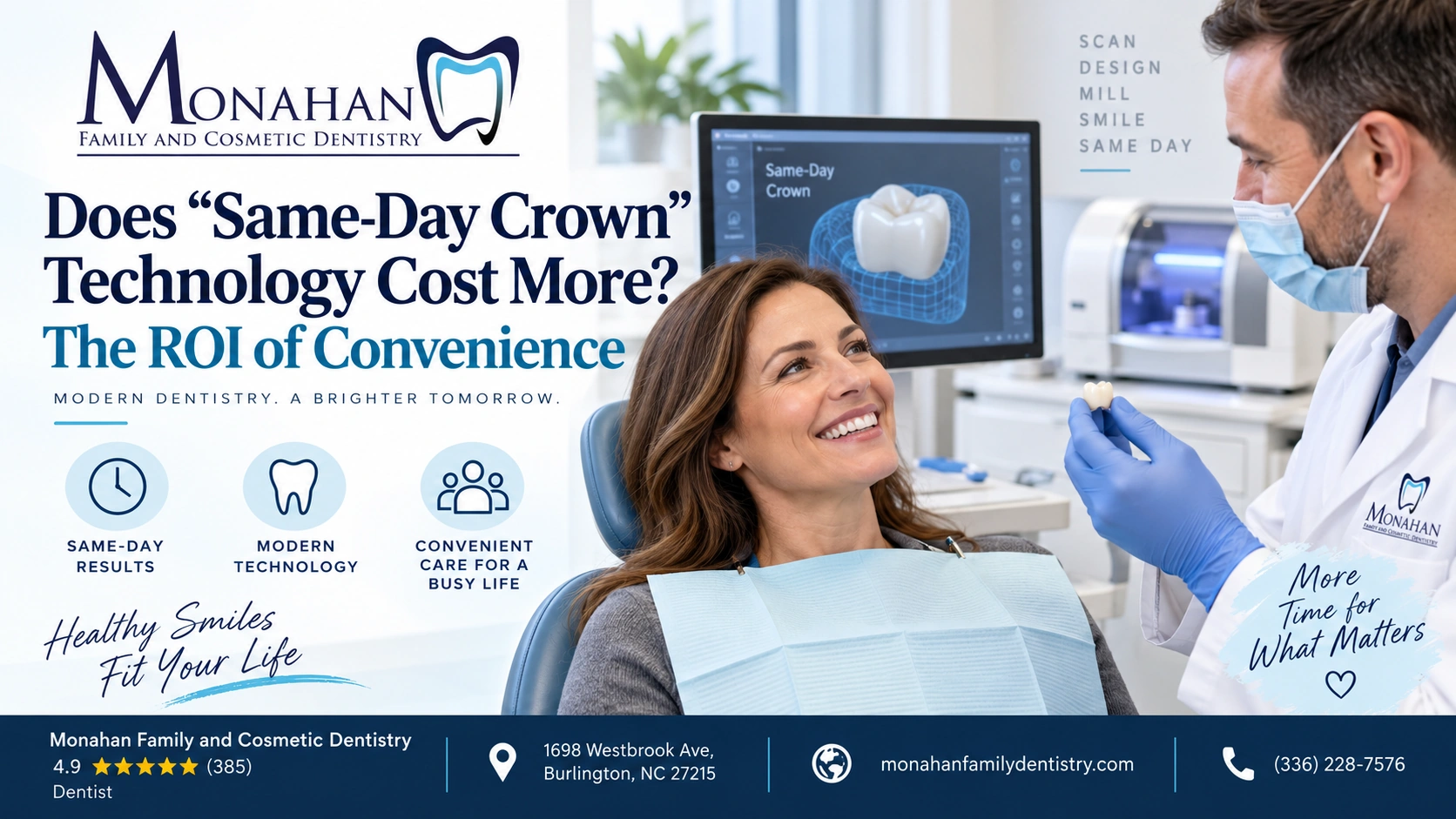
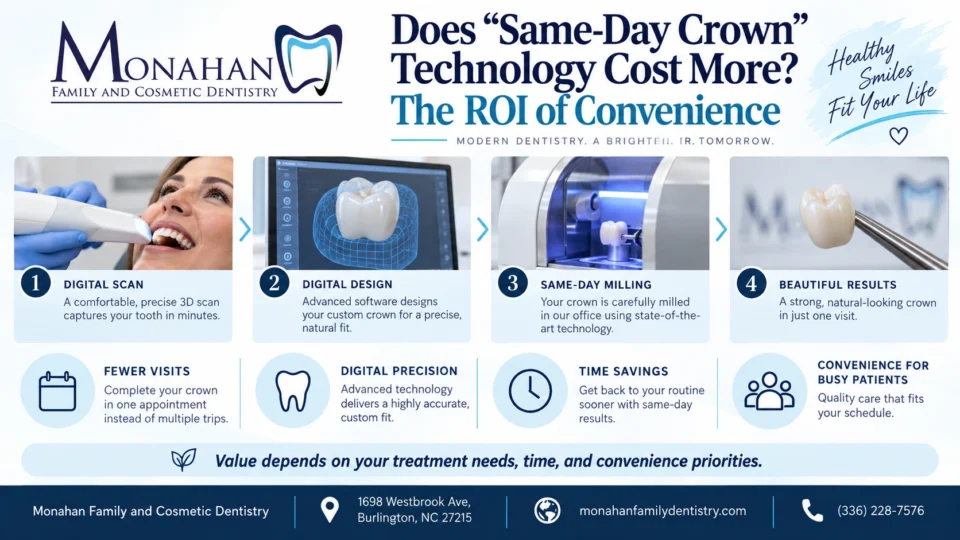
At Monahan Family & Cosmetic Dentistry in Burlington, NC, our CEREC technology allows us to digitally scan the tooth, design the restoration, mill the ceramic crown in our office, and place the permanent restoration during the same visit when the case is appropriate.
That eliminates the temporary crown and, in many cases, the second dental appointment.
So the better question is not simply:
“Is the crown cheaper?”
It is:
“What does the entire process cost me in money, time, travel, missed work, and inconvenience?”
That is where the return on convenience becomes more interesting.
Does a Same-Day Crown Actually Cost More?
There is no universal “same-day crown surcharge.”
Dental crown fees vary according to the tooth, restorative material, condition of the remaining tooth structure, insurance contract, whether a buildup is required, and other clinical factors.
Current national crown estimates vary substantially. CareCredit reports average crown costs broadly around $697 to $1,399, depending on crown type, while Delta Dental reports an average out-of-network range of roughly $1,100 to $2,000 for a permanent crown. Geography and individual treatment needs affect those numbers.
Locally, our current published guide at Monahan Family & Cosmetic Dentistry places many Burlington-area single crowns around $1,100 to $1,700 before insurance. Cases involving a core buildup, root canal, complex cosmetic treatment, or other additional care can cost more.
That published range is for crown treatment generally.
It does not mean every crown costs $1,100 to $1,700. It also does not mean every same-day crown costs exactly the same as every laboratory-made crown.
You need an examination to get a useful number.
Why isn’t same-day technology automatically more expensive?
The technology itself is expensive for a dental practice to purchase, maintain, and update.
CEREC systems combine digital scanning, computer-aided design, and in-office manufacturing equipment. Dentsply Sirona’s current workflow uses digital scanning followed by in-office milling and fabrication of the restoration.
But an office using that technology may also eliminate several expenses associated with the traditional process.
That can include:
- An outside laboratory step for appropriate cases
- Traditional impression materials
- Fabricating a temporary crown
- A separate crown-delivery appointment
- Staff and chair time associated with the second visit
In other words, advanced technology costs the dental office more in equipment.
That does not automatically mean the patient must pay a large technology premium.
What Are You Really Paying for With a Same-Day Crown?
You are not simply paying to have a crown manufactured quickly.
You are paying for a complete dental restoration.
The dentist still has to diagnose the tooth correctly.
The damaged tooth still has to be prepared.
The restoration has to fit the tooth accurately.
The contact with neighboring teeth must be correct.
The bite has to feel right.
The material must be appropriate for where the crown is being placed.
And the crown must seal and protect the remaining tooth.
The machine does not make those clinical decisions.
Technology is a tool.
The dentist’s diagnosis, tooth preparation, design choices, material selection, bite adjustment, and final evaluation still determine much of the outcome.
That distinction matters because “made in one day” should never be confused with “rushed.”
How Does a Same-Day CEREC Crown Work?
At Monahan Family & Cosmetic Dentistry, our CEREC system allows appropriate restorations to be designed and fabricated inside our Burlington office.
The basic process is straightforward.
Step 1: The tooth is evaluated and prepared
First, the dentist determines whether a crown is actually needed.
Decay, old restorative material, or damaged portions of the tooth are addressed. The remaining tooth is shaped so the crown can fit properly.
If the tooth does not have enough healthy structure remaining, a buildup may also be required.
Step 2: We digitally scan the tooth
Instead of relying entirely on traditional impression material, CEREC uses a digital scanner to capture the tooth.
The information is used to create a three-dimensional digital model.
Step 3: The crown is designed digitally
The dentist can use that model to design the restoration.
Shape matters.
So do neighboring contacts, bite relationships, contours, and the way the crown fits the prepared tooth.
Step 4: The restoration is made in the office
The crown is milled from a ceramic block using the in-office manufacturing system.
Monahan’s current technology page describes this process as a one-visit restoration workflow, with the crown fabricated and placed during that appointment.
Step 5: The crown is checked and placed
Before final placement, the crown still needs to be evaluated.
The dentist checks its fit, appearance, contacts, and bite.
Only then is the permanent restoration seated.
What Is the Financial ROI of Avoiding a Second Dental Visit?
This is where the price comparison becomes more realistic.
Your time has a cost.
Imagine a traditional crown requires a second appointment two weeks later.
The crown-delivery appointment itself might not consume your entire day.
But the appointment is only part of the time commitment.
You may need to:
- Leave work early
- Drive across Burlington or Alamance County
- Pick up a child early from school
- Arrange childcare
- Reschedule meetings
- Miss class
- Pay for additional transportation
- Use paid or unpaid time off
For someone with a flexible schedule, this may be a minor inconvenience.
For someone paid hourly, self-employed, responsible for children, or commuting from another community, the second appointment can represent a real expense.
A simple way to calculate the value
Suppose the second crown appointment costs you two hours of productive time once travel, waiting, and treatment are included.
The value of avoiding that trip might look like this:
| Value of your time | Two hours avoided |
| $20 per hour | $40 |
| $30 per hour | $60 |
| $50 per hour | $100 |
| $75 per hour | $150 |
| $100 per hour | $200 |
That still does not include gas, childcare, parking, lost commissions, missed client work, or schedule disruption.
This is why a patient should not compare crown options only by asking whether one treatment is $50 or $100 more.
If there is a price difference, compare that difference against the cost of the appointment you are avoiding.
What About the Cost of a Temporary Crown?
Traditional crowns usually require a temporary restoration while the final crown is being manufactured.
Most temporary crowns work perfectly well.
But they are still temporary.
They can occasionally loosen, break, feel sensitive, or come off.
When that happens, you may need another dental visit before the permanent crown is ready.
That does not mean temporary crowns are bad dentistry.
They are a normal part of traditional crown treatment.
But avoiding the temporary stage has value.
With an appropriate [same-day crown in Burlington, NC], the permanent restoration can often be placed without spending days or weeks protecting a temporary crown. Monahan’s CEREC workflow specifically avoids the temporary restoration and separate follow-up visit for appropriate cases.
For many patients, that is the biggest practical advantage.
Is a Same-Day Crown Lower Quality Because It Is Made Faster?
No. Speed alone does not determine quality.
But same-day does not automatically mean better either.
That is an important distinction.
Modern CAD/CAM ceramic crowns have substantial clinical evidence behind them. A recent systematic review found strong five-year survival rates for modern monolithic lithium-disilicate and zirconia single crowns, with outcomes comparable to established metal-ceramic options in the studies evaluated.
Research comparing CAD/CAM and traditional fabrication has produced varying results over the years, partly because materials, scanners, milling systems, and manufacturing techniques continue to change.
A 2026 systematic review examining crown marginal fit found that CAD/CAM and conventionally fabricated ceramic crowns produced comparable marginal gaps overall, with both approaches falling within clinically acceptable limits in the included studies.
Here is what patients should take from that:
Do not choose a crown based on the machine alone.
Choose based on the tooth, material, diagnosis, dentist, bite, fit, and clinical situation.
When Might a Traditional Lab-Made Crown Be the Better Choice?
Same-day crowns are useful.
They are not mandatory for every patient.
There are cases where involving a dental laboratory may give the dentist more restorative options.
This can matter particularly when esthetics are unusually complex.
For example, matching one highly visible front tooth to the neighboring natural teeth can require careful attention to translucency, surface texture, internal coloring, and subtle shade variation.
A laboratory technician may also provide additional options for certain materials or complex restorations.
Our own Burlington crown guide makes this point directly: neither a same-day crown nor a lab-made crown is automatically superior. Lab-made crowns may provide greater flexibility in certain complex cosmetic cases or when particular materials are preferred.
That is the correct way to think about this choice.
Convenience matters.
Fit and diagnosis matter more.
Situations where a laboratory crown may deserve consideration
A lab-made restoration may make sense when:
- Extremely precise cosmetic characterization is needed
- The dentist wants a particular material not suited to the chairside workflow
- Several restorations must be coordinated aesthetically
- The case is unusually complex
- A dental technician’s additional customization would be valuable
There is nothing wrong with taking two appointments when two appointments produce the better restoration.
The goal should not be to complete everything in one day at all costs.
Does Dental Insurance Pay Differently for Same-Day Crowns?
Do not assume your insurance company will pay more simply because advanced technology is used.
Dental benefits usually depend on the service covered, your specific policy, deductible, annual maximum, network status, waiting periods, and other plan rules.
Coverage varies significantly between patients.
Delta Dental specifically recommends obtaining a pre-treatment estimate because crown coverage and out-of-pocket responsibility depend on the individual benefit plan.
Ask the dental office three separate questions:
- What is the total treatment fee?
- What is insurance estimated to pay?
- What is my estimated out-of-pocket responsibility?
Do not ask only, “Does my insurance cover crowns?”
A plan can “cover crowns” and still leave you responsible for a substantial portion of the bill.
What Actually Makes a Dental Crown Expensive?
Patients sometimes focus too heavily on whether the crown is same-day.
That may not be the biggest cost factor.
The condition of the tooth can matter much more.
You may need a core buildup
If a large filling, fracture, or decay has removed substantial tooth structure, the dentist may need to rebuild the foundation before placing the crown.
That adds treatment and cost.
You may need a root canal
A crown covers and protects the outside of the tooth.
It does not treat an infected or severely damaged nerve.
If the nerve is involved, root canal treatment may be needed separately.
That can raise the total treatment cost far more than any difference between same-day and traditional crown fabrication.
Crown material matters
Ceramic, zirconia, porcelain-fused-to-metal, and other materials have different indications.
The cheapest material is not automatically the smartest material.
Cosmetic complexity matters
A molar primarily needs strength, fit, and proper function.
A highly visible front tooth needs those things plus excellent esthetics.
That additional planning can change both treatment approach and cost.
When Is Paying More for Convenience Worth It?
Assume for a moment that you are offered two clinically appropriate crown options.
Option A requires two appointments.
Option B can be completed in one appointment but costs slightly more.
The decision becomes fairly practical.
A convenience premium may be worth it when:
- You are paid hourly and lose income for appointments
- Taking time off work is difficult
- You own a business and missed time affects revenue
- You travel frequently
- You live outside Burlington
- Childcare arrangements are difficult
- Dental appointments make you anxious and you prefer fewer visits
- You want to avoid wearing a temporary crown
- Your schedule makes returning in two weeks difficult
Paying more for same-day treatment may not make sense when:
- Your schedule is flexible
- There is a significant price difference
- Insurance strongly favors another approach
- The dentist believes a laboratory restoration is better for the case
- The tooth requires specialized material or cosmetic work
- You are choosing same-day technology only because it sounds newer
Technology should solve a problem.
If the convenience provides no meaningful value to you, there is no reason to overpay solely for the label.
How Should You Compare a Same-Day Crown Quote With a Traditional Crown Quote?
Do not compare two numbers until you understand what those numbers include.
Ask each office:
- What crown material is being used?
- Is a buildup included?
- Are X-rays separate?
- Is the temporary crown included?
- Is there a separate laboratory fee?
- How many appointments are required?
- What happens if the temporary crown comes off?
- Is the final placement included?
- What is insurance estimated to pay?
- What will I likely owe?
- Is this crown appropriate for my bite and tooth location?
Then compare the full treatment.
A $1,200 quote and a $1,400 quote may not represent the same dentistry.
One may include services that the other does not.
The Cheapest Crown Is Not Always the Lowest-Cost Crown
This is where crown shopping can go wrong.
A dental crown is supposed to protect a tooth for years.
Saving a small amount today is not useful if the restoration has to be replaced prematurely.
Problems with crowns can include:
- Recurrent decay
- Poor bite
- Fracture
- Gum irritation
- Loose cement
- Tooth fracture
- Need for replacement
- Additional treatment to the tooth
A crown’s long-term value comes from correct diagnosis, preparation, fit, material selection, and maintenance.
Not from how impressive the equipment looks.
Not from how inexpensive the advertisement was.
And not simply from how quickly the crown was manufactured.
What Is the Real ROI of Same-Day Crown Technology?
There are really three forms of return.
1. Time ROI
You may eliminate an additional trip to the dental office.
For many working adults, parents, students, and business owners, that has measurable value.
2. Convenience ROI
You may avoid a temporary crown, an additional injection, another appointment, and the disruption of returning weeks later.
That benefit is harder to put into dollars, but it is real.
3. Clinical workflow ROI
Digital scanning and in-office manufacturing allow the restoration to move from preparation to final placement in one continuous workflow when the tooth is appropriate for same-day treatment.
At Monahan Family & Cosmetic Dentistry, the current CEREC system digitally scans the tooth, creates a 3D model, mills the ceramic restoration in-office, and allows the dentist to place it during the same visit.
None of those advantages means the crown should automatically cost more.
They mean you should evaluate the total value, not simply the treatment fee.
One Visit Is Valuable—When It Is the Right Visit
For patients considering [dental crowns in Burlington, NC], our approach at Monahan Family & Cosmetic Dentistry is not to use technology simply because we own it.
The restoration still needs to make sense for your tooth.
Dr. Thomas Monahan and our team can evaluate whether a same-day ceramic crown is appropriate, whether another restorative option would be better, and what your expected cost may be before treatment.
Our CEREC technology gives us the ability to provide one-visit permanent ceramic restorations for appropriate patients.
For someone balancing work in Burlington, classes in Elon, family responsibilities in Graham, or a commute from Mebane, avoiding another appointment may have meaningful value.
For another patient, a laboratory-made crown may be the smarter choice.
Both can be good dentistry.
The important part is understanding why one is being recommended for you.
If you have been told that you need a crown, contact Monahan Family & Cosmetic Dentistry and ask for a clear treatment estimate.
We can help you understand the condition of the tooth, your restorative options, expected insurance benefits, and whether same-day treatment offers enough convenience to make sense for your situation.
Frequently Asked Questions About Same-Day Crown Costs
Are same-day crowns more expensive than regular crowns?
Not automatically.
Prices vary by dental office, material, insurance plan, and complexity. Some offices price same-day and traditional crowns similarly. Others may have different fees.
Ask for the total out-of-pocket estimate rather than assuming faster treatment means more expensive treatment.
How much does a dental crown cost in Burlington, NC?
Monahan Family & Cosmetic Dentistry’s current 2026 crown guide says many Burlington patients can expect approximately $1,100 to $1,700 per single crown before insurance. Additional treatment such as a buildup, root canal, or complex cosmetic work can raise the total.
Can a CEREC crown really be completed in one visit?
For appropriate cases, yes.
Monahan’s CEREC workflow uses digital scanning, computerized design, and in-office milling so a permanent ceramic restoration can be made and placed during one appointment.
Do same-day crowns require a temporary crown?
Typically, the advantage of a true same-day workflow is that the permanent restoration is made and placed during the same visit, so a temporary crown is generally unnecessary.
Is a same-day crown as strong as a traditional crown?
The answer depends more on the crown material, tooth location, preparation, bite, and clinical execution than on whether the restoration was made inside the office or in a laboratory.
Modern CAD/CAM ceramic crown materials can provide strong clinical performance when appropriately selected.
Are same-day crowns good for front teeth?
They can be.
However, front teeth can require more demanding shade and cosmetic matching. Certain highly visible or complex cases may benefit from laboratory customization.
The dentist should recommend the workflow based on the cosmetic demands of the individual tooth.
Will insurance cover a CEREC crown?
Coverage depends on your dental benefit plan and clinical circumstances.
Do not assume that being made with CEREC guarantees or prevents coverage. Ask the dental office to estimate your benefits before treatment.
Is a same-day crown worth it if it costs slightly more?
It can be.
Calculate the value of the additional appointment you avoid. Include missed work, transportation, childcare, travel time, and the inconvenience of wearing a temporary crown.
If those costs exceed the price difference, same-day treatment may actually be the lower-cost option for you.
Who is a good candidate for a same-day crown?
Many patients needing a single ceramic restoration may be candidates, but the final decision depends on the tooth, bite, amount of remaining healthy structure, restorative material needed, and cosmetic requirements.
An examination is the only reliable way to determine whether one-visit treatment makes sense.