
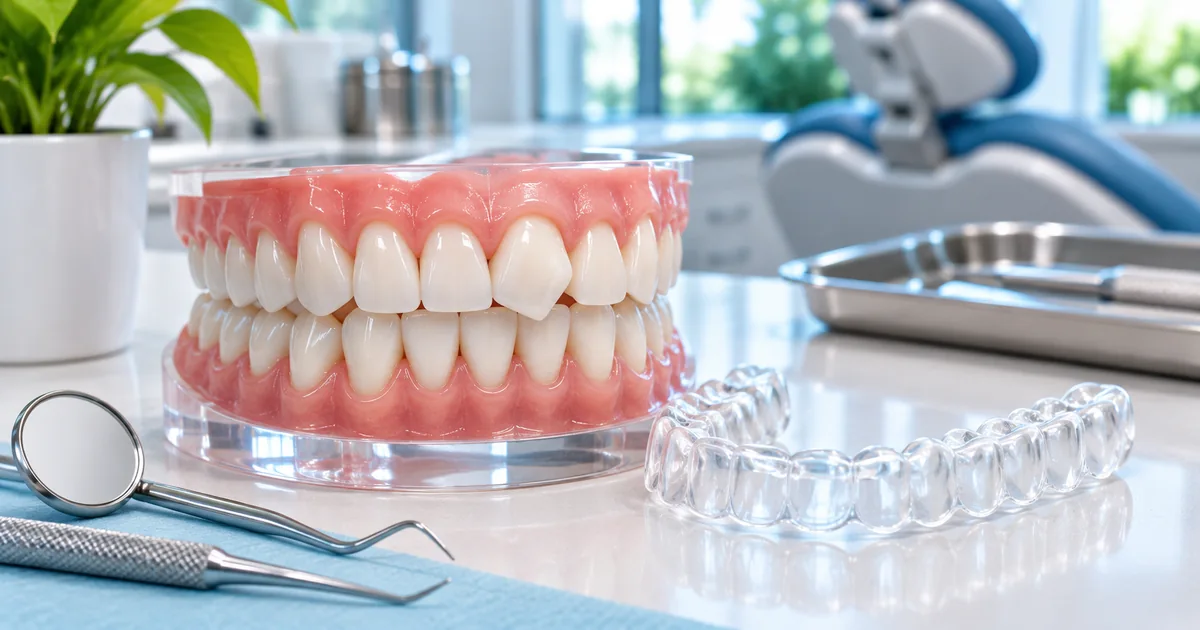
Sometimes your smile is almost exactly where you want it.
Except for one tooth.
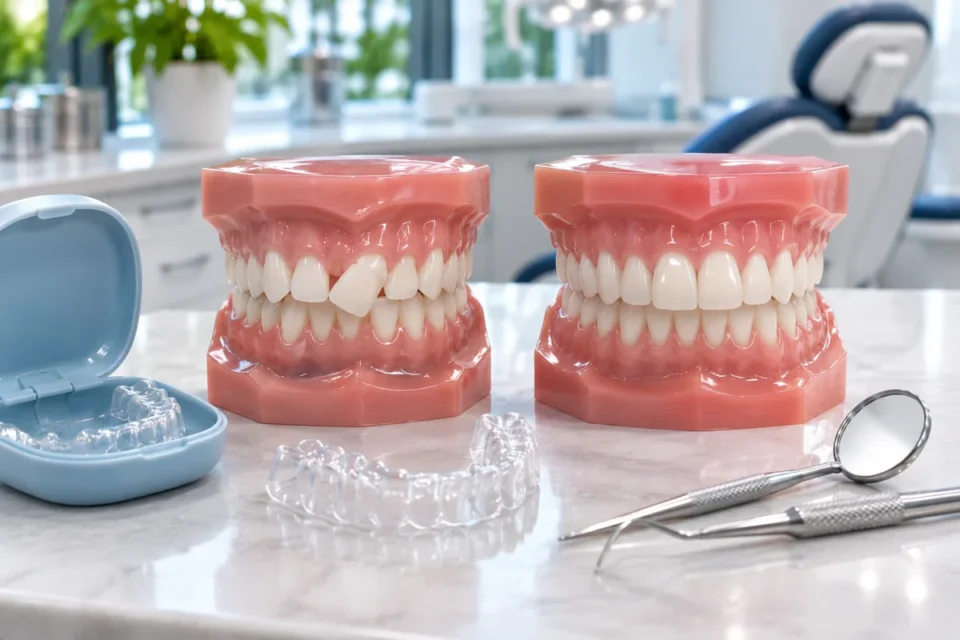
Maybe one front tooth turns inward.
A lateral incisor sits behind the others.
One lower tooth has rotated enough that its edge points toward your tongue.
Or a tooth that was straight after braces slowly shifted because the retainer stopped fitting years ago.
Patients sometimes call this a “flipped tooth.”
Dentists and orthodontists are more likely to describe it as a rotated, crowded, displaced, or misaligned tooth.
The obvious question is:
Do you really need braces on your entire mouth to fix one crooked tooth?
Often, no.
A small alignment problem may sometimes be corrected with a limited course of clear aligners, short-term orthodontic treatment, or another targeted approach.
But there is a catch.
The tooth you see may be the only tooth bothering you, but it may not be the only tooth that needs to move.
Orthodontic treatment has to create room, control the root, protect the bite, and keep the corrected tooth stable afterward.
At Monahan Family & Cosmetic Dentistry, that is why we do not judge an orthodontic problem from one selfie.
We need to look at the tooth.
Then we need to look at everything around it.
What Does a “Flipped Tooth” Actually Mean?
“Flipped tooth” is patient language rather than a technical orthodontic term.
Most people are describing rotation.
Imagine looking down at a tooth from above.
Instead of facing forward in the dental arch, it has twisted around its long axis.
The amount of rotation can be small.
Or it can be dramatic enough that the side surface of the tooth faces forward.
Other patients use “flipped” to describe a tooth that sits:
- Behind neighboring teeth
- In front of the dental arch
- Angled inward
- Angled outward
- Tilted rather than truly rotated
- Relapsed after previous orthodontic treatment
Those distinctions matter because each type of movement behaves differently.
A tooth that only needs slight tipping may be much easier to correct than a severely rotated tooth whose root also needs repositioning.
Can Invisalign Fix Just One Crooked Tooth?
Sometimes.
Clear aligners can be a very reasonable option for mild or moderate alignment problems.
The American Association of Orthodontists lists crowded, crooked, and gapped teeth among the conditions that can potentially be treated with clear aligners. It also emphasizes that aligners are not appropriate for every bite or every type of tooth movement.
Monahan Family & Cosmetic Dentistry currently offers Invisalign in Burlington. Our 2026 Invisalign guidance specifically notes that treatment makes the most sense when the case can be predictably treated with aligners and the patient can wear the trays consistently.
For one visibly rotated front tooth, clear aligners may be able to:
create a small amount of space,
rotate the tooth,
adjust nearby teeth,
and refine the final bite.
That can avoid conventional full-mouth braces in an appropriate case.
But “one crooked tooth” does not necessarily mean “one tooth moves.”
Why Do Other Teeth Have to Move If Only One Looks Crooked?
Because the tooth needs somewhere to go.
Suppose one lower front tooth is rotated.
To straighten it, the tooth may require additional width within the dental arch.
If there is no room, simply trying to rotate it would push against neighboring teeth.
The treatment plan may therefore need to move several teeth slightly to create the required space.
Think of cars in a crowded parking lot.
If one car is parked crooked, you may not be able to straighten it until the cars on either side move.
Orthodontics works under similar space constraints.
Aligners also need anchorage
When an aligner pushes one tooth, force has to come from somewhere.
The surrounding teeth help provide stability.
That means even a very limited cosmetic correction often involves an aligner covering the entire dental arch.
Patients sometimes ask:
“Why can’t you make a little tray for just these three teeth?”
Because controlled orthodontic movement usually requires support from additional teeth.
Are Rotated Teeth Difficult to Move With Clear Aligners?
Some are.
This is one area where the newest research is particularly useful.
A 2025 systematic review specifically examined rotational tooth movement in adults treated with clear aligners.
Across the included studies, the reported accuracy of planned rotation ranged widely from approximately 36% to 85%, averaging around 65%.
Incisors and molars tended to be more predictable, while upper canines and premolars were among the least predictable teeth to rotate. The authors rated the overall certainty of the evidence as low to moderate because studies differed substantially in methods and quality.
That does not mean Invisalign “only works 65%.”
It means the exact rotation predicted by software is not always the exact rotation achieved biologically.
Teeth are not pixels.
Treatment sometimes needs adjustment.
Why Are Some Teeth Harder to Rotate?
Shape matters.
A relatively flat or rectangular tooth gives the aligner more surface to grip.
A rounder tooth can be harder to rotate because the tray has less natural mechanical purchase.
This is one reason canines and some premolars can be challenging.
Imagine trying to twist a square block inside a fitted container.
Now imagine trying to twist a smooth cylinder.
The cylinder is harder to grip.
Dental biomechanics are obviously more complex, but the basic concept helps explain why tooth shape affects aligner predictability.
What Are Those Little Attachments on Invisalign Teeth?
Attachments are small tooth-colored shapes bonded temporarily to selected teeth.
They give the aligner additional surfaces to push against.
If you are correcting a rotated tooth, an attachment may help the tray produce a more useful rotational force.
Attachments are removed after treatment.
They are not fillings.
And needing them does not mean Invisalign “failed.”
They are part of the mechanics.
Do attachments guarantee a rotated tooth will move perfectly?
No.
The 2025 systematic review on rotation found that attachments and interproximal reduction were commonly used, but their effectiveness varied among studies.
They are tools.
They are not guaranteed.
What Is IPR, and Why Might You Need It for One Tooth?
IPR stands for interproximal reduction.
That means carefully reducing a very small amount of enamel between selected teeth to create space.
For example, if a rotated lower incisor needs a fraction of a millimeter more room, controlled IPR may help create that space without extracting a tooth.
Patients often hear the phrase “shaving teeth” online.
That makes the procedure sound far more dramatic than it usually is.
Properly planned IPR involves very small, measured amounts of enamel.
But it is still an irreversible procedure.
The enamel removed does not grow back.
So the reason for doing it should be clear.
Can You Fix One Crooked Tooth With a Retainer?
Sometimes but mostly in specific relapse situations.
If you previously had orthodontic treatment and one tooth has shifted only slightly, a dentist or orthodontist may sometimes use a limited aligner approach or modify the retention plan.
But a passive retainer is primarily designed to hold teeth rather than conduct substantial new orthodontic treatment.
The American Association of Orthodontists notes that when teeth have shifted slightly after orthodontic treatment, a retainer may occasionally help with a small correction. More significant movement can require another short course of braces or clear aligners.
Do not force an old retainer over a tooth that has moved significantly.
Pain is not proof that the tooth is “moving back.”
You can damage the appliance or create uncontrolled pressure.
What About Limited Braces?
Short-term fixed orthodontics can also be used for isolated problems.
Instead of placing braces for a comprehensive correction lasting years, an orthodontic provider may sometimes place brackets on a limited number of teeth to address a specific alignment issue.
This can provide excellent mechanical control.
Fixed braces also have an advantage:
You cannot forget to wear them.
Clear aligners depend heavily on patient compliance.
Monahan’s current Invisalign guidance recommends wearing aligners approximately 20–22 hours per day for predictable treatment.
If you know you will routinely leave the trays on the bathroom counter, clear aligners may be a poor investment even if the tooth movement itself is simple.
Is Limited Treatment Always Better Than Full Orthodontic Treatment?
No.
This is the most important consumer warning.
Patients understandably focus on the tooth visible in the mirror.
Your dentist has to look at the bite behind it.
The American Association of Orthodontists emphasizes that orthodontic treatment is not only cosmetic. The goal is a healthy, functional bite involving how upper and lower teeth fit together.
Suppose one upper front tooth is rotated.
You ask us to straighten only that tooth.
But examination reveals:
a significant crossbite,
deep overbite,
crowding throughout the lower arch,
or several teeth hitting unevenly.
A cosmetic-only correction could potentially make the front tooth look better without addressing and possibly while worsening the bite.
That is where limited treatment becomes the wrong shortcut.
Who Is a Good Candidate for a Small Invisalign Correction?
Limited clear-aligner treatment tends to make more sense when the overall bite is reasonably stable and the primary problem is mild.
Examples can include:
a small relapse after previous braces,
one moderately rotated incisor,
minor front-tooth crowding,
a small space,
or a slight tooth-position change.
The healthier the gums and supporting bone, the better.
Adults can move teeth successfully, but existing crowns, implants, gum recession, bone loss, and previous dental work may affect planning.
AAO guidance specifically notes that adults may have restorative or periodontal concerns requiring individualized orthodontic monitoring.
When Is One-Tooth Treatment a Bad Idea?
A limited cosmetic plan may be inadequate when there is:
significant bite correction required,
severe crowding,
a major crossbite,
large tooth movements,
substantial root-position problems,
active gum disease,
an impacted tooth,
or a complex skeletal problem.
Certain movements are also harder for clear aligners than others.
Recent reviews continue to show that while clear aligners can effectively treat many mild-to-moderate cases, the accuracy varies considerably by movement. Rotation, intrusion, expansion, torque, and bodily root movement can be less predictable than simple tipping.
In difficult cases, fixed orthodontic appliances or specialist treatment may offer more predictable control.
Referral is not failure.
It is choosing the tool that matches the problem.
Can You Just Put a Veneer on the Crooked Tooth?
You can sometimes make a crooked tooth look straighter with restorative dentistry.
That does not mean you moved it.
The American Association of Orthodontists makes this distinction clearly: veneers can cover the appearance of misalignment but do not actually correct the arrangement of the teeth or an improper bite.
A veneer may make sense when a tooth also has substantial:
discoloration,
enamel damage,
shape problems,
or existing restorative needs.
But if a completely healthy tooth is merely rotated, orthodontically moving the natural tooth may be more conservative than removing healthy enamel so porcelain can disguise its position.
Bonding can disguise small irregularities too
Composite bonding can alter tooth shape.
For a tiny visual asymmetry, that may sometimes create an acceptable cosmetic result without orthodontics.
But bonding also does not move the root.
If the actual problem is tooth position, you should understand that distinction before choosing restorative treatment.
How Long Does It Take to Fix One Crooked Tooth?
There is no honest universal number.
A small relapse may require a relatively short aligner plan.
A severely rotated canine can take substantially longer.
Treatment time depends on:
how far the tooth needs to move,
the amount of space available,
tooth shape,
root position,
bite correction,
your biological response,
aligner wear,
and whether refinements are necessary.
This is why “one tooth” does not automatically mean “six weeks.”
Orthodontic movement is still biology.
What Are Refinements?
A refinement is an additional series of aligners prescribed when the teeth have not completely reached the planned positions after the initial trays.
For rotated teeth, that possibility should not be surprising.
The newest rotation research shows that computer-predicted movement is not perfectly expressed clinically.
A refinement does not automatically mean treatment failed.
It often means:
The plan needs another round to finish what biology did not complete on the first attempt.
When comparing Invisalign prices, ask whether refinements are included.
A cheap limited-treatment quote becomes less attractive if every additional tray series creates a new bill.
How Much Does Invisalign Cost for One Crooked Tooth in Burlington?
This is where expectations need adjusting.
The cost is not based solely on the number of visibly crooked teeth.
You are paying for diagnosis, digital planning, aligners, monitoring, attachments when needed, refinements depending on the plan, and retention afterward.
Monahan’s current 2026 Burlington Invisalign guide gives a broad planning range of approximately:
$3,000–$8,000 total
with financing examples around:
$125–$300+ per month, depending on the arrangement.
A genuinely limited case may fall toward the lower end or potentially be structured differently.
But Monahan’s public site does not currently publish a guaranteed “single-tooth Invisalign price.”
That means we should not invent one.
The only useful quote comes after evaluating the actual movement required.
Why Retainers Matter Even More After Fixing One Tooth
Patients frequently think:
“It was only one tooth. Surely it will stay there.”
Not necessarily.
Teeth can continue shifting throughout life.
And a tooth that was previously rotated can have a particular tendency toward relapse.
The AAO recommends retention after orthodontic treatment because teeth can drift as the bone and soft tissues stabilize and continue changing over time. It advises some degree of lifelong retainer wear to maintain orthodontic results.
That means your treatment budget should include the ending.
Not just the movement.
The cheapest retainer is the one you do not lose
After spending thousands of dollars correcting alignment, throwing away a clear retainer wrapped in a restaurant napkin is a painful way to restart the process.
Keep it in its case.
Replace it if it stops fitting properly.
And do not wait until the tooth is visibly rotated again before asking for help.
Can a Single Crooked Tooth Affect Dental Health?
Sometimes.
A rotated tooth can create tight or irregular contacts that make cleaning more difficult.
Misaligned teeth may also create uneven bite relationships or premature wear in certain cases.
The AAO notes that poorly aligned teeth can be more difficult to keep clean and can contribute to abnormal enamel wear.
But we should not exaggerate.
One slightly crooked front tooth is not automatically a disease.
For some people, correcting it is mainly cosmetic.
That is completely legitimate.
You do not need to invent a medical emergency to justify wanting a straighter smile.
Straighten the Tooth Without Losing Sight of the Bite
At Monahan Family & Cosmetic Dentistry, we understand why patients ask for the smallest solution.
If 27 teeth look fine and one tooth bothers you every time you smile, a two-year full-braces plan may sound excessive.
Sometimes it is.
A limited Invisalign plan can be an excellent way to correct mild relapse, rotation, crowding, or spacing without conventional braces.
But the word limited should describe the scope of the problem.
Not the quality of the diagnosis.
Dr. Thomas Monahan can evaluate the position of the tooth, the space around it, your bite, gum health, existing dental work, and whether clear aligners can predictably produce the movement you want.
If a short aligner plan makes sense, we can explain it.
If neighboring teeth need to move too, you should understand why.
If the tooth is poorly suited to predictable aligner rotation, you should know that before paying for treatment.
And if a more complex orthodontic problem warrants specialist care, that should be part of the conversation too.
The goal is not to talk someone with one crooked tooth into treating an entire mouth unnecessarily.
It is also not to straighten one visible tooth while ignoring a bite problem that determines whether the result will actually function and last.
Frequently Asked Questions About Fixing One Crooked Tooth
Can you straighten only one tooth?
Often, yes, if the overall orthodontic problem is limited.
But other teeth may need small movements to provide space and anchorage for the tooth being corrected.
Can Invisalign fix a rotated tooth?
Yes, many rotated teeth can be treated with clear aligners.
Predictability varies by tooth and severity. A 2025 systematic review found average rotational accuracy around 65%, with a wide range between studies and lower predictability for certain canines and premolars.
Does Invisalign move the whole mouth if I only care about one tooth?
The trays usually cover the entire arch because neighboring teeth often provide anchorage.
That does not mean every tooth must undergo significant movement.
How long does fixing one tooth take?
It depends on the amount and type of movement.
Minor relapse can be relatively quick. Significant rotation or space creation can take longer and may require refinement trays.
Can I use my old retainer to push the tooth back?
If a retainer still fits comfortably and the movement is extremely small, a dental professional may sometimes advise increased wear.
Do not force a painful or poorly fitting retainer. More significant relapse may require active orthodontic treatment.
Is bonding cheaper than Invisalign for one crooked tooth?
Bonding can sometimes disguise a small shape or alignment irregularity and may cost less than orthodontic treatment.
But bonding does not move the tooth or root.
The comparison depends on whether you want to correct the position or merely alter the appearance.
Are veneers a good way to straighten one tooth?
Veneers can camouflage a misaligned tooth, but they do not move it.
For an otherwise healthy tooth, removing enamel solely to make the tooth appear straight may be less conservative than orthodontic movement.
How much does Invisalign cost in Burlington?
Monahan’s current 2026 planning range is approximately $3,000–$8,000, with the actual cost depending on case complexity and the treatment plan.
There is no publicly listed guaranteed “one-tooth” price.
Do I need a retainer after fixing only one tooth?
Yes, retention remains important.
Teeth can shift after treatment, and the AAO recommends ongoing retainer use to maintain orthodontic results.
What is the biggest mistake with a single crooked tooth?
Assuming that because only one tooth looks wrong, only one tooth is involved.
The cosmetic complaint may be isolated.
The orthodontic mechanics may not be.
A proper examination should determine the difference before treatment begins.