
Every spring, it happens.
The cars turn yellow.
The sidewalks turn yellow.
Your porch turns yellow.
And suddenly, one of your upper teeth starts hurting.
Most people assume the same thing:
“Great. I have a cavity.”
But here in Burlington and throughout the Piedmont region of North Carolina, that’s not always what’s happening.
In fact, during peak allergy season, many patients come into the office convinced they need a filling or root canal when the real culprit is something completely different:
Sinus pressure.
The Short Answer
If your tooth pain started around the same time as:
- Seasonal allergies
- Nasal congestion
- Sinus pressure
- Sneezing
- Postnasal drip
There’s a good chance your teeth aren’t the problem.
Your sinuses may be.
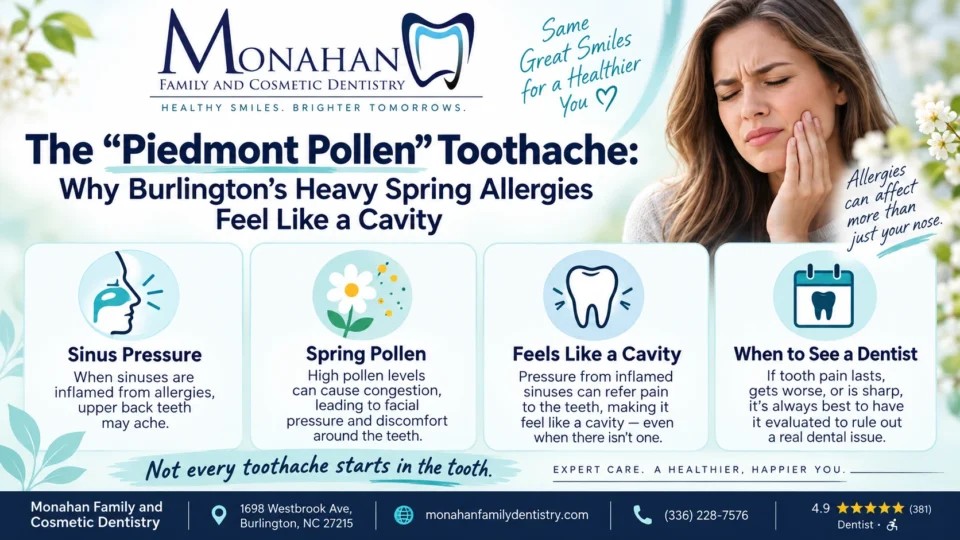
The maxillary sinuses sit directly above your upper back teeth. When allergies cause inflammation and pressure in those sinus cavities, the sensation can feel remarkably similar to a toothache.
Why This Happens Every Spring in Burlington
Anyone who has lived in Alamance County for more than a year knows spring pollen here is no joke.
North Carolina’s Piedmont region regularly experiences significant tree pollen seasons, especially from oak, pine, maple, cedar, and other common local species. During peak pollen periods, allergy symptoms can become severe enough to create substantial sinus inflammation.
When those sinuses become swollen and congested, they press against nerves that serve the upper teeth.
Your brain interprets that pressure as:
- Tooth pain
- Tooth sensitivity
- Pressure when biting
- A dull ache in multiple teeth
- Pain that seems to move around
That’s why allergy-related tooth pain often feels strange compared to a cavity.
The Biggest Clue: Multiple Teeth Hurt
Most cavities don’t affect three or four teeth at the same time.
Sinus pressure often does.
Here’s what we commonly see:
More Likely a Sinus Issue
- Several upper teeth hurt
- Pain feels widespread
- Symptoms started during allergy season
- Congestion is present
- Pressure worsens when bending forward
- Both sides of the mouth feel affected
More Likely a Dental Issue
- One specific tooth hurts
- Pain is getting progressively worse
- Hot or cold triggers discomfort
- Chewing causes sharp pain
- Symptoms continue after allergy symptoms improve
- Swelling develops around a specific tooth
The “Bending Over Test”
This isn’t a diagnosis.
But it can be a clue.
If you bend forward to tie your shoes and suddenly feel increased pressure in your upper teeth, sinuses may be involved.
Many allergy sufferers notice tooth discomfort becomes worse when:
- Bending over
- Lying down
- Exercising
- Flying
- Experiencing heavy congestion
That’s because sinus pressure changes with position.
Cavities generally don’t behave that way.
The Honest Warning
Here’s where people get into trouble.
They assume all tooth pain during allergy season is sinus-related.
Sometimes it is.
Sometimes it isn’t.
We’ve seen patients delay treatment for weeks because they thought pollen was causing the problem, only to discover:
- A cracked tooth
- A deep cavity
- An abscess
- A failing filling
- A tooth requiring root canal treatment
The opposite happens too.
Patients become convinced they need major dental treatment when their teeth are perfectly healthy and the real issue is sinus inflammation.
When It Is Time to Call a Dentist
You should have tooth pain evaluated if:
- Pain persists after allergy symptoms improve
- One tooth hurts significantly more than the others
- You experience swelling
- You have pain while chewing
- Hot or cold triggers discomfort
- The pain wakes you up at night
- Symptoms continue for more than several days
The goal isn’t necessarily treatment.
The goal is getting an accurate diagnosis.
Why Diagnosis Matters
One of the most valuable things a dental exam can do is tell you what the problem is not.
Sometimes patients leave relieved because they don’t need a crown, filling, or root canal.
Other times, we identify a problem early before it becomes more painful and more expensive.
Either outcome is better than guessing.
The Bottom Line
Every spring, Burlington patients mistake sinus pressure for dental disease.
And honestly, it’s understandable.
The symptoms can feel almost identical.
If your tooth pain arrived at the same time as sneezing, congestion, itchy eyes, and the annual yellow coating on everything outside, allergies may be contributing to what you’re feeling.
But if the pain is severe, persistent, localized to one tooth, or accompanied by swelling, don’t assume pollen is to blame.
At Monahan Family and Cosmetic Dentistry, Dr. Thomas Monahan helps patients throughout Burlington, Graham, Mebane, Elon, and Alamance County determine whether tooth pain is actually a dental problem or whether something else is causing the discomfort. Knowing the difference can save you a lot of worry and help you get the right treatment faster.
Frequently Asked Questions
Can allergies really cause tooth pain?
Yes. Sinus inflammation can create pressure near the roots of upper teeth, leading to discomfort that feels similar to a toothache.
Which teeth are usually affected?
Most commonly, the upper back teeth because they sit closest to the maxillary sinuses.
Can sinus tooth pain feel like a cavity?
Absolutely. Many patients describe it as aching, pressure, sensitivity, or soreness when chewing.
How long should allergy-related tooth pain last?
It often improves as sinus inflammation improves. Persistent symptoms should be evaluated by a dentist.
Can a dentist tell the difference between sinus pain and a cavity?
In many cases, yes. A dental examination and appropriate imaging can often determine whether the pain originates from a tooth or from surrounding sinus structures.