
A missing tooth creates more than an empty space.
You may chew differently.
Food may collect in the gap.
The neighboring teeth can become harder to keep clean.
And when the missing tooth is visible when you smile, appearance becomes part of the decision too.
For years, one of dentistry’s standard solutions was a porcelain-fused-to-metal bridge.
It worked because metal gave the restoration strength while porcelain improved its appearance.
Today, patients have another option:
metal-free dental bridges made from modern ceramics such as zirconia.
For the right patient, these restorations can provide excellent strength and a natural appearance without a visible metal substructure.
But there is an important warning.
Metal-free does not automatically mean better.
A zirconia bridge is not automatically stronger than every metal-ceramic bridge.
A highly translucent ceramic is not automatically appropriate for a heavily loaded back tooth.
And if the healthy teeth beside your missing tooth have never needed crowns, cutting them down for any conventional bridge metal-free or otherwise may not be the most conservative option.
At Monahan Family & Cosmetic Dentistry, we believe the decision should begin with a more useful question:
What is the best way to replace this particular missing tooth?
The material comes after that.
What Is a Metal-Free Dental Bridge?
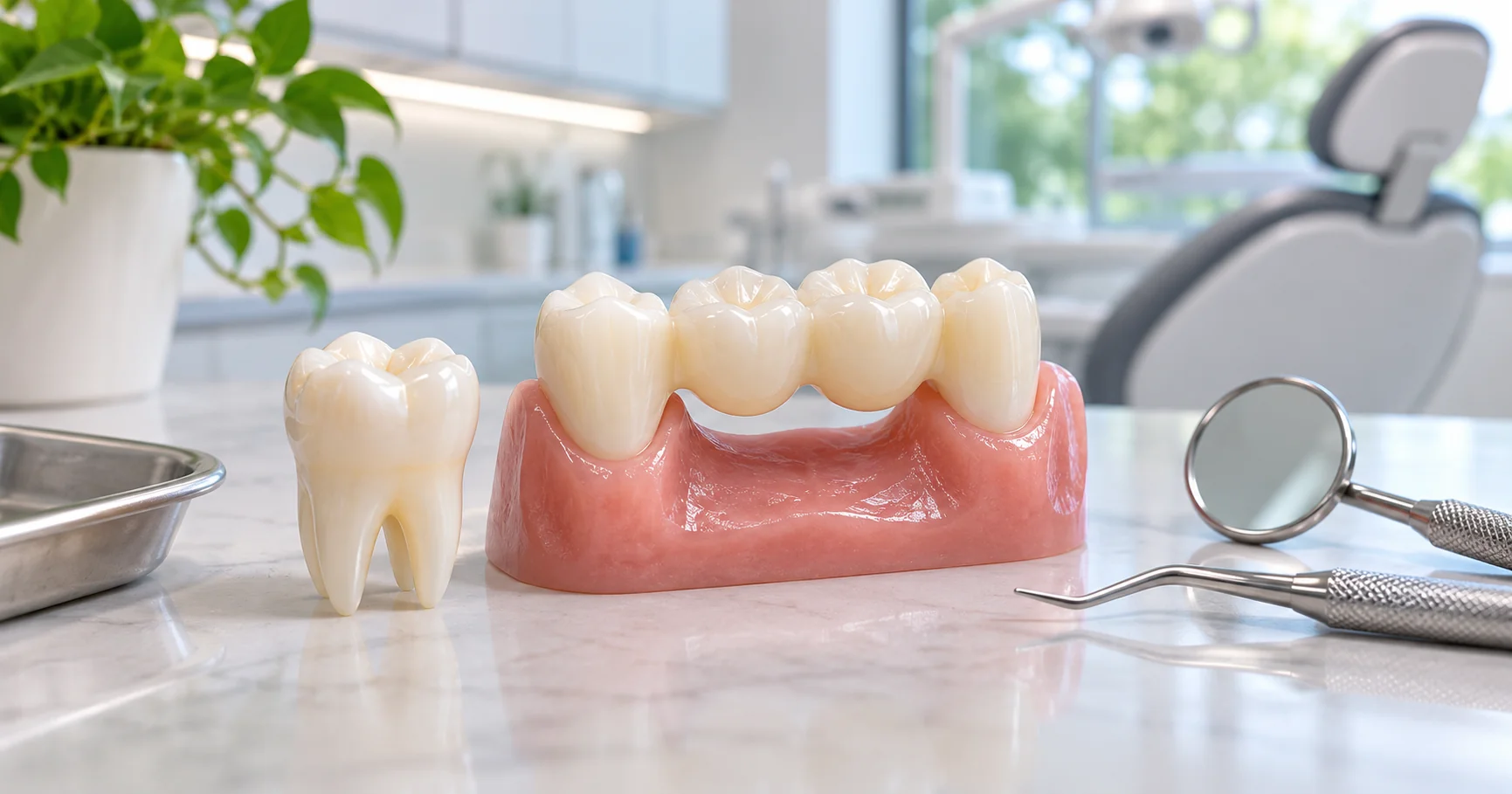
A dental bridge replaces one or more missing teeth with artificial teeth called pontics.
A traditional tooth-supported bridge typically uses crowns on the teeth beside the gap as anchors.
Those supporting teeth are called abutment teeth.
The crowns and replacement tooth are connected together into one fixed restoration.
Monahan Family & Cosmetic Dentistry currently provides several bridge designs in Burlington, including traditional fixed bridges, cantilever bridges, Maryland or resin-bonded bridges, and implant-supported bridges.
A metal-free bridge describes the restorative material rather than one specific bridge design.
Instead of relying on a metal framework covered with porcelain, the visible bridge may be fabricated entirely from a dental ceramic.
Zirconia is one of the most important materials in this category.
What Is Zirconia?
Zirconia is a high-strength dental ceramic.
It has become widely used for crowns and fixed bridges because it can combine substantial mechanical strength with tooth-colored appearance.
The American Dental Association describes both framework zirconia and full-contour zirconia as viable alternatives to porcelain-fused-to-metal and full-metal restorations.
Traditional high-strength zirconia materials can have flexural strengths in the range of approximately 1,000 to 1,400 MPa.
That helps explain why zirconia moved beyond front-tooth cosmetic dentistry.
It can be strong enough for many posterior applications where chewing loads are much greater.
Not all zirconia is the same
This is important.
Modern zirconia exists in different formulations.
Some versions emphasize maximum strength.
Others increase translucency so the restoration looks more lifelike.
But increasing translucency can involve a tradeoff.
The ADA notes that higher-yttria, more translucent zirconia generally becomes more brittle and has lower flexural strength than traditional high-strength zirconia.
So asking:
“Is zirconia strong?”
is not quite enough.
The better question is:
“Which zirconia is being used, where is the bridge going, and how much force will it need to tolerate?”
Why Do Patients Want Metal-Free Bridges?
Usually for one of three reasons.
They want a more natural-looking restoration
Metal-ceramic bridges can look excellent.
But the dentist and laboratory must use opaque porcelain to hide the metal framework underneath.
That can affect how light passes through the restoration.
All-ceramic materials eliminate that metal foundation.
For a visible tooth, particularly near the front of the smile, that can help the restorative team create a more tooth-like appearance.
They do not want a dark metal margin
As gums change over time, the edge of an older porcelain-fused-to-metal crown or bridge can sometimes become more noticeable.
A ceramic restoration avoids having a dark metal framework underneath the porcelain.
That can be particularly appealing when the restoration is in the smile zone.
They simply prefer avoiding metal in the visible restoration
That preference is reasonable.
But the material should still make sense mechanically.
We would not choose a weaker design in a high-force location simply to satisfy a label.
Appearance matters.
So does keeping the restoration intact.
Are Metal-Free Bridges Durable?
They can be.
But the durability question deserves more nuance than most dental marketing pages give it.
A major systematic review and meta-analysis published in 2026 evaluated 2,132 multi-unit tooth-supported bridges, including both metal-ceramic and all-ceramic restorations.
Estimated five-year survival was:
92.9% for veneered densely sintered zirconia
91.3% for metal-ceramic
87.9% for monolithic densely sintered zirconia
82.5% for lithium-disilicate reinforced glass-ceramic bridges
The differences between metal-ceramic and several zirconia categories were not statistically significant, although lithium-disilicate bridges had significantly lower survival than metal-ceramic restorations.
That tells us something useful.
Modern ceramic bridges can work well.
But “all ceramic” is not one material with one survival rate.
Why Do You Sometimes Hear That Metal-Ceramic Bridges Last Longer?
Because other reviews have reached more cautious conclusions.
A 2024 meta-analysis comparing zirconia-based tooth-supported bridges with metal-ceramic bridges found higher failure rates and significantly more ceramic chipping among the zirconia group studied.
The authors concluded that traditional metal-ceramic bridges remained well supported by the available evidence and noted that long-term evidence for monolithic zirconia bridges was still limited.
That does not mean the 2026 review proves the 2024 review wrong.
The studies include different ceramic generations, bridge designs, fabrication methods, patient populations, and follow-up periods.
Older veneered zirconia bridges had particular problems with the porcelain layer chipping.
Newer monolithic designs eliminate a separate veneering layer in many situations.
The practical conclusion is:
Metal-free bridges are legitimate modern restorations, but they have not made traditional metal-ceramic bridges obsolete.
What Is the Difference Between Veneered and Monolithic Zirconia?
This distinction explains a lot of the conflicting information patients see online.
Veneered zirconia
A strong zirconia framework sits underneath a more esthetic porcelain layer.
The framework supplies strength.
The outer ceramic supplies color and translucency.
The concern is that the veneering porcelain can chip.
Several older studies of zirconia bridges identified veneering ceramic fracture as one of their most common technical complications.
Monolithic zirconia
The restoration is primarily milled from one zirconia structure rather than using a separate weak outer porcelain layer over a zirconia core.
That can reduce the particular problem of veneering porcelain chipping.
Modern zirconia can also be characterized, polished, and shaded to produce increasingly natural results.
The tradeoff is that the strongest zirconia is not always the most translucent zirconia.
Material selection still matters.
Do Metal-Free Bridges Look More Natural?
They certainly can.
But material alone does not determine whether a bridge looks like a real tooth.
A natural result depends on:
tooth shape,
shade,
surface texture,
gum position,
translucency,
the color of the supporting teeth,
laboratory work,
and how the restoration emerges from the gumline.
A poorly designed zirconia bridge can still look artificial.
A beautifully made porcelain-fused-to-metal bridge can still look excellent.
This is why “metal-free” should not be confused with “automatically invisible.”
The dentist and dental laboratory still have to do the esthetic work.
Is a Metal-Free Bridge Good for Front Teeth?
Often, yes.
The front of the mouth is where eliminating a metal framework may provide its clearest cosmetic advantage.
Light behavior matters more here.
Gumlines are visible.
Small differences in color and translucency can be easier to notice.
But bridge design becomes especially important.
For example, a Maryland bridge may sometimes replace a front tooth with substantially less preparation of neighboring teeth than a conventional bridge.
Monahan currently provides Maryland bridges as one of its Burlington bridge options and notes that they require relatively little alteration of adjacent teeth compared with traditional bridges.
That can be a major advantage when the neighboring teeth are healthy.
Are Metal-Free Bridges Strong Enough for Molars?
Some zirconia bridge systems are designed for posterior use.
The ADA notes that high-strength framework and full-contour zirconia can be used for multi-unit bridges, including posterior restorations.
But posterior bridges face larger chewing forces.
Your bite matters.
The length of the missing-tooth space matters.
The size of the bridge connectors matters.
Grinding matters.
And the material formulation matters.
A heavy grinder replacing a molar presents a different engineering problem from someone replacing a lateral incisor.
That is why the dentist should not choose a bridge solely from a shade chart.
What If You Grind Your Teeth?
Tell the dentist before the bridge is designed.
Bruxism can place substantial repetitive forces on teeth and restorations.
That may influence material selection, bridge design, and whether a protective nightguard should be considered after treatment.
A patient who has already broken several crowns deserves a different conversation than someone with no history of restorative fracture.
A strong ceramic helps.
It does not make the laws of physics disappear.
What Are the Biggest Downsides of a Traditional Bridge?
The most important downside has nothing to do with metal.
It is tooth preparation.
For a conventional bridge replacing one missing tooth, the dentist typically prepares the teeth on either side of the gap for crowns.
Monahan’s current bridge process explains that adjacent abutment teeth are prepared by removing some enamel to create space for the bridge.
That can make complete sense when those neighboring teeth already have large fillings or crowns.
It is a more difficult tradeoff when both neighboring teeth are perfectly healthy.
Once significant tooth structure is removed for crowns, you cannot put it back.
Metal-Free Bridge vs. Dental Implant: Which Is Better?
Neither is universally better.
An implant-supported crown replaces a missing tooth without using the adjacent natural teeth as bridge supports.
Monahan’s current implant guidance identifies this preservation of neighboring teeth as one of the advantages of a single implant.
That can make an implant especially attractive when the teeth beside the space are untouched and healthy.
But implants require adequate bone, surgical treatment, healing time, and generally a longer overall treatment process.
Some medical or anatomical situations may also complicate implant treatment.
A bridge can make more sense when neighboring teeth already need crowns
Suppose a missing tooth sits between two teeth with enormous failing fillings.
Those neighboring teeth may already need crowns.
In that situation, using those crowns to support a bridge can be very reasonable.
You are not sacrificing two pristine teeth just to replace one missing tooth.
An implant can make more sense when the neighbors are untouched
If both neighboring teeth are healthy and have never needed restorations, preparing them for a conventional bridge is a more significant biological cost.
That is exactly when an implant deserves serious consideration.
The choice is not simply bridge versus implant.
It is:
What happens to the rest of the mouth under each plan?
Does a Bridge Prevent Bone Loss?
A traditional tooth-supported bridge fills the visible gap and restores function.
It does not replace the missing tooth root in the jaw.
An implant does.
That means an implant can provide stimulation to the bone at the replacement site that a conventional bridge cannot provide.
Monahan’s implant information specifically notes preservation of bone as one advantage of endosteal implant treatment.
That does not mean every missing tooth must receive an implant.
But bone preservation belongs in the comparison.
Is an Implant-Supported Bridge Metal-Free?
Not necessarily.
This is an important language issue.
The visible bridge may be zirconia or another ceramic.
But conventional dental implants are commonly made from titanium.
Monahan’s current implant information describes titanium posts placed in the jaw to support crowns, bridges, or dentures.
So someone specifically requesting zero metal anywhere in the restoration system needs to say that clearly.
“Metal-free bridge” may describe the prosthetic teeth while the underlying implant supports still contain metal.
Do not assume the phrase means the same thing to everyone.
How Much Does a Metal-Free Bridge Cost in Burlington?
This is one place where we should not invent a number.
Monahan’s public site currently confirms that the practice provides dental bridges, including traditional, Maryland, cantilever, and implant-supported designs.
It does not currently publish a definitive fee specifically for a zirconia or metal-free bridge.
The cost can change based on several factors:
- Number of teeth being replaced
- Number of supporting crowns
- Bridge material
- Traditional versus Maryland or implant-supported design
- Condition of supporting teeth
- Need for fillings, root canals, or buildups first
- Laboratory complexity
- Temporary restorations
- Dental insurance benefits
That is why a useful estimate needs to be based on the actual treatment plan.
If you are comparing quotes, make sure both dentists are quoting the same type of bridge.
A three-unit zirconia bridge and an implant-supported bridge are not equivalent treatments simply because both fill one space.
Will Dental Insurance Pay for a Metal-Free Bridge?
Possibly.
Bridge coverage varies significantly by plan.
A dental plan may cover part of a fixed bridge while applying a deductible, annual maximum, waiting period, missing-tooth clause, or replacement-frequency limitation.
Another issue is the insurer’s alternate benefit.
Some plans calculate benefits based on a less expensive acceptable restoration even if you and your dentist choose another material or design.
That does not necessarily dictate your treatment.
It changes what the insurer contributes.
Before starting care, ask for a written treatment estimate showing the practice fee, estimated insurance benefit, and estimated patient portion.
And remember that an insurance estimate is not a payment guarantee.
How Long Should a Dental Bridge Last?
No honest dentist can promise a fixed lifespan.
Clinical studies show that conventional tooth-supported bridges can survive for many years.
A classic systematic review estimated approximately 93.8% five-year survival and 89.2% ten-year survival for conventional tooth-supported fixed bridges overall.
Modern material-specific data continue to show strong five-year results for several ceramic systems.
But survival depends on more than ceramic strength.
A bridge can fail because of:
decay in a supporting tooth,
root-canal problems,
fracture,
loss of cement retention,
gum disease,
ceramic chipping,
or structural failure.
The bridge may be strong while the supporting tooth develops a problem.
That is why maintenance matters.
How Do You Clean Under a Dental Bridge?
This is one of the compromises people need to understand before choosing a bridge.
You cannot floss down between a connected pontic and crown as if they were separate natural teeth.
The area underneath still needs cleaning.
Patients commonly use floss threaders, specialized bridge floss, or interdental brushes depending on the design and available space.
The exact method matters less than doing it consistently.
Monahan’s current bridge guidance emphasizes daily brushing and cleaning around bridges along with regular professional examinations.
A beautiful zirconia bridge over inflamed gums is not a successful long-term result.
When Is a Metal-Free Bridge a Good Fit?
It may be a strong option when appearance matters, the bridge span is appropriate for the chosen ceramic, the supporting teeth are suitable, and the patient prefers a tooth-colored restoration without a metal substructure.
It can be particularly reasonable when neighboring teeth already need crowns.
It may also appeal to patients replacing a visible front tooth where gumline appearance is especially important.
When Is It Probably the Wrong Choice?
A metal-free bridge should not be chosen merely because “metal-free” sounds healthier.
It may be a poor decision when the particular ceramic is not suited to the length or force demands of the bridge.
A conventional tooth-supported bridge may also be unnecessarily aggressive when the adjacent teeth are pristine and an implant is a realistic alternative.
And a fixed bridge of any material is a poor investment if severe active gum disease, uncontrolled decay, or inadequate supporting teeth have not first been addressed.
Fix the foundation before buying the porcelain.
Ask What the Bridge Is Made Of—Not Just What Color It Is
Patients deserve more information than:
“It will be tooth-colored.”
Ask:
What material are you recommending?
Is it monolithic zirconia?
Veneered zirconia?
Another ceramic?
Why is that material appropriate in this location?
What are the realistic failure modes?
Do the neighboring teeth already need crowns?
Is an implant a reasonable alternative?
How will I clean under it?
Those questions lead to a much better decision.
And they protect you from assuming that every ceramic bridge is interchangeable.
Replace the Tooth Without Creating a Bigger Problem
At Monahan Family & Cosmetic Dentistry, replacing a missing tooth should solve a problem rather than create two new ones.
Our Burlington practice currently provides traditional, cantilever, Maryland, and implant-supported dental bridge options, along with dental implant restoration and other restorative treatment.
If you want a metal-free restoration, tell Dr. Thomas Monahan that material preference matters to you.
Then we can look at the bigger picture.
Where is the missing tooth?
How healthy are the neighboring teeth?
How strong is your bite?
Do you grind?
How visible is the restoration?
Would a conventional bridge require sacrificing healthy tooth structure?
Would an implant be more conservative?
Only then does material selection make sense.
One important note: Monahan’s current public website confirms a range of dental bridge options but does not specifically publish which all-ceramic or zirconia bridge systems are currently offered for every clinical situation.
That should be confirmed during your consultation rather than assumed from the phrase “metal-free.”
If a ceramic bridge is appropriate, the goal is simple:
A restoration that looks like a tooth.
Functions like a tooth.
Can be cleaned properly.
And has a reasonable chance of lasting.
That matters more than whether the brochure calls it “premium.”
Frequently Asked Questions About Metal-Free Dental Bridges
What is a metal-free dental bridge?
It is a fixed tooth-replacement restoration whose bridge structure is made from ceramic rather than relying on a conventional metal framework.
Zirconia is one of the most widely used modern materials for these restorations.
Is zirconia really strong enough for a bridge?
Certain zirconia formulations are specifically used for multi-unit bridges and can provide very high strength.
The ADA reports flexural-strength ranges around 1,000–1,400 MPa for high-strength zirconia materials.
Whether it is appropriate depends on the bridge design, location, span, and bite.
Is zirconia stronger than porcelain fused to metal?
Not in every clinical sense.
Recent research shows good survival for zirconia bridges, but some studies have reported higher technical complication or failure rates compared with metal-ceramic restorations.
The answer depends partly on the specific zirconia and whether the restoration is veneered or monolithic.
Do metal-free bridges look better?
They can offer excellent aesthetics because there is no dark metal framework underneath.
But a natural result still depends on shade, shape, translucency, gum position, preparation, and laboratory craftsmanship.
Can I have a metal-free bridge on a back tooth?
Possibly.
High-strength zirconia can be appropriate for posterior bridges in selected situations.
The dentist needs to consider biting forces and bridge dimensions.
Is a dental implant better than a bridge?
Sometimes.
An implant avoids preparing neighboring healthy teeth and replaces the missing root as well as the visible tooth.
A bridge may make more sense when neighboring teeth already require crowns or implant treatment is unsuitable.
Does getting a traditional bridge damage neighboring teeth?
A conventional bridge requires the supporting teeth to be prepared for crowns.
That means removing tooth structure.
Whether that represents an acceptable compromise depends largely on the condition of those teeth before treatment.
Is an implant-supported zirconia bridge completely metal-free?
Not necessarily.
The visible restoration can be ceramic while the implants supporting it are titanium.
Patients seeking a completely metal-free treatment system should specifically discuss that requirement with their provider.
How long does a metal-free bridge last?
There is no guaranteed lifespan.
A 2026 meta-analysis estimated five-year survival around 92.9% for veneered densely sintered zirconia bridges and 87.9% for monolithic densely sintered zirconia bridges in the studies analyzed.
Individual outcomes depend on design, hygiene, decay risk, bite forces, supporting teeth, and material.
Does Monahan Family & Cosmetic Dentistry offer dental bridges?
Yes.
Monahan currently provides traditional, cantilever, Maryland, and implant-supported dental bridges in Burlington.
The practice’s public website does not currently specify the exact metal-free material available for every bridge case, so patients specifically interested in zirconia or another all-ceramic system should confirm their options during the clinical consultation.
What is the biggest mistake when choosing a metal-free bridge?
Choosing the material before choosing the correct tooth-replacement strategy.
First determine whether a bridge is actually the best option.
Then determine the bridge design.
Then choose the material that can meet the esthetic and mechanical requirements.