
You finally treated your gum disease.
The bleeding improved.
The swelling went down.
Your mouth feels cleaner.
Then you smile in the mirror and notice something you were not expecting.
Dark triangular spaces have appeared between your front teeth.
They look like gaps.
Food may collect in them.
And your first thought may be:
“Did the deep cleaning make my gums recede?”
Sometimes the spaces really do become more visible after periodontal treatment.
But that does not automatically mean the treatment caused damage.
In many cases, gum disease had already destroyed some of the bone and tissue supporting the teeth. Inflamed gums were swollen and temporarily filled more of the space.
Once scaling and root planing controls the inflammation, that swollen tissue contracts.
The gums become healthier.
The underlying loss becomes easier to see.
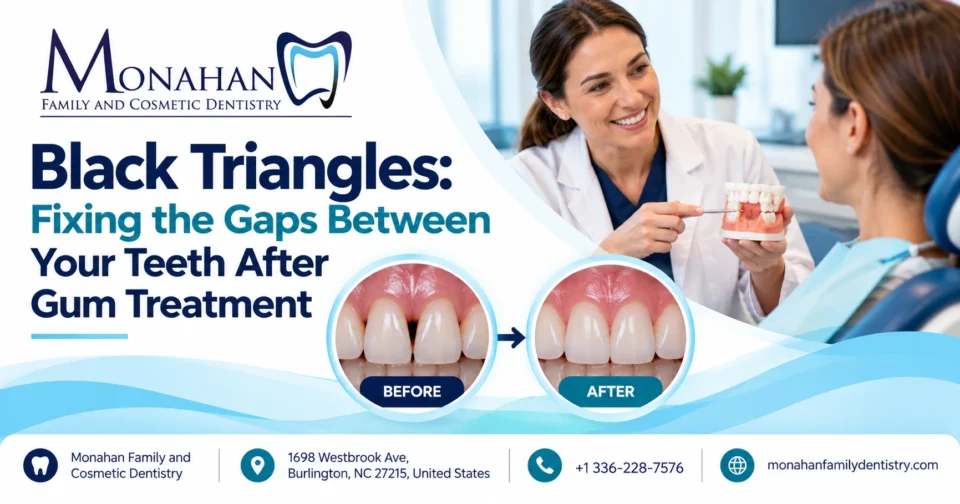
Dentists call these spaces open gingival embrasures. Most patients know them as black triangles.
At Monahan Family & Cosmetic Dentistry, the first goal after gum treatment is not to immediately fill every visible triangle.
First, we want the periodontal disease to be stable.
Then we determine why the space exists.
Only after that should we decide whether bonding, orthodontic movement, periodontal treatment, or simply leaving the area alone makes the most sense.
Bothered by Black Triangles Between Your Teeth?
Restore confidence in your smile with personalized treatment options for gaps after gum treatment. Call today to schedule a consultation.
What Exactly Is a Black Triangle?
Between two healthy teeth is a small wedge of gum called the interdental papilla.
Ideally, that tissue fills the area beneath the point where the neighboring teeth touch.
When the papilla no longer fills that space completely, you can see through the opening.
Because the inside of the mouth is dark, the opening appears black.
That is the triangle.
Black triangles can occur because of several factors, including periodontal bone loss, aging, gum recession, tooth shape, root position, orthodontic movement, and the location of the contact between neighboring teeth.
So there is no single “black triangle treatment.”
The correct solution depends on the cause.
Why Do Black Triangles Sometimes Appear After a Deep Cleaning?
This is one of the most frustrating parts of periodontal treatment.
Before treatment, diseased gums may be red, enlarged, swollen, and inflamed.
That swelling can make the gum tissue look fuller than it really is.
Scaling and root planing removes plaque and calculus from below the gumline and allows inflammation to decrease.
The tissues then heal.
Healthier gums can take up less space
Research measuring tissue changes after scaling and root planing has confirmed that gingival tissue can shrink in both height and width as inflammation resolves.
Earlier clinical studies found the same general pattern: decreases in periodontal pocket depth after root planing can initially occur partly because the swollen gum margin recedes toward a healthier position.
That can reveal spaces that were hidden by inflammation.
The treatment did not necessarily create the underlying bone loss.
The disease often did.
This is not a reason to avoid treating gum disease
Leaving inflamed tissue swollen so the teeth look cosmetically fuller is not a reasonable trade.
Untreated periodontitis can continue damaging the attachment and bone supporting the teeth.
The ADA recommends scaling and root planing as initial nonsurgical treatment when periodontitis is present.
Healthy gums with a cosmetic space are preferable to swollen gums covering active disease.
Once the health problem is controlled, we can talk about appearance.
Should You Fix Black Triangles Immediately After Gum Treatment?
Usually, not immediately.
Periodontal tissues need time to heal after nonsurgical treatment.
The ADA notes that periodontal tissues generally require about four weeks to demonstrate the optimal initial effects of scaling and root planing.
That does not mean every cosmetic treatment should automatically begin on day 29.
It means the gums should first be reassessed.
Dr. Monahan may want to know whether pocket depths improved, whether inflammation has settled, whether bleeding decreased, and whether the tissue position is reasonably stable.
Trying to design cosmetic bonding around gums that are still changing can make the final result harder to predict.
Why Does Bone Level Matter So Much?
This is one of the most useful facts for understanding black triangles.
The gum papilla needs underlying support.
A classic periodontal study looked at the distance from the contact point between two teeth to the crest of the supporting bone.
When that distance was 5 millimeters or less, the papilla was present almost 100% of the time.
At 6 millimeters, it was present only 56% of the time.
At 7 millimeters or more, the papilla was present only 27% of the time or less.
More recent research has found a similar relationship.
That explains why simply asking the gum to “grow back” is often unrealistic.
If bone has been lost and the contact point between the teeth sits far above that bone, the soft tissue may not predictably fill the entire space.
Tooth Shape Can Make Black Triangles Worse
Not every black triangle is mainly a gum problem.
Some are partly a tooth-shape problem.
Triangular teeth are more likely to show open spaces
Imagine two teeth shaped like rectangles.
Their sides remain relatively parallel, so the contact between them can extend farther toward the gumline.
Now imagine two teeth shaped like triangles.
They are narrow near the gums and wider near the biting edges.
The teeth touch higher up.
That leaves a larger space underneath.
Research on open gingival embrasures identifies crown shape and contact position as important risk factors.
In that situation, changing tooth shape may be more predictable than trying to surgically create more gum.
Option 1: Composite Bonding
For many cosmetically bothersome black triangles, bonding is one of the more conservative options.
Composite resin can be added to the sides of neighboring teeth to move the contact area closer toward the gums.
Instead of trying to make the papilla dramatically taller, we make the space it has to fill smaller.
When bonding makes sense
Bonding can be useful when the gums are healthy and stable but the tooth shape leaves an open embrasure.
It may work especially well when front teeth are somewhat triangular and the space can be closed without making the teeth look unnaturally wide.
Monahan Family & Cosmetic Dentistry currently provides tooth-colored dental bonding in Burlington and specifically lists closing small gaps and reshaping teeth among its uses.
Advantages of bonding
Bonding can often be performed conservatively.
It generally requires less removal of tooth structure than porcelain veneers.
Results can often be achieved quickly.
And the material can be repaired or reshaped later if necessary.
The downside
Composite is not indestructible.
It can stain, chip, roughen, or require polishing and maintenance over time.
Black-triangle bonding is also technically demanding.
If too much material is added, the teeth can look wide or bulky.
Poor contours can also make cleaning difficult.
Closing the gap cosmetically while creating a plaque trap is not a good result.
How Much Does Bonding Cost in Burlington?
Monahan’s current 2026 Burlington planning guide places cosmetic bonding around $300–$700 per tooth.
If two teeth need reshaping around one black triangle, both teeth may require treatment.
If several spaces are involved, the total can increase quickly.
That is why you should ask whether every visible triangle truly needs treatment.
Sometimes correcting the one or two spaces visible when you smile provides enough improvement without rebuilding six teeth.
Option 2: Orthodontics or Invisalign
Sometimes the problem is not missing material.
It is the tooth position.
Roots may diverge.
Crowded teeth may have been hiding periodontal recession.
Or the contact between neighboring teeth may sit too far from the gumline because of alignment.
Orthodontic movement can sometimes improve the geometry of the space.
Moving teeth can move the contact point
By changing tooth position and root alignment, orthodontic treatment may reduce an open embrasure.
In selected cases, a small amount of interproximal reduction can reshape triangular teeth so they can be moved closer together with a broader contact area.
A review of interproximal enamel reduction lists elimination of black gingival triangles among its potential orthodontic uses.
But this needs planning.
Removing enamel simply because a triangle exists is not automatically appropriate.
Orthodontics can also create black triangles
Patients should know the other side of the story.
Crowded teeth can sometimes hide spaces that become apparent once the teeth are straightened.
A systematic review found reported rates of black triangles after fixed orthodontic treatment ranging from 38% to 58%, although the evidence was heterogeneous and the authors said firm conclusions could not be drawn.
That does not mean orthodontics damages gums in 38% to 58% of patients.
It means adult orthodontic treatment can reveal or contribute to open embrasures depending on anatomy, bone level, tooth shape, and movement.
How Much Does Invisalign Cost?
Monahan’s current 2026 Burlington planning information places Invisalign and clear-aligner treatment broadly around $3,000–$8,000, depending on case complexity, treatment duration, refinements, and other factors.
That obviously makes orthodontics a much larger investment than bonding when your only concern is one tiny cosmetic triangle.
But if you already have crowding, bite problems, or several spacing issues, orthodontics may solve more than one problem at once.
That is the decision threshold.
Option 3: Porcelain Veneers
Porcelain veneers can also change tooth shape and contact position.
That can make them useful when black triangles are part of a broader cosmetic concern involving color, size, shape, wear, or symmetry.
But veneers are a much bigger treatment decision than adding a small amount of composite.
Veneers make more sense when several problems need solving
Suppose your front teeth have:
significant discoloration,
uneven sizes,
old restorations,
shape problems,
and multiple open spaces.
A porcelain treatment plan may create a more durable and comprehensive cosmetic result.
But if your teeth are otherwise healthy and attractive and you only dislike one 1-mm black triangle, veneers may be excessive.
What do veneers cost?
Monahan’s current Burlington cost guide places veneers around $1,000–$2,500+ per tooth.
Several veneers can therefore turn a relatively small cosmetic complaint into a substantial investment.
Before approving treatment, ask what a more conservative bonding option would look like.
Option 4: Periodontal Reconstruction
Patients often assume a gum graft can simply replace the missing papilla.
Sometimes periodontal procedures can improve these areas.
But interdental papilla reconstruction is one of the more difficult areas of periodontal esthetics.
Why?
The tissue between teeth is small.
Blood supply is limited.
And the supporting bone level may already be reduced.
A 2024 systematic review evaluated 45 studies involving approaches such as hyaluronic acid, platelet-rich fibrin, soft-tissue grafting, and orthodontics. Several techniques appeared promising, but the authors concluded that the evidence was still insufficient to make strong clinical recommendations.
That is an important warning.
Papilla surgery should not be sold as a guaranteed way to make a black triangle disappear.
What About Hyaluronic Acid Injections?
This is one of the newer treatments patients increasingly encounter online.
Hyaluronic acid can be injected into deficient papillary tissue in an attempt to increase volume.
Some studies have reported meaningful improvements.
A systematic review found an average reduction in black-triangle area of about 57.7% after six months among the studies included.
A newer 2026 review also found hyaluronic acid promising and generally well tolerated, but emphasized that the overall evidence remains limited and longer-term standardized trials are still needed.
That means:
promising does not equal predictable,
improvement does not equal complete closure,
and short-term improvement does not guarantee permanent stability.
This is not yet a treatment that should be presented as the obvious first choice for every black triangle.
Does “Same-Day Crown” Technology Cost More? The ROI of Convenience
When patients hear same-day crown, one of the first questions [...]
Learn More
Can the Gum Just Grow Back by Itself?
Sometimes a small amount of tissue change can occur during healing.
But significant papilla loss caused by underlying bone loss should not be expected to completely regenerate spontaneously.
Remember the bone-to-contact-point relationship.
If the anatomy does not support complete papilla fill, waiting alone may not close the opening.
That does not mean you have to treat it.
A stable black triangle can be primarily cosmetic.
The decision depends on whether it bothers you and whether it creates functional problems.
Are Black Triangles Only Cosmetic?
No.
They can also affect daily function.
Open embrasures may contribute to:
food trapping,
plaque accumulation,
root sensitivity,
speech changes in some patients,
and increased difficulty keeping the area clean.
That makes hygiene especially important after periodontal treatment.
Do not stop cleaning because the gap looks bigger
This is a common mistake.
A patient sees the new space and becomes afraid that flossing caused it.
So they stop cleaning between those teeth.
That allows plaque to build up again.
The periodontal problem returns.
A better approach is to ask your hygienist what device fits the space.
For some patients that is floss.
For others an appropriately sized interdental brush may clean an open embrasure more effectively.
The method should fit the anatomy.
Can Aggressive Flossing Cause Black Triangles?
Traumatic oral-hygiene habits can injure papillary tissue.
Research reviews identify improper flossing and overly aggressive cleaning among possible contributors to papilla loss.
That does not mean normal flossing causes black triangles.
Do not floss violently into the gums.
Guide it gently around the side of each tooth.
If you are uncertain how to clean an enlarged space after periodontal therapy, ask for a demonstration.
Should You Fix the Gums or the Teeth First?
The sequence matters.
Health first. Cosmetic correction second.
If periodontitis is still active, adding bonding simply to close a dark space may hide an unstable situation.
Monahan currently provides scaling and root planing and ongoing periodontal maintenance for patients with periodontal disease in Burlington.
Once inflammation is controlled and the gums have been reassessed, cosmetic planning becomes more predictable.
Then the question becomes:
Is this primarily a tissue problem?
A bone-support problem?
A tooth-shape problem?
A tooth-position problem?
Or a combination?
That determines the treatment.
Which Treatment Is Usually the Best Value?
There is no universal answer.
For one or two small spaces with otherwise well-positioned teeth, bonding may provide the most conservative financial and biological option.
For someone with significant crowding or root-position problems, orthodontics may make more sense.
For a person already considering a major smile makeover, veneers may address the black triangles as part of a larger plan.
For a tissue-focused defect, periodontal consultation may be appropriate.
And for someone who is not bothered by the appearance and can clean the area well, the cheapest appropriate option may be:
Do nothing cosmetically.
That is a legitimate treatment decision.
Don’t Fix the Shadow Until the Gum Disease Is Stable
Black triangles can be discouraging after periodontal therapy.
You did the responsible thing.
You treated the disease.
Then your smile looked different.
That deserves an explanation.
At Monahan Family & Cosmetic Dentistry, we would rather show you why the space exists before choosing a cosmetic procedure.
Dr. Thomas Monahan can evaluate your bone levels, gum health, tooth shape, spacing, existing restorations, and bite.
Sometimes bonding is enough.
Sometimes orthodontic movement makes more sense.
Sometimes the gums need more time.
Sometimes a periodontal specialist should be involved.
And sometimes the best recommendation is to leave a healthy, cleanable space alone.
If black triangles have become visible after a deep cleaning or periodontal treatment in Burlington, bring the concern to your follow-up visit.
Do not assume the treatment ruined your gums.
The healthier tissue may simply be revealing damage that the previous inflammation was hiding.
Once the periodontal condition is stable, we can decide whether closing the space is worth the cost, maintenance, and additional dentistry.
That is a much better decision than treating the shadow before understanding what created it.
Frequently Asked Questions About Black Triangles After Gum Treatment
Why did gaps appear after my deep cleaning?
Inflamed gums can be swollen and enlarged.
As inflammation decreases after scaling and root planing, the tissue may shrink toward a healthier position. If periodontal disease previously caused bone or papilla loss, that healing can make spaces more visible.
Did the hygienist remove too much gum?
Scaling and root planing removes plaque and calculus. It does not intentionally remove the papilla between your teeth.
The apparent loss is commonly related to resolution of inflammation and pre-existing periodontal damage.
Will black triangles go away after my gums finish healing?
Some tissue changes can continue during healing, but significant black triangles caused by bone loss or unfavorable tooth anatomy may remain.
The ADA notes that the initial optimal effects of nonsurgical periodontal therapy generally become apparent after about four weeks.
Can bonding close black triangles?
Yes, in selected cases.
Composite can be added to reshape teeth and move the contact point closer to the gumline. Monahan currently offers bonding for small gaps and tooth reshaping.
How much does bonding cost in Burlington?
Monahan’s current 2026 planning range is approximately $300–$700 per tooth.
The number of teeth requiring treatment determines the total.
Can Invisalign fix black triangles?
Sometimes.
Orthodontics can improve tooth and root position and may allow the contact area to be changed. But orthodontic treatment can also reveal black triangles in patients with certain anatomy or periodontal bone loss.
Will a gum graft fix the space?
Papilla reconstruction is less predictable than ordinary root-coverage grafting.
Current systematic reviews find several promising surgical and nonsurgical techniques, but there is still insufficient high-quality evidence to recommend one predictable solution for every patient.
Do hyaluronic acid injections work?
Research suggests they can reduce black-triangle size in selected patients.
However, long-term predictability and standardized treatment protocols remain uncertain.
Are black triangles dangerous?
Not necessarily.
They are often primarily cosmetic, but they can trap food and plaque, complicate cleaning, and contribute to root sensitivity or localized inflammation.
Should I stop flossing between teeth with black triangles?
No.
Keeping the area clean is particularly important after periodontal treatment.
The technique or cleaning device may need to change based on the size of the space, so ask your dentist or hygienist what works best.
What is the biggest mistake after noticing black triangles?
Rushing into cosmetic treatment before the gums are stable.
First control periodontal disease.
Then determine whether the remaining problem is mainly gum tissue, bone support, tooth shape, tooth position, or a combination of those factors.
Close the Gaps. Love Your Smile Again!
Black triangles affecting your smile? Get expert dental care and explore solutions for a more natural-looking smile. Call today!