
For many patients, the worst part of dental treatment happens before the dentist starts working on the tooth.
It is the injection.
You know the shot is supposed to make the procedure comfortable.
But that does not make watching a syringe approach your mouth any easier.
Some patients remember a painful dental injection from childhood.
Others are not afraid of drilling, crowns, fillings, or root canals. They are afraid of the needle used to get numb.
Modern dentistry has developed several ways to make that part easier.
Two approaches get particular attention:
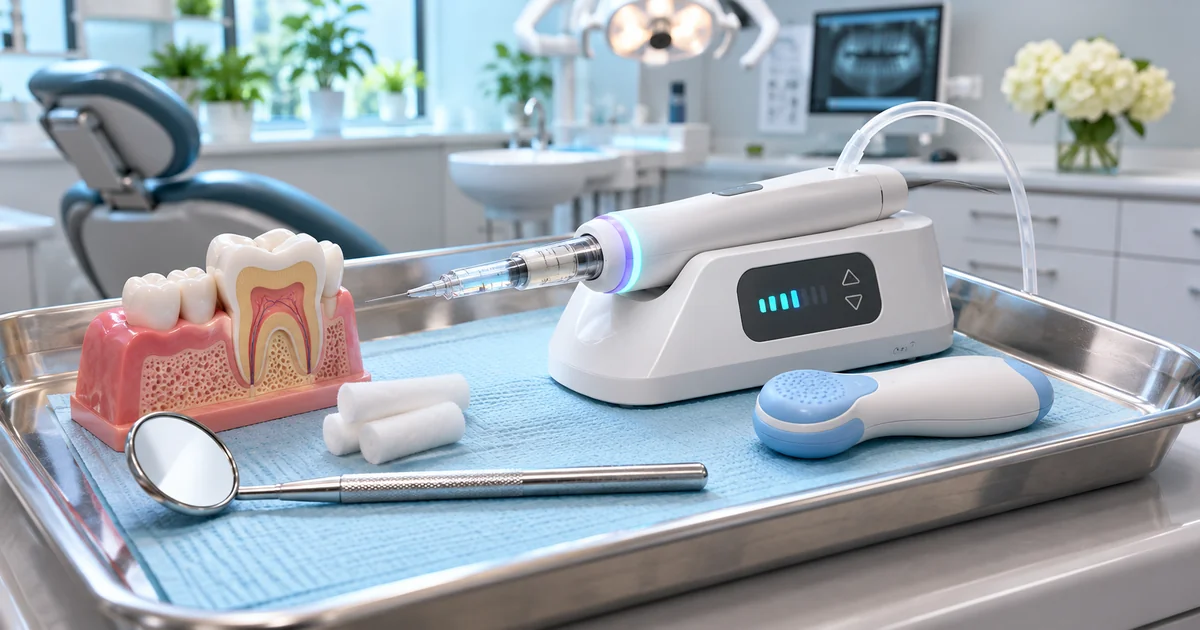
computer-controlled anesthetic delivery, commonly associated with systems such as The Wand, and vibration-assisted injection devices, sometimes described casually as “the buzz.”
They work differently.
The Wand controls how anesthetic enters the tissue.
Vibration-based devices provide sensory stimulation near the injection site that may reduce how strongly the patient perceives the needle.
Both can help.
Neither means you are guaranteed to feel absolutely nothing.
At Monahan Family & Cosmetic Dentistry, that distinction matters. Our public patient-education materials discuss computer-assisted anesthetic delivery as one way modern dentistry can make injections more comfortable. However, our current public website does not specifically identify The Wand, DentalVibe, Buzzy, VibraJect, or another branded injection device as equipment currently used in the office.
So rather than sell a device name, let us explain what actually reduces the sting.
Why Do Dental Injections Hurt in the First Place?
Patients often assume the needle is responsible for all injection pain.
It is not.
There are several separate sensations.
First comes the needle entering the tissue
That produces the initial pinch.
Topical anesthetic can help reduce surface sensation before needle insertion, although it cannot numb the deeper tissues where the anesthetic still has to travel.
Then comes pressure from the anesthetic
This is the part patients frequently describe as:
“That burning pressure.”
Dental anesthetic solution has to enter living tissue.
If fluid is delivered too quickly, tissue pressure can increase rapidly.
That pressure can be uncomfortable.
Research into computer-controlled local anesthetic delivery repeatedly identifies controlled, slow delivery as one reason these systems may reduce pain compared with conventional injection techniques.
Anxiety changes what you experience
Pain is not purely mechanical.
If you are already tense, watching every movement, waiting for the injection to hurt, the experience can feel worse.
That does not mean the pain is imaginary.
Anxiety affects pain perception.
This is one reason a patient with severe needle fear may need more than a different syringe.
Communication, topical anesthetic, slow injection, distraction, breaks, or sedation may also be appropriate depending on the patient.
What Is “The Wand” in Dentistry?
The Wand is a well-known computer-controlled local anesthetic delivery system, or CCLAD.
Instead of the dentist controlling anesthetic flow entirely with hand pressure on a conventional syringe, a computerized system regulates how the solution is delivered.
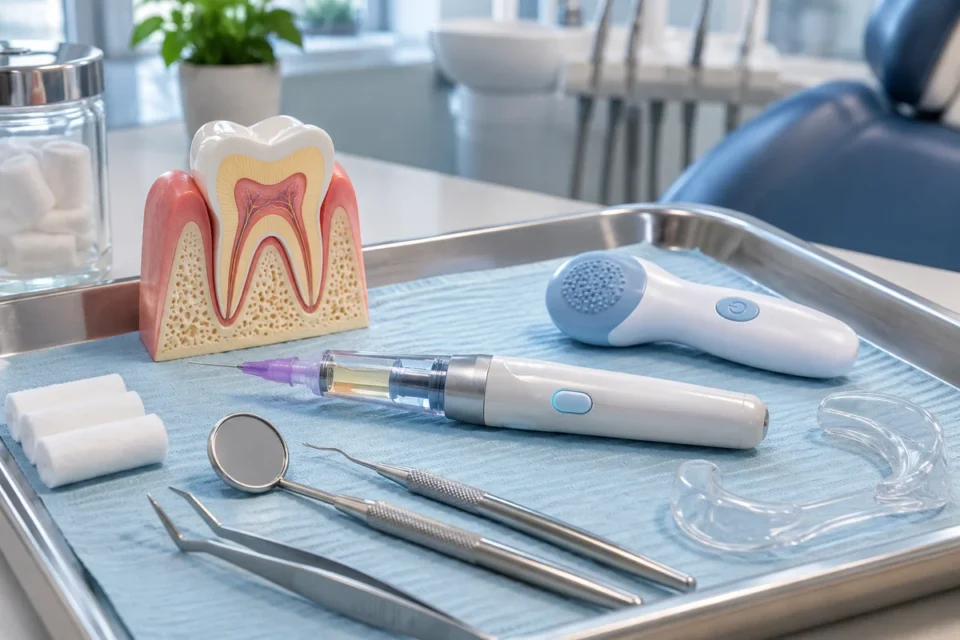
The handpiece itself can also look considerably less like the traditional metal dental syringe that many anxious patients recognize immediately.
The computer controls the flow
The key advantage is not that the system somehow removes the needle.
It does not.
The advantage is controlled delivery.
Computer-controlled systems can deliver anesthetic at carefully regulated rates rather than depending entirely on manual pressure.
That can reduce the sudden tissue pressure associated with a fast injection.
A 2024 systematic review examined 14 randomized clinical trials comparing computer-controlled anesthetic delivery with conventional injections.
Overall, the researchers found significantly lower pain perception with computer-assisted delivery, along with improved patient behavior during injections.
Another 2024 review evaluated 20 studies involving 1,347 patients, including adults and children, and likewise found that computerized anesthesia frequently produced favorable pain and patient-comfort outcomes compared with traditional techniques.
That is real evidence.
But it still does not make “100% painless” an appropriate promise.
Does The Wand Eliminate the Needle?
No.
This is one of the biggest misunderstandings.
The Wand changes how anesthetic is delivered.
Local anesthetic still needs to reach the appropriate tissue.
There is still a needle involved in most of these techniques.
The objective is to make the experience more controlled and less uncomfortable.
If an advertisement tells you The Wand means “needle-free dentistry,” that is misleading.
It is not needle-free.
It is computer-controlled injection technology.
Does The Wand Really Hurt Less Than a Regular Injection?
For many patients, research suggests it can.
A study involving adults undergoing tooth extraction found significantly lower pain during both needle insertion and anesthetic delivery with The Wand compared with conventional injection.
Pediatric research has also produced favorable results.
In a crossover study of children and adolescents, patients receiving anesthesia with The Wand reported lower pain ratings, showed a smaller heart-rate increase, and demonstrated more relaxed behavior than during conventional injections.
But newer reviews add an important qualification.
A 2024 scoping review of 107 publications found that The Wand and other computer-controlled systems are among the best-studied alternative anesthetic technologies. The evidence was mixed for pain from the initial needle insertion, while benefits were more consistent for reducing discomfort while the anesthetic itself was being deposited.
That makes biological sense.
A flow-control system can directly control injection pressure.
It cannot make the physical needle cease to exist.
What Is “The Buzz”?
Unlike The Wand, “The Buzz” is not one universally standardized dental product name.
Patients and dental offices may use similar language to describe several vibration-based technologies.
Products studied in dental research include systems such as DentalVibe, Buzzy, and syringe-mounted vibrating devices.
The basic idea is different from computer-controlled anesthesia.
Instead of controlling the flow of anesthetic, these devices create vibration near the injection site.
Why would vibration help an injection?
Vibration provides a strong non-painful sensory signal at approximately the same time as the injection.
The explanation is often discussed using gate-control theory.
In simplified terms, competing sensory input such as pressure or vibration may alter how pain signals are transmitted and perceived.
Think about what you naturally do after bumping your elbow.
You rub it.
The rubbing does not reverse the injury.
It changes the sensory information reaching your nervous system.
Vibration-assisted dental injection uses a related concept.
Does Vibration Actually Reduce Injection Pain?
The newest evidence is encouraging, but not perfect.
A 2026 systematic review evaluated 12 randomized controlled trials of dental vibration devices.
Most of the included trials found improved comfort or reduced pain scores when vibration or similar distraction techniques were used during local-anesthetic injections.
The researchers concluded that dental vibration devices may reduce injection-related pain, while noting variability among studies and the need for more standardized research.
That is more useful than saying vibration “blocks pain.”
It may help.
It does not work identically for everybody.
Earlier studies were more mixed
A 2021 systematic review focusing on children found that DentalVibe itself did not produce statistically significant reductions on several pooled pain measures, although another vibration device called Buzzy produced promising results.
Another systematic review of 376 children found low-quality evidence suggesting that vibratory stimulation reduced subjective pain during dental injections.
A 2025 pediatric review was more favorable, finding that vibrotactile devices generally reduced pain and anxiety, particularly when combined with other approaches such as topical anesthesia or cold.
This is a good example of why we should avoid miracle-device language.
The overall direction is promising.
The results are not unanimous.
The Wand vs. Vibration: What Is the Difference?
They are solving different parts of the injection problem.
The Wand or another CCLAD system controls the rate and pressure of anesthetic delivery.
A vibration device adds competing sensory stimulation near the injection.
That means these are not necessarily competing ideas.
The first addresses anesthetic delivery.
The second primarily addresses sensory perception.
And neither replaces basic injection technique.
A dentist can own sophisticated equipment and still give an uncomfortable injection if the overall technique is poor.
Likewise, a skilled clinician using a conventional syringe slowly and carefully can often deliver local anesthetic very comfortably.
Is a Slow Injection Really That Important?
Yes.
This is one of the least glamorous answers in dentistry.
Patients frequently assume the newest gadget must be the main reason an injection feels better.
Often, slow delivery matters enormously.
Computer-controlled systems are useful largely because they make controlled delivery repeatable.
A dentist using a conventional syringe can also intentionally inject slowly.
That is why you should not choose a dental office based solely on whether its website displays a picture of The Wand.
Technology can help.
Technique still matters.
What Does Topical Numbing Gel Do?
Topical anesthetic is placed on the gum before the injection.
Its job is primarily to reduce sensation at the surface.
That can help with the initial needle penetration.
It does not generally numb the tissue deeply enough to perform restorative dentistry by itself.
You can think of it as the first layer.
Topical anesthetic helps with the entry.
The local anesthetic injection provides the deeper numbness required for treatment.
Vibration and computer-controlled delivery may then make the injection itself more tolerable.
Can a Dental Injection Be Truly Painless?
Sometimes a patient genuinely reports:
“I didn’t feel that at all.”
That happens.
But no dentist can responsibly guarantee it.
Pain perception differs between patients.
The location of the injection matters.
The tissue matters.
Palatal injections, for example, can be more uncomfortable because the tissue is tightly attached and less able to accommodate fluid.
The type of nerve block matters.
Existing infection and inflammation can affect anesthesia.
Anxiety matters.
And previous experiences matter.
So “painless injection” is best understood as a goal.
Not a warranty.
What If You Are Terrified of Needles?
Tell the office before the dentist brings out the anesthetic.
Do not wait until you are gripping the chair.
A patient with mild injection anxiety may do well with explanation, topical anesthetic, slow delivery, and distraction.
A patient with severe dental phobia may need a broader strategy.
Monahan’s current anxiety-management information discusses communication, relaxation strategies, local anesthesia, and sedation options for patients with significant fear.
The important thing is to be specific.
Do not simply say:
“I hate the dentist.”
Tell us what actually bothers you.
Is it the needle?
The sight of blood?
Feeling trapped?
The sound of instruments?
Fear that the anesthetic will not work?
A previous experience of treatment while not fully numb?
Those are different problems.
They deserve different solutions.
What If Local Anesthetic Never Seems to Work on You?
Tell the dentist before treatment starts.
Do not assume you simply have to tolerate pain.
Several factors can make anesthesia more difficult.
Active inflammation or infection can affect local tissue conditions.
Individual anatomy can vary.
Certain teeth particularly severely inflamed lower molars can sometimes be more difficult to anesthetize predictably.
The injection technique may need to change.
Additional anesthetic may be required.
A different injection location may be appropriate.
The important point is that The Wand or a vibration device does not guarantee successful anesthesia.
Comfort during injection and effectiveness of anesthesia are two separate questions.
You need both.
Can The Wand Numb Only One Tooth?
Computer-controlled systems can support techniques designed to anesthetize a more localized area.
The Wand STA name itself refers to Single Tooth Anesthesia.
That can be attractive in selected cases because traditional nerve blocks may leave a much larger area such as the lip, cheek, or tongue feeling numb.
However, whether localized anesthesia is appropriate depends on the tooth, procedure, anatomy, and clinical situation.
Not every procedure can or should be handled by numbing only one tooth.
Again, the technology expands options.
It does not eliminate clinical judgment.
Are These Technologies Better for Children?
They can be particularly useful for children who are anxious about traditional dental syringes.
The Wand has been studied extensively in pediatric dentistry, and several trials have found improvements in pain scores and behavior.
Vibration has also been studied heavily in children.
The most recent reviews suggest benefits, but results differ by device and study.
There is another advantage that has nothing to do with physics.
A device that does not look like the large metal syringe a child expects may simply be less frightening.
That psychological difference can matter.
But pediatric dentistry still requires communication, behavior management, appropriate dosing, and realistic expectations.
A gadget cannot replace those things.
Are There Downsides to The Wand?
Yes.
Computer-controlled injections can take longer because part of their comfort advantage comes from slow, regulated delivery.
The equipment is also more complex and costly for a dental office than a conventional syringe.
Certain injection techniques have a learning curve.
And not every clinical situation requires technology.
If an ordinary infiltration can be given comfortably and effectively with conventional equipment, using a computer-controlled system does not automatically improve the outcome.
Are There Downsides to Vibration?
Yes.
Some people do not like the buzzing sensation.
The 2026 systematic review found no significant serious adverse effects but noted that some patients can experience mild tingling or discomfort from the device itself. It also suggested that vibration may be less useful for patients whose anxiety is very high.
There is also the simple reality that vibration does not control the anesthetic pressure.
If the injection itself is delivered too quickly, buzzing beside the needle may not solve the whole problem.
Does Monahan Family & Cosmetic Dentistry Use The Wand or “The Buzz”?
This is where accuracy matters.
Monahan’s public website currently discusses computer-assisted anesthetic delivery systems as technology that can make injections less painful. The practice also discusses local anesthesia and sedation in its dental-anxiety resources.
However, the publicly available website information I could verify does not specifically confirm a current branded Wand, DentalVibe, Buzzy, or VibraJect system.
We should not turn a general discussion of modern injection technology into a claim about equipment the practice has not publicly identified.
If a specific device matters to you, ask when scheduling.
That is better than assuming.
What Should You Ask If You Are Worried About the Injection?
You do not need to know the name of every anesthetic system.
A few practical questions are enough:
- Can you use topical anesthetic first?
- Can the injection be given slowly?
- I am afraid of needles. Can you keep the syringe out of my direct view?
- What should I do if I feel something during treatment?
- Do you use computer-controlled or vibration-assisted injections?
- What anxiety-management options are available if I am extremely nervous?
The answers tell you more about the patient experience than an equipment logo.
Does a More Comfortable Injection Cost More?
There is no universal answer.
A dental office may incorporate comfort technology into routine care.
Another may charge differently for certain anesthesia or sedation services.
Monahan’s public website does not currently publish a separate fee specifically for The Wand or a vibration-assisted injection device.
So it would be misleading to invent a “painless injection surcharge.”
Ask about your complete treatment estimate.
More importantly, do not confuse local anesthesia with sedation.
Local anesthetic numbs tissue.
Sedation reduces anxiety or awareness.
Those are separate services and may have very different costs, risks, and insurance treatment.
A Better Injection Does Not Mean You Need More Dentistry
Comfort technology should never become a sales tool for unnecessary treatment.
The point of a better anesthetic experience is to make necessary dentistry easier to tolerate.
Not to make patients less likely to question the treatment itself.
You should still know:
Why does this tooth need treatment?
Do I need a filling or a crown?
Is treatment urgent?
What will it cost?
Are there reasonable alternatives?
Comfort matters.
Informed consent matters just as much.
Tell Us About the Needle Before We Talk About the Tooth
Patients sometimes apologize for being afraid of dental injections.
There is no reason to.
Dental needle anxiety is common.
And pretending you are comfortable does not make treatment easier for you or the dentist.
At Monahan Family & Cosmetic Dentistry, we would rather know what you are worried about before treatment begins.
If your biggest concern is the injection, tell us.
Dr. Thomas Monahan and our Burlington team can discuss how local anesthesia will be delivered, what comfort measures are appropriate, and whether additional anxiety-management options make sense for your situation.
Our public patient-education materials specifically recognize computer-assisted anesthetic systems, communication, local anesthesia, and sedation strategies as tools that can make care more manageable for anxious patients.
What we will not do is promise that every injection is literally painless.
That is not a promise any dentist can guarantee.
The better goal is:
less pressure, less surprise, less fear, adequate numbness, and a patient who stays in control of the experience.
If you have been postponing dental treatment because you dread getting numb, contact Monahan Family & Cosmetic Dentistry in Burlington.
Tell us that the needle is the issue when you schedule.
That gives us a chance to plan around the part of dentistry you actually fear instead of expecting you to simply endure it.
Frequently Asked Questions About Painless Dental Injections
Is The Wand really painless?
Not always.
Research generally shows reduced pain with computer-controlled anesthetic delivery compared with conventional injections, but no system can guarantee zero sensation for every patient.
Does The Wand still use a needle?
Yes.
The Wand is a computer-controlled local-anesthetic delivery system, not a needle-free anesthetic system.
The difference is how the anesthetic is delivered.
Why does The Wand hurt less for some people?
The computer regulates anesthetic flow, helping reduce the rapid tissue pressure that can make injections uncomfortable.
Its handpiece can also appear less intimidating than a conventional dental syringe.
What is “The Buzz” in dentistry?
“The Buzz” is not one standardized device name.
The phrase may describe vibration-based aids such as DentalVibe, Buzzy, VibraJect, or similar technologies that provide sensory stimulation near an injection.
Does buzzing or vibration really reduce dental injection pain?
It can.
A 2026 systematic review of 12 randomized trials found that most studies reported improved comfort or reduced pain with dental vibratory devices, although results were not completely consistent.
Which works better: The Wand or vibration?
They address different aspects of the injection.
The Wand primarily regulates anesthetic delivery.
Vibration primarily provides sensory counter-stimulation.
There is not enough evidence to declare one universally better for every patient and every injection.
Does topical numbing gel eliminate the need for an injection?
Usually not.
Topical anesthetic primarily numbs superficial tissue. Most restorative and surgical dental procedures still require local anesthetic to reach deeper nerves.
Why does the anesthetic sometimes burn?
Part of the sensation can result from tissue pressure as anesthetic solution is deposited.
Slower, controlled delivery can reduce discomfort.
What if I’m still not numb after the injection?
Tell the dentist.
Do not allow treatment to continue simply because you think you are expected to tolerate it.
Additional anesthetic or a different technique may be necessary.
Can sedation replace local anesthetic?
Usually, no.
Sedation primarily manages anxiety and awareness.
Local anesthetic blocks pain from the treatment area. Many sedated dental procedures still require local anesthesia.
Does Monahan use The Wand?
Monahan’s public website currently discusses computer-assisted anesthetic delivery as a comfort technology but does not specifically identify The Wand as a device currently used in the office. Patients who specifically want that system should confirm availability directly.
What is the most important thing I can tell my dentist?
Tell the dentist exactly what frightens you.
If the injection is your biggest concern, say that before treatment begins.
That allows the dental team to plan the experience around the problem that actually matters to you.