
A deep cleaning is usually explained as treatment for your gums.
That is correct.
But periodontitis is not just tartar sitting on teeth.
It is an inflammatory disease involving bacterial biofilm and your body’s immune response. When the disease progresses, the tissues and bone supporting the teeth begin to break down.
That raises an interesting question:
If you reduce inflammation in the mouth, does inflammation elsewhere in the body decrease too?
Research suggests the answer can be yes, to a degree.
Studies of periodontal treatment have found reductions in blood markers of systemic inflammation after treating periodontitis. One of the most studied markers is C-reactive protein, or CRP.
A meta-analysis of randomized clinical trials found that periodontal treatment reduced CRP by an average of about 0.69 mg/L at six months, with larger reductions among people whose CRP was elevated before treatment.
That is meaningful.
But it does not mean scaling and root planing is a whole-body inflammation cure.
At Monahan Family & Cosmetic Dentistry, we recommend deep cleaning because a patient has periodontitis that needs treatment.
The potential systemic effect is additional context.
It should never be the excuse for prescribing periodontal treatment to someone who does not actually need it.
What Is Periodontal Inflammation?
Periodontitis begins with bacterial biofilm around the teeth.
When bacteria and hardened deposits remain around and below the gumline, your immune system responds.
Inflammation develops.
Over time, that inflammatory response contributes to destruction of the tissues attaching the gums to the teeth and the bone supporting the teeth.
The American Dental Association describes periodontitis as an inflammatory disease of bacterial origin that can produce periodontal pockets, bleeding, gum recession, tooth mobility, attachment loss, and eventually tooth loss.
That is different from saying bacteria simply “eat the bone.”
Much of the damage occurs because of the interaction between bacteria and the body’s inflammatory response.
Why deep pockets matter
Healthy gums form a relatively shallow space around the tooth.
When periodontal disease progresses, the attachment around the tooth is damaged.
That creates deeper pockets.
Plaque and calculus can accumulate below the gumline where your toothbrush and floss cannot reliably remove them.
That is when ordinary preventive cleaning may no longer be enough.
What Does a Deep Cleaning Actually Remove?
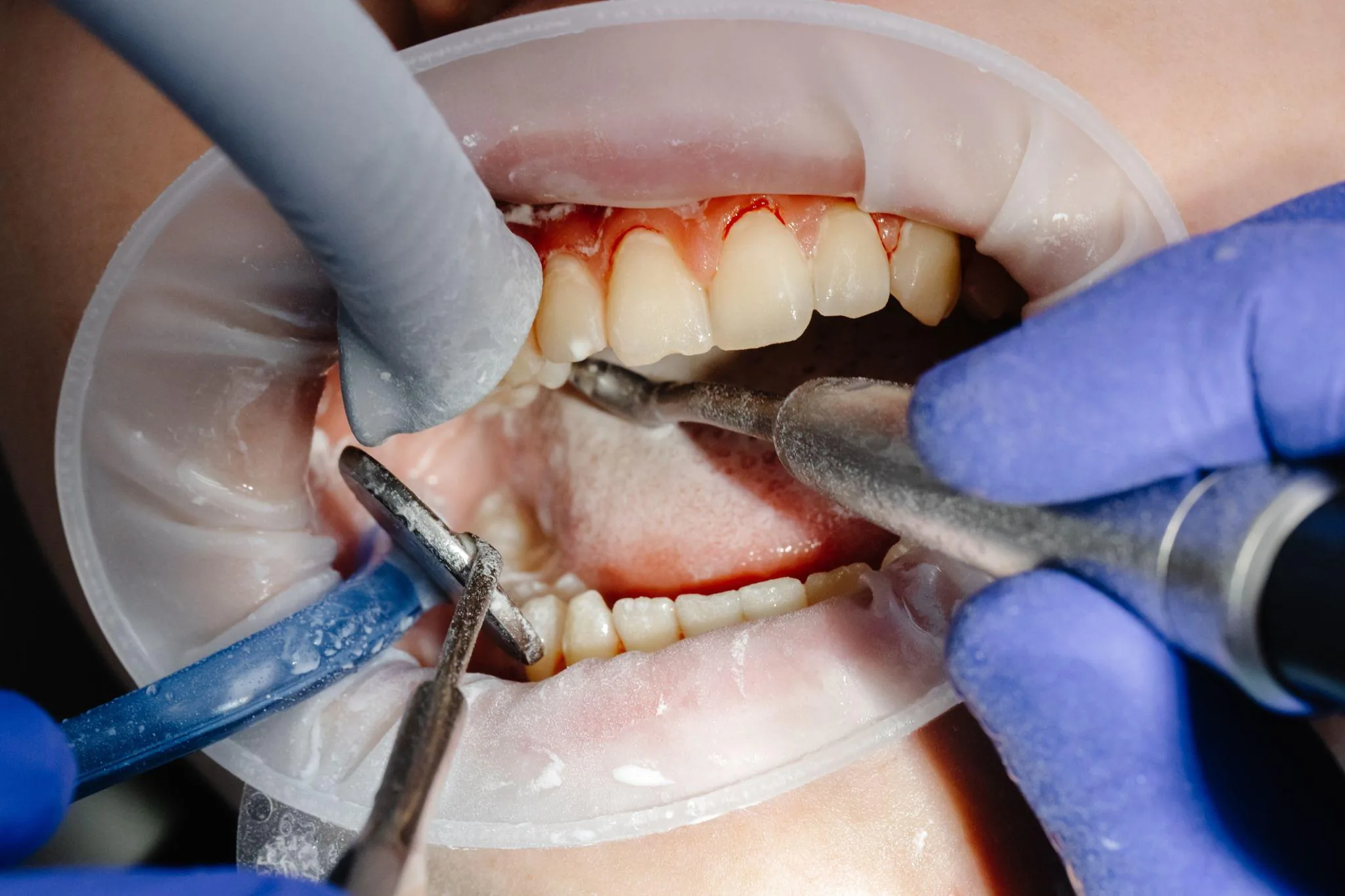
A deep cleaning is more accurately called scaling and root planing, or SRP.
Scaling removes plaque and hardened calculus from above and below the gumline.
Root planing cleans the root surfaces so the tissues have a healthier surface against which to heal.
The ADA recommends scaling and root planing as the initial nonsurgical treatment for patients with periodontitis.
That treatment is not designed to “detox” your bloodstream.
Its primary job is much more concrete:
Reduce the bacterial burden and inflammation around teeth so periodontal destruction can be controlled.
The systemic-inflammation discussion comes after that.
How Can Gum Inflammation Affect the Rest of the Body?
Your gums have a blood supply.
They are not biologically isolated from everything below your neck.
With active periodontitis, a large surface area of inflamed and ulcerated tissue may exist around multiple teeth.
Researchers have proposed two broad mechanisms that could connect periodontal disease with systemic effects.
The ADA explains that chronic periodontal inflammation may contribute inflammatory mediators to the circulation. Oral bacteria or their products may also enter the bloodstream and interact with distant tissues.
That creates what researchers sometimes describe as an additional systemic inflammatory burden.
But this is where dental claims often go too far.
Periodontitis has been associated with conditions including cardiovascular disease and diabetes.
Association does not automatically prove causation.
The ADA specifically warns that direct causal relationships between periodontal disease and many systemic conditions remain difficult to establish.
So we should not tell patients:
“Your gum disease is going to cause a heart attack.”
Science does not support that certainty.
What Is CRP, and Why Do Researchers Measure It?
CRP stands for C-reactive protein.
Your liver produces more CRP when inflammation is occurring in the body.
Doctors can measure it with a blood test.
CRP is not specific to gum disease.
It can rise because of infection, inflammatory disease, obesity, injury, and many other conditions.
That is exactly why it is useful as a research marker but cannot diagnose periodontal disease by itself.
Researchers have consistently found that people with periodontitis tend to have higher CRP levels than people without periodontal disease.
A large systematic review and meta-analysis involving both observational studies and periodontal-treatment trials concluded that periodontitis was associated with higher systemic CRP and that nonsurgical periodontal therapy was followed by reductions in CRP over subsequent months.
That gives us a measurable biological signal.
Treating the mouth can affect at least some markers outside the mouth.
How Much Can a Deep Cleaning Lower CRP?
One systematic review of randomized clinical trials found an average reduction of approximately:
0.69 mg/L after six months.
The researchers also found that patients who started with CRP levels above 3 mg/L tended to show larger reductions.
Should every periodontal patient ask their physician to measure CRP before and after a deep cleaning?
No.
That is not necessary for routine dental care.
CRP is useful here because it demonstrates the broader biological effect researchers have observed.
The purpose of your periodontal treatment is still to improve periodontal health.
Can Inflammation Temporarily Go Up After Deep Cleaning?
Yes.
This is an interesting detail patients rarely hear.
If extensive periodontal treatment is completed intensively, inflammatory markers can temporarily rise immediately afterward.
That makes sense.
Instrumentation of severely inflamed periodontal tissues is still a physical treatment event.
A large meta-analysis found an immediate increase in high-sensitivity CRP after intensive nonsurgical periodontal therapy, followed by a progressive reduction during the months after treatment. Treatment performed across multiple visits showed a more consistently downward pattern.
So if someone describes deep cleaning as an instant inflammation “flush,” that is biologically inaccurate.
Healing takes time.
When Do the Gums Actually Improve After SRP?
Not the moment the hygienist puts down the instrument.
The tissues need time to respond.
The ADA notes that periodontal tissues generally require approximately four weeks to demonstrate the optimal initial effects of nonsurgical treatment.
That is why periodontal treatment includes reassessment.
We want to know:
Did bleeding decrease?
Did the tissues become less inflamed?
Did pocket measurements improve?
Are certain deep sites still present?
Is additional treatment necessary?
The follow-up is not an administrative formality.
It tells us whether treatment worked.
Does Deep Cleaning Reduce Heart-Disease Risk?
This is where we need to draw a bright line.
We cannot currently promise that scaling and root planing prevents heart attacks or strokes.
Periodontitis is associated with cardiovascular disease.
Periodontal treatment can improve some short-term inflammatory and vascular markers.
But the ADA states that studies have not established enough evidence around actual cardiovascular outcomes to recommend periodontal treatment as a method of preventing cardiovascular disease.
That means you should treat gum disease because:
- Your gums are diseased.
- Bone supporting your teeth is at risk.
- Untreated periodontitis can contribute to tooth loss.
- Periodontal therapy can improve the local disease.
If systemic inflammatory markers improve too, that is encouraging.
It should not be turned into a cardiovascular guarantee.
What About Diabetes?
This connection is particularly interesting.
Diabetes and periodontal disease appear to have a bidirectional relationship.
Poorly controlled diabetes can make periodontal disease more difficult to manage.
Periodontal inflammation may also influence metabolic control.
The ADA describes the evidence around periodontal treatment and blood-sugar control as suggestive but not perfectly consistent.
More recent analyses continue to find modest improvements.
A recent systematic review found that periodontal interventions in people with type 2 diabetes generally improved periodontal measurements and produced small favorable changes in HbA1c and fasting glucose.
Another meta-analysis reported HbA1c reductions of approximately 0.64 percentage points at three months and 0.33 percentage points at six months, although researchers emphasized variation among the studies.
Those findings are promising.
But periodontal treatment is not diabetes treatment.
You should not change insulin, metformin, diet, or other medical treatment because your gums have improved.
Your physician manages diabetes.
Your dentist manages periodontal disease.
The two clinicians may sometimes need to communicate.
Does Everyone With Bleeding Gums Need a Deep Cleaning?
No.
Bleeding indicates inflammation.
It does not automatically diagnose periodontitis.
A patient can have gingivitis, which involves inflammation without the attachment and bone loss that defines periodontitis.
The ADA distinguishes ordinary preventive cleaning, scaling for generalized gingival inflammation without bone loss, and scaling and root planing for patients with periodontal disease and attachment loss.
That distinction matters financially and medically.
If you do not have periodontitis, there is no reason to prescribe four quadrants of SRP just because someone wants to lower your “body inflammation.”
That would be poor dentistry.
How Do We Determine Whether You Need Scaling and Root Planing?
A legitimate recommendation should have evidence behind it.
At Monahan Family & Cosmetic Dentistry, the evaluation may consider periodontal pocket depths, attachment levels, bleeding, calculus, gum recession, tooth mobility, and bone levels visible on appropriate X-rays.
You should be able to ask:
“Can you show me why this is gum disease instead of gingivitis?”
That is a fair question.
You can also ask which quadrants need treatment.
Periodontal disease does not always affect every area of the mouth equally.
How Much Does Deep Cleaning Cost in Burlington?
Monahan’s current 2026 Burlington dental-cost guide lists scaling and root planing at approximately:
$200–$400+ per quadrant before insurance or discount adjustments.
Because the mouth has four quadrants, a patient needing treatment throughout the mouth may spend substantially more than someone needing therapy in only one or two areas.
For example:
Two quadrants at $200 each: about $400
Two quadrants at $400 each: about $800
Four quadrants at $200 each: about $800
Four quadrants at $400 each: about $1,600
These are examples.
They are not quotes.
Insurance may also reduce the patient’s out-of-pocket expense.
Is Reducing Inflammation Worth That Cost?
If you have properly diagnosed periodontitis, the main financial comparison is not between a $150 routine cleaning and an $800 deep cleaning.
Those are not interchangeable treatments.
The more relevant question is:
What is the cost of controlling the periodontal disease now versus allowing it to continue damaging tooth support?
Advanced gum disease can eventually contribute to loose teeth and tooth loss.
Replacing a lost tooth can cost substantially more.
Monahan’s current Burlington guide places complete single-tooth implant treatment including the implant, abutment, crown, and related procedures at roughly $3,100–$5,800+.
That does not mean an $800 deep cleaning guarantees you avoid a $5,000 implant.
No treatment gives that guarantee.
It means maintaining natural teeth generally deserves serious consideration before periodontal destruction becomes advanced.
Does Deep Cleaning “Reset” Your Inflammation Permanently?
No.
This is probably the most important warning.
Scaling and root planing reduces bacterial deposits and gives the periodontal tissues an opportunity to heal.
It does not make you permanently immune to periodontal disease.
Plaque begins forming again.
Risk factors remain.
Smoking still matters.
Diabetes control still matters.
Home hygiene matters.
Genetics may matter.
And previously damaged periodontal tissues require monitoring.
That is why the term “reset” should be understood as a useful analogy, not a promise.
SRP can reduce an active inflammatory burden. Keeping it reduced requires maintenance.
Why Does Periodontal Maintenance Matter So Much?
After active gum treatment, many patients transition to periodontal maintenance rather than ordinary preventive cleanings.
Maintenance is designed to monitor and manage a mouth with a history of periodontitis.
Without regular plaque control and professional maintenance, disease can recur.
The ADA emphasizes daily plaque control and continued professional management after nonsurgical periodontal therapy.
Think of SRP as the active treatment phase.
Maintenance is how you protect the result.
Spending $800 on periodontal therapy and then disappearing from the dental office for three years is not a good investment.
What Can You Do at Home to Keep Oral Inflammation Down?
The expensive part happens in the dental chair.
The daily work happens at home.
Brush thoroughly twice daily with fluoride toothpaste.
Clean between the teeth every day.
Follow the cleaning method recommended for your particular periodontal anatomy.
For some patients that may mean floss.
Others may benefit from interdental brushes or another device.
Smoking cessation is particularly important.
Diabetes control matters when applicable.
And do not ignore maintenance appointments simply because the gums stopped bleeding.
Feeling better does not prove every periodontal pocket disappeared.
Should You Get a Deep Cleaning Just to Improve Your General Health?
No.
That reverses the logic.
You should receive scaling and root planing because you have periodontitis and SRP is appropriate treatment for that disease.
The ADA explicitly warns that there is insufficient evidence to recommend periodontal treatment solely for the purpose of preventing future systemic disease.
This is important because oral-systemic health claims have become a major marketing tool.
You may see statements such as:
“Clean your gums to prevent heart attacks.”
“Deep cleaning eliminates inflammation throughout your body.”
“Periodontal treatment prevents Alzheimer’s.”
Those claims go beyond what current evidence can support.
There is an oral-systemic connection.
There is evidence that periodontal treatment affects systemic inflammatory markers.
That does not mean we can promise specific medical outcomes.
What Should You Ask Before Approving Periodontal Treatment?
If you are told you need a deep cleaning, ask to see the evidence.
You should understand:
- Your periodontal measurements
- Whether bone loss is visible
- Whether attachment loss is present
- Which areas require treatment
- Whether the diagnosis is gingivitis or periodontitis
- How many quadrants need SRP
- What treatment is expected to cost
- What insurance is expected to pay
- When the gums will be reassessed
- What maintenance will be needed afterward
Those questions do not make you a difficult patient.
They make you an informed one.
Lower the Inflammation We Can Actually Measure
At Monahan Family & Cosmetic Dentistry, we do not want to sell periodontal therapy using vague promises about “whole-body wellness.”
There is a stronger case than that.
Periodontitis is an inflammatory disease that can destroy the bone and tissues supporting your natural teeth.
Scaling and root planing is an evidence-based first-line treatment.
Research also shows that successfully treating periodontitis can reduce some systemic inflammatory markers, including CRP.
That is useful information.
But the first goal remains your mouth.
If you have bleeding gums, deeper periodontal pockets, gum recession, loose teeth, or have been told you need a deep cleaning in Burlington NC, contact Monahan Family & Cosmetic Dentistry.
Dr. Thomas Monahan and our Burlington team can evaluate your periodontal health, explain whether you actually have periodontitis, identify which areas need treatment, and discuss the expected cost.
If a routine cleaning is enough, you should know that.
If scaling and root planing is necessary, you should understand exactly why.
And if you also have diabetes, cardiovascular disease, or another medical condition affected by inflammation, we can help make sure your dental care is considered as one part of your larger health picture.
The goal is not a miracle “inflammation reset.”
It is something more useful:
Treat active disease, lower an unnecessary inflammatory burden, preserve the teeth, and maintain the result.
Frequently Asked Questions About Deep Cleaning and Inflammation
Does a deep cleaning reduce inflammation?
Yes.
Scaling and root planing is designed to reduce bacterial deposits and inflammation associated with periodontitis.
Studies also show reductions in certain systemic inflammatory markers after periodontal treatment.
How much can periodontal treatment lower CRP?
A meta-analysis of randomized trials found an average CRP reduction of about 0.69 mg/L at six months.
The effect was larger among patients whose CRP levels were higher before treatment.
Does that mean deep cleaning prevents heart attacks?
No.
Periodontal disease is associated with cardiovascular disease, but current evidence does not establish that periodontal treatment prevents heart attacks or strokes.
The ADA specifically warns against making that claim.
Can inflammation temporarily increase after scaling and root planing?
Yes.
Research has found a temporary increase in inflammatory markers immediately after intensive periodontal treatment, followed by reductions during healing.
How long does it take gums to improve after deep cleaning?
The ADA notes that periodontal tissues generally need about four weeks to demonstrate the optimal initial effects of nonsurgical periodontal therapy.
Your dentist then reassesses the response.
Can deep cleaning improve blood sugar in people with diabetes?
Research suggests periodontal treatment may produce modest improvements in HbA1c for some people with type 2 diabetes, although studies are not completely consistent.
It does not replace medical diabetes treatment.
Does everyone with bleeding gums need scaling and root planning?
No.
Bleeding can occur with gingivitis as well as periodontitis.
SRP should be based on evidence of periodontal disease, including findings such as attachment loss, periodontal pockets, and bone changes.
How much does deep cleaning cost in Burlington?
Monahan’s current 2026 planning range is approximately $200–$400+ per quadrant before insurance or discounts.
Your total depends on how much of the mouth requires treatment.
Will one deep cleaning permanently eliminate gum disease?
No.
Successful periodontal therapy needs appropriate home care and ongoing professional maintenance.
Periodontitis can recur when plaque and risk factors are not controlled.
Should I get periodontal treatment solely to lower inflammation elsewhere in my body?
No.
Periodontal treatment should be recommended because you have periodontal disease requiring treatment.
Potential systemic benefits are an additional consideration not a reason to perform unnecessary dentistry.